Affichage des articles dont le libellé est sociologie. Afficher tous les articles

samedi 14 juillet 2018

The Victorian female condition according to Lucinda Hawskley

British biographer, broadcaster and former Patron of the Museum of London, Lucinda Hawksley has many talents. After an MA in Literature and Art History, she specialised in social history from the 19th and 20th centuries. With a keen interest in her family, it was only natural that I should interview the great-great-great granddaughter of Charles Dickens.


Les Carnets de VV: To you mind, what are the major studies on the feminine condition of the Victorian period and how did they make research progress?
Lucinda Hawksley: Like so many women of her generation, Harriet Martineau was largely self-taught. Her research was born out of a desire to study and improve her own education. She also researched by talking to people, conducting interviews and recording what she experienced. She spent over two years on a research trip to America.
Caroline Norton learnt about injustices first hand and then studied the law and used her writing skills to bring other people to awareness of what was going on. It took her decades, but it changed the British law. 
Josephine Butler researched by talking to the women she wanted to help and badgering the lawmakers, she made sure that work got into the media and wrote to as many influential people as possible. 
Eleanor Marx began her research skills by working with her father, and then worked on her own projects, constantly wanting to improve the lives of people she learnt about.
Clementina Black made progress by making her voice heard in the Trades Union movements and by publishing "On Marriage". 
Post-Victorian, look at Jill Liddington and Jill Norris' book One Hand Tied Behind Us as it is a fantastic look at the women who fought for suffrage rights and often in their own words. Henry Mayhew's London Labour also has fascinating interviews. 

LCdVV: The 'Angel in the House' expression has been widely discussed. Do you think the vision Victorians had about women was one-sided?
LH: I think the vision that most Victorian men and the Victorian media - run by men - was very one-sided, but women's views of themselves were changing rapidly, and of course there was a number of men, in the minority of their gender, who also fought to re-define the concept of equality. 

LCdVV: In the catalogue of Tate's Victorian Nude exhibition, Martin Myrone shows that the current notion about prudery was created in the early 20th century by the Edwardians who wished to present themselves as modern. He goes as far as maintaining that Victorian sexuality wasn't truly repressed by social and political structures. What do you think about this?
LH: I agree. When you write biography, you realise how very little human nature changes, it os restricted or shaped by the society in which a person lives, the rules or religious codes of conduct thay are forced to accept or the laws which they live under, but inherent human nature and behaviour doesn't change. Lytton Strachey famousley wrote that the Victorians were so prudish that they even needed to cover the ankles of their table and chair legs, it was a joke, but people since have read it as an historic fact and it has been passed on as a truism about Victorian life, which simply wasn't! That's not to say there was not also a great deal of prudery in the Victorian era, such as the emphasis laid on the "fallen woman" and the insistence on preventing children from masturbating (if you've ever seen, for instance, examples of hideous devices attached to the boys' penises before bed to prevent them from having erections as they slept it it amazing to consider any of them made it to adulthood without being permanently emotionally scarred), but it wasn't widespread as the Edwardians would like us to think. There were always freethinkers and experimenters, such as Wilkie Collins and Caroline Norton, who went against the norm, and whole stratas of society existed outside of the middle-class bourgeois world in which everyone had to act, dress and behave the same. 

LCdVV: What was the status of prostitution and how was it considered?
LH: Prostitution was the evil that contaminated family life and it was the female prostitutes who were blamed, not the married men who were using them. You should also look up the Contagious Diseases Acts and the activism of Josephine Butler and others to find out more. One of the nastiest facts of Victorian life was that the age of consent being raised, in the 1870s, from just 12 to 13 years old. This made Britain the paedophiliac sex tourism capital of Europe, with children being trafficked to be raped in brothels. You should also look up the William Stead case in 1885, his journalism about child prostitution - and his subsequent imprisonment (because he "bought" a child for £5 to show how the scandal was carried out, he was then imprisoned for carrying out the crime he was trying to expose). He was a remarkable man and deserves to be remembered and recognised for his work. NB Male prostitution was seldom mentioned, unless it was a cause célébre, such as the Cleveland St Scandal or the Oscar Wilde scandal. 

LCdVV: When did the first feminist movements start to gain importance?
LH: The history of feminism has waxed and waned since ancient times when tribes were matriarchal and worshipped female gods. In modern British history, the 18th century was far more enlightened than the 19th century, ironically Queen Victoria's reign pushed what had been a burgeonning women's movement back into the shadows. 

LCdVV: After publications by Foucault, Marcus (The Other Victorians) and gender studies, is there room for more? 
LH: Of course! There's always room for more discussion. 


mardi 15 mai 2018

La, femme, sujet problématique peinture de genre


Regarder des soaps operas[1] et séries télévisées qui mettent en scène des personnages auxquels nous pouvons nous identifier fait à présent partie de nos distractions habituelles. Nous sommes plongés dans les tracas de leur vie quotidienne, pour partager avec avidité leurs joies, leurs peines de cœurs et leurs préoccupations. Si cet attrait pour la représentation de personnes ordinaires s’observe dès les débuts de la peinture de genre au sein de l’école flamande, il connaît un succès sans précédent à l’époque victorienne. Dans son roman Adam Bede, George Eliott s’exclame : « Je ressens la plus exquise des compassions en contemplant ces scènes pittoresques d’une vie simple et modeste, que tant de mes semblables ont vécue, plutôt qu’une destinée glorieuse truffée d’héroïques exploits ».
David Teniers, Fumeurs dans un intérieur, vers 1637
Huile sur bois, 37,3 x 39,4 cm
Musée Thyssen-Bornemisza, Madrid
La femme de lettres prouve qu’au 19ème siècle, la scène de genre détrône la peinture d’histoire. La peinture de genre, qui dépeint un univers familier à dimension anecdotique, détient un statut inférieur dans la hiérarchie des genres établie en Grande-Bretagne par Reynolds, mais elle atteignit un exceptionnel degré de maturité au 17ème siècle aux Pays-Bas, que l’on caractérise d’« âge d’or de la peinture flamande ». David Teniers (1610 – 1690) et Jan Steen (1626 – 1679) sont très appréciés des intellectuels victoriens. L’avènement de la bourgeoisie sur le plan socioculturel crée un terrain fertile pour les peintres de genre : les classes moyennes désirent posséder des œuvres qui mettent en image des personnages dans lesquels ils peuvent se reconnaître.
David Wilkie, Le joueur de violon aveugle, 1806
Huile sur bois, 57,8 x 79,4 cm
Tate Britain
David Wilkie (1785 – 1851) et Charles Robert Leslie (1794 – 1859) incarnent au 19ème la première génération de maîtres de la scène de genre. Influencés par William Hogarth, ils s’inspirent également d’œuvres littéraires : Le bourgeois gentilhomme de Molière remporte un certain succès à l’époque où les nouveaux riches issus des classes moyennes se mettent à dominer le marché de l’art. Progressivement, la peinture de genre voit apparaître des scènes de la vie quotidienne. Si la bonne société en devient un des motifs les plus récurrents, les artistes font aussi figurer la femme comme allégorie des classes laborieuses. Dès lors, la femme occupe cette dangereuse frontière entre le statut de la chaste vierge et celui de la prostituée. Pour les peintres les plus académiques, il s’agit d’atténuer cette ambivalence en faisant de la femme une icône de la vie de famille. La scène de genre constitue l’un des sujets les plus abordables pour les artistes femmes. Avec le portrait, c’est la catégorie que l’on suppose respectable pour celles qui étaient tenues de passer la plupart de leur temps au sein du domaine conjugal. On concevait les compétences créatives du sexe faible comme limitées : la scène de genre, qui dans l’esprit des intellectuels, exigeait une aptitude médiocre, était parfaitement adaptée aux bourgeoises désirant pratiquer ce loisir en tant qu’amateur. Peu de rôles sont ainsi accessibles aux femmes et par les femmes dans la peinture de genre, même si réalistes et préraphaélites ont tenté d’apporter une vision quelque peu nuancée à ces stéréotypes.

William Powell Frith, La plage de Ramsgate (La vie au bord de mer), 1852 – 1854
Huile sur toile, 155,1 x 77 cm, Collections royales


Loisirs et activités de la femme victorienne
Originaire du Yorkshire, William Powell Frith (1819 – 1909) fait preuve d’un sens commercial aigu dés son plus jeune âge en voulant devenir commissaire-priseur. Dans les années 1840, Frith s’intéresse aux sujets de la vie quotidienne. Il nourrit l’ambition de peindre un échantillon représentatif de toutes les couches de la société victorienne. L’attitude méthodique qu’il adopte lors de la composition de ses toiles s’apparente au souci de vérité quasi scientifique des britanniques relatif à la représentation des traits du visage, du costume contemporain et du paysage. Le projet de Frith constituerait l’ancêtre du reportage télévisé : ses scènes de la vie courante possèdent une vigueur qui se démarque de la peinture littéraire de ses débuts. Ce sont entre autres ces toiles aux teintes chatoyantes qui nous ont permis de nous représenter l’époque victorienne telle que nous la percevons aujourd’hui.
Frith s’essaye pour la première fois aux dimensions du panorama en 1851 avec La plage de Ramsgate. Las des portraits en costume, Frith raconte : « J’ai été attiré par la diversité de personnages sur la plage (…) de charmants groupes de femmes lisaient, flânaient, s’affairaient, sans s’apercevoir qu’elles formaient l’attrayant sujet d’une composition. » Encouragé par ses amis Thomas Webster et Augustus Egg, Frith mit trois ans pour terminer cette œuvre monumentale.
Frith excelle dans l’art d’attirer l’attention du spectateur sur les éléments de la toile qui possèdent une forte intention dramatique. Le point de fuite se situe au niveau du seul personnage ayant un contact direct avec la mer, la petite fille qui soulève sa robe pour tremper ses pieds. Elle porte un bonnet pour se protéger du soleil, que l’on fuyait à l’époque pour préserver un teint d’albâtre. Comme la chaise longue n’avait pas encore été inventée, on ramenait ses propres meubles pour « prendre les eaux », le nouveau loisir à la mode chez les femmes de la bonne société. Admirée par la reine en personne, la toile de Frith remporta tous les suffrages.
Maria Matilda Brooks, De Piccadilly jusqu'au marché de
Covent Garden un matin de juin,
1882
Huile sur toile, 95 x 127 cm, localisation inconnue
Grâce aux transports en communs modernes tels le train ou l’omnibus, il était possible de passer quelques jours à la campagne ou à la mer. L’omnibus présente un sujet fécond pour les artistes victoriens car il leur permet de représenter des passagers issus de classes sociales diverses. Maria Matilda Brooks (1837 – 1813) se forme à l’école de South Kensington, puis à la Royal Academy. Elle se fait ensuite connaître par ses portraits et scènes de genre. Le cadrage serré renforce les dimensions étroites de l’intérieur qui figure dans De Piccadilly jusqu’à Covent Garden. Maria Brooks s’inspire d’une tradition artistique en vogue au 18ème siècle qui fit la renommée de Hogarth : la conversation piece. Ce terme désigne un portrait de groupe réuni autour d’une discussion informelle. Si celle-ci auparavant ne mettait en scène que les membres de la gentry, le genre s’étend aux classes laborieuses, telles ces bouquetières qui se rendent sur leur lieu de travail.

William Hogarth, The Cholmondely Family, 1732
Huile sur toile, collection particulière


L’ange de la maison
La représentation des femmes qui travaillent ou s’adonnent à des loisirs de plein air est pourtant bien éloignée de la plupart des scènes d’intérieur que l’on trouve à l’époque. La sphère privée est le domaine auquel les femmes de la bourgeoisie sont reléguées. Le foyer constitue une institution sacrée que les peintres se sont plu à représenter tout au long de la période victorienne. L’expression d’ « ange de la maison » est à ce titre employé pour désigner la matrone respectable, modèle de chasteté et de pureté[2]. Toutefois, Mrs Isabella Beeton, l’auteur du Manuel de gestion domestique, décrit l’épouse comme une figure d’autorité, qui tient « les reines d’une main ferme et tendue, sans jamais se séparer du fouet, qu’elle n’utilise que rarement ». Victoria elle-même, bien que peu portée sur la procréation, incarnait cet idéal. Cette mère de neuf enfants transmettait inconsciemment le message suivant : le rôle de la femme, c’était d’enfanter et de diriger avec succès la maisonnée.
Adopter une posture polémique quant à ce statut présentait pour les artistes femmes un choix audacieux. Emily Mary Osborn (1828 – 1925) fit des portraits d’enfants et de femmes déchues ses thèmes de prédilection. En s’attaquant au sujet de la veuve ou du sinistré, Emily Osborn invitait le spectateur à éprouver de la compassion.

Emily Mary Orsborn, Retour à la maison, 1856
Huile sur toile, 28 x 38 cm, localisation inconnue
Retour à la maison n’est pas exempt d’interrogations sur la condition féminine. Ce n’est pas un hasard si l’unique personnage masculin est écarté de l’action principale. Le subtil jeu de regards rend notre interprétation de la scène plus complexe qu’elle n’y paraît. On y aperçoit une domestique qui déboutonne la capeline d’une fillette de retour d’une promenade, cette dernière observant directement le spectateur. Sa sœur malade lui jette un coup d’œil envieux, tandis que la mère au second plan contemple avec bienveillance la gouvernante qui a préparé la leçon à venir.

Enfants et histoires d’amour : le sentimentalisme à l’anglaise
Si l’épouse est un des emblèmes de la peinture de genre, le temps des premiers amours constitue un des motifs les plus populaires de la peinture victorienne. Sérénades, retrouvailles et chagrins, tous les aspects de la passion amoureuse sont évoqués dans ces scènes qui nous paraissent aujourd’hui dépassées. L’habile technique de la lettre issue de la tradition épistolaire permet à l’artiste de faire figurer sur la toile des temporalités différentes : elle suggère un avant et un après la lecture, que le spectateur est amené à imaginer. Dans Le sonnet, William Mulready (1786 – 1863) accentue l’attente de l’amant en refusant de nous montrer son visage. Celui-ci touche nerveusement ses lacets pendant que la jeune fille réprime un éclat de rire.
William Mulready, Le sonnet, 1836
Huile sur panneau, 31 x 39 cm
Victoria and Albert Museum
Aussi fréquentes sont les scènes de genre qui mettent en scène des enfants. Ce sont les romantiques qui ont remis ce sujet au goût du jour, en préférant la représentation contemporaine à celle des angelots et putti qui peuplent la peinture allégorique. Au début du 19ème, la figure de l’enfant évoque un paradigme de l’innocence. C’est avec le développement des attitudes puritaines de l’époque victorienne qu’il est progressivement associé au péché originel, il nécessite une éducation ferme et le châtiment si besoin. Les scènes de groupe qui comportent des enfants présentent donc un message moral fort. Les tableaux qui suggèrent la tentation à travers la représentation de fruits ou de friandises sont des poncifs du genre. Même les portraitistes ou peintres d’histoires s’essayèrent au sujet, au risque de se faire accuser de mièvres : Millais fut particulièrement raillé lorsqu’il collabora avec le fondateur de l’entreprise Pears Soap qui désirait utiliser son œuvre Les bulles de savon (1886) pour sa campagne publicitaire. Rappelons nous qu’à l’époque victorienne, la mortalité infantile est encore très virulente et les maladies font partie du quotidien.
Sophie Anderson, On ne sort pas aujourd'hui
1850, huile sur toile, 49,5 x 39,5 cm
Collection particulière
La fascination des victoriens pour les enfants révèle les attitudes contemporaines à leurs égards. A l’époque ou la pédophilie n’était pas clairement identifiée, il était fréquent de voir des photos de petites filles nues circuler parmi les membres de la bourgeoisie. Lewis Caroll, l’auteur d’Alice au pays des merveilles, réalisait lui-même des clichés des fillettes Liddell à demi vêtues. Sophie Anderson (1823 – 1903) présente également une vision de l’enfance qui diffère considérablement de la majorité des images d’enfants espiègles que nous associons volontiers à la peinture victorienne. Le titre est suffisamment évocateur, c’est l’expression maussade de la petite fille à travers la fenêtre qui retient l’attention du spectateur.

La femme comme icône de la misère humaine
S’il est rare de trouver des tableaux évoquant la misère des classes laborieuses, la femme pauvre n’en demeure pas moins un topoï de la peinture de genre. Sous la palette d’artistes bourgeois, elle est sublimée ; à travers les œuvres du mouvement réaliste, elle incarne le symbole du paupérisme contre lequel le spectateur doit s’insurger. L’une des professions les plus fréquentes pour les femmes issues des classes moyennes était celle de gouvernante. Le peintre Richard Redgrave (1804 – 1888), issu d’une famille modeste, avait deux sœurs gouvernantes dont l’une mourut du typhus à l’âge de vingt ans. Le sujet fait ainsi sont apparition en littérature (Jane Eyre et Agnes Grey des sœurs Brontë) et en peinture dans les années 40. 
Rebecca Solomon, La gouvernante, 1851
Huile sur toile, dimensions et localisations inconnues

Rebecca Solomon (1832 – 1886) se rallie à la cause de la gouvernante dans ce tableau de 1854. La toile suggère la position complexe de l’héroïne éponyme, qui, ayant quitté sa propre famille, ne fait pas non plus véritablement partie du foyer pour lequel elle travaille, malgré son salaire plus élevé que celui des domestiques. Son expression austère et sa robe noire s’opposent aux distractions de sa jeune maîtresse qui joue pour son mari. Avec sa composition en sections bien séparées, Rebecca Solomon démontre que la gouvernante appartient au domaine des enfants, celui de la nursery
Plus émouvante encore est La couturière de Richard Redgrave. L’artiste fut influencé par un poème de Thomas Hood intitulé Ode à la chemise (1843). L’industrie textile constituait le secteur aux conditions de travail les plus déplorables. Le visage de cette couturière est décharné, et ses yeux cernés sont injectés de sang. Malgré la pendule qui indique deux heures passées, elle est toujours à sa besogne pour terminer sa commande du lendemain. La réaction de l’artiste Paul Falconer Poole devant ce tableau est symptomatique du succès qu’il rencontra lors de son exposition à la Royal Academy : « Si toute préoccupation serait en pouvoir de me faire combattre l’injustice sociale, c’est bien la contemplation de ce merveilleux tableau plein de vérité ».
Richard Regrave, La couturière, 1844
Huile sur toile, 63,9 x 76,9 cm, collection particulière
Les peintres naturalistes portent un intérêt encore plus vif aux figures féminines marginales. Dans les années 80, nombreux étaient ceux qui éprouvaient un mécontentement croissant face aux enseignements de la Royal Academy. Au Salon de 1850 à Paris, Courbet s’était proclamé chef de file de l’école réaliste. Son œuvre eu un impact significatif en Grande-Bretagne. Quelques années plus tard, c’est Jules Bastien-Lepage (1848 – 1884) que les membres du réalisme social anglais érigèrent en maître. Dans les Ramasseuses de pierre, George Clausen (1852 – 1944) adopte la palette claire de Bastien-Lepage ainsi que son utilisation de pinceaux plats afin de traduire les gradations de teintes. La femme n’est ici nullement idéalisée, elle est présentée de manière crue, sans concession, dans un environnement rural qui évoque le dénuement le plus total.

George Clausen, Les ramasseuses de pierres, 1887
Huile sur toile, 106,5 x 79 cm, Laing Art Gallery, Newcastle

La femme déchue
Ces problem pictures ou images problématiques, comme les critiques d’art se plaisent à les appeler, constituent un genre dont les œuvres présentent un sujet narratif délibérément ambigu, faisant l’objet d’interprétations diverses de la part du spectateur. Les artistes adeptes de ces scènes choisissent de mettre en image l’instant de la narration qui possède la charge émotionnelle la plus intense. Ces tableaux recèlent de symboles aisément décodés par leurs contemporains sans forcément nécessiter la connaissance de sources littéraires. The fallen woman, la femme déchue, devient un motif récurrent de la peinture de genre dans la deuxième moitié du 19ème.
Augustus Leopold Egg, Passé et présent (premier panneau), 1858
Huile sur toile, 63,5 x 76,2 cm, Tate Britain
Le triptyque Passé et présent d’Augustus Leopold Egg (1816 – 1863) dépeint la découverte de l’adultère par le mari et les conséquences drastiques qu’il entraine pour le foyer. Dans le premier panneau, nous apercevons l’épouse éplorée aux pieds de son mari qui tient une lettre, preuve de son infidélité. Une pomme coupée en deux rappelle le péché originel, référence que l’on retrouve dans une gravure d’Adam et Eve accrochée au mur du salon. Le second panneau montre une mansarde dans laquelle se trouve la mère en compagnie de sa fille déshonorée par sa faute. L’ultime volet de la série révèle la mère sous un pont qui dissimule le résultat de sa liaison dont on aperçoit les jambes. L’absence de sa fille suggère que celle-ci est morte, ou travaille en tant que prostituée. Le triptyque ne nous renseigne cependant pas sur la position de son auteur. Réprouve-t-il l’adultère de la mère ou invite-il le spectateur à prendre parti pour elle ? Toujours est-il que l’opinion fut défavorable, si bien que Egg ne put jamais vendre le troisième panneau jusqu’à sa mort.

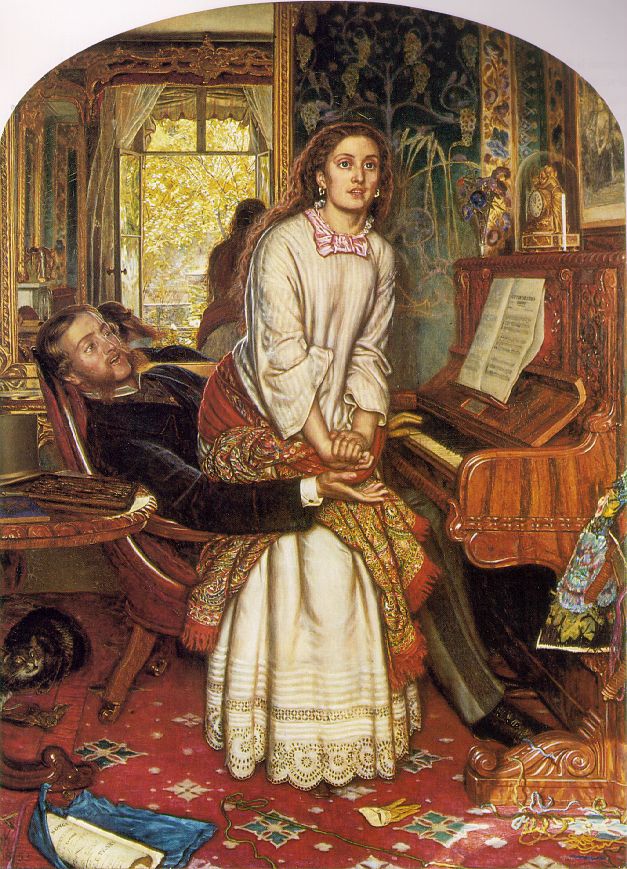
William Holman Hunt, L'éveil de la conscience, 1853
Huile sur toile, 76,2 x 55,9 cm, Tate Britain
Plus ambigu encore est L’éveil de la conscience de William Holman Hunt (1827 – 1910). L’œuvre représente une prostituée qui se met à éprouver des regrets. Même si on acceptait qu’un homme fréquente une fille de joie, en dépit de sa prolifération phénoménale, la prostitution était perçue comme « la Grand Menace de l’époque ». Hunt, inspiré par Emily de David Copperfield, enlevée par son amant la veille de son mariage, avait loué une garçonnière à St John’s Wood et fit poser Annie Miller, une roturière dont il s’était épris, qu’il voulait éduquer pour en faire une femme du monde. La prise de conscience de la jeune femme est provoquée par la mélodie jouée par son compagnon, Oft in the Stilly Night (Souvent, pendant le calme de la nuit), qui lui remémore la perte de son innocence. Ses bagues aux doigts, – l’annulaire excepté – le chat tenant sa proie entre ses pattes, le gant jeté négligemment au sol, les aiguilles de la pendule approchant midi, ce sont tout autant de signes qui indiquent son statut de captive.


Femmes déchues et tribulations du sexe faible : les victoriens raffolaient des mélodrames qui mettaient en scène des récits impliquant infidélités et secrets de famille. Ceux-ci constituaient leurs principales sources de distraction et c’étaient le genre d’intrigues qu’on allait souvent voir jouer au théâtre. Depuis les séries de Hogarth, les modern moral subjetcs captivent les britanniques. L’artiste avait à l’origine pour but d’élever la scène de la vie quotidienne au rang de peinture académique. Plusieurs générations de peintres victoriens témoignent de la dette qu’ils doivent à Hogarth. Ses séries, caractérisées de « romans en peinture », étaient entrées au panthéon du patrimoine artistique britannique.
Si cet attrait du récit révèle la fascination des victoriens pour l’aspect narratif des arts visuels qui pouvaient s’adresser à des couches diverses de la société, il est en revanche plus préoccupant de constater qu’il dénote bel et bien des attitudes masculines sexistes dont les femmes souffraient en permanence. L’émergence de mouvements féministes à partir des années 1890 a considérablement inquiété la bourgeoisie qui se mit à ridiculiser « the New Woman » (la nouvelle Eve) à travers de nombreux pamphlets et caricatures.

Le problème, c’est que l’on a souvent vu ces scènes de genre reprises par dans des affiches publicitaires et des gravures reproduites en masse, qui renforçaient ainsi l’idée de rôles auxquelles les femmes étaient cantonnées. Ces images reflétaient le goût des classes moyennes et professions libérales. On ne peut donc que se féliciter des œuvres d’artistes qui interrogeaient la condition féminine afin d’ébranler les convictions les plus soldes du public bourgeois.


[1] Le terme de soap opera désigne un feuilleton sentimental ou mélodramatique. Aux Etats-Unis, les premiers soap operas étaient diffusés à la radio en semaine pour pouvoir être suivis par les femmes aux foyers : ils s’adressent à l’origine à un public principalement féminin.
[2] L’ange de la maison (1854 – 1862) est un poème narratif de Coventry Patmore dédié à sa femme. Si Virginia Woolf pensait que les femmes écrivains avaient pour devoir de tuer l’ange de la maison, l’expression dérivée du poème a perdu son sens d’origine : selon Patmore, elle faisait seulement référence à l’amour que sa femme lui portait, et non à son rôle au sein du foyer.


Bibliographie
Généralités
Lionel LAMBOURNE, ‘The frailer sex and the fallen woman’, op.cit, pp. 368 – 389
---, ‘The narrative impulse: genre painting’, in Victorian Painting, op.cit, pp. 126 – 148
Jeremy PAXMAN, ‘The angel in the house’ in Victorians: Britain through the paintings of the age, op.cit, pp.105 – 161
Ouvrages spécialisés
Mary COWLING, The artist as anthropologist: the representation of type and character in Victorian art, Cambridge, 1989
---, Victorian figurative painting: domestic life and the contemporary social scene, Windsor, 2000
E.D.H JOHNSON, Paintings of the British social scene: From Hogarth to Sickert, Londres, 1986
Lionel LAMBOURNE, An Introduction to Victorian genre painting, Londres, 1982
Sacheverel SITWELL, Conversation pieces, Londres, 1936
---, Narrative Pictures, Londres, 1937
Nancy Rose MARSHALL, City of gold and mud: painting Victorian London, Yale University Press, 2012
Pamela Gerrish NUNN, Problem pictures: women and men in Victorian painting, Scolar Press, Ahgate, 1995
Susan P. CASTERAS, Images of Victorian womanhood in English art, Rutherford, New Jersey, 1987
Julia THOMAS, Victorian narrative painting, Tate Gallery, Londres, 2000
Catalogues d’exposition
Nina Gail ANDERSON et Joanna WRIGHT, ed, The pursuit of leisure: Victorian depictions of pastimes, Royal Albert Memorial Museum et Djanology Art Gallery, Londres, 1997
Susan P. CASTERAS et Ronald PARKINSON, Richard Redgrave, Victorian and Albert Museum, Londres, 1988
Joan CROSSLEY et Sarah HOLDSWORTH, Innocence and experience: images of childhood in British art from 1600 to the present, Manchester City Art Gallery, 1992
Julian TREUHERZ, Hard times: social realism in Victorian art, Manchester City Art Gallery, 1988


mercredi 3 janvier 2018

Postcolonial fiction: Utopia or Dystopia?


‘For readers reared on travellers’ tales, the words desert isle may conjure up a place of soft sands and shady trees where brooks run to quench the castaway’s thirst and ripe fruit falls into his hand, (…). But the island on which I was cast away was quite another place (…)’[1] tells Susan Barton in J.M. Coetzee’s Foe, a rewriting of Daniel Defoe’s Robinson Crusoe. In this extract, the author re-adapts an essential feature of utopian fiction, that is, the motif of the island: Coetzee mocks its traditional association to abundance and possession; indeed, the novel’s male hero, Cruso[2], does his utmost make the place his.


Significantly, literary critic J.K Noyes argues that in the colonial mentality, conquered space is recreated as a Promised Land, a utopian place that is made anew and where colonialism pervades every aspect of social life[3].
Utopia can refer to both a place and a literary genre. Etymologically, the term means ‘no-where’, (u: no and topos: place in Ancient Greek) or ‘good place’ (eu: good and topos:  place). It was coined in 1516 by British author Thomas More, to refer to the place and society that are described in his eponymous tale, in which he stabilises the characteristics of the genre. The island of Utopia, formed of 54 geometrical cities, is depicted as an ideal place of social harmony, in order to criticize the social ills of 16th century Britain. This genre enabled writers to build a political ideal that, in the traditional storyline, was discovered by a foreign traveller. As in the 17th and 18th centuries Britain became progressively a major European power and sought to extend its supremacy over new-discovered colonies, it may not be surprising to find the motif of Utopia in works of British literature, such as Shakespeare’s Tempest (1610) and Johnathan Swift’s Gulliver’s Travels (1726)[4]. A century later however, with the rise of imperialism, globalisation and through the intensification of industrialisation, the utopian island was either re-cast as a remote pastoral suffused with nostalgia (see William Morris’ 1890 News from Nowhere) or a Dystopia[5], the exact reversal of the traditional genre by creating a totalising, nightmarish society. Samuel Butler’s Erewhon[6] seemed to have been a precursor of a genre favoured by British authors in the 20th century, whereas in the 1980s, utopian and dystopian fiction were means for postcolonial authors to exploit their links with the former British Empire. For Ralph Pordzik the utopian genre is naturally linked to postcolonial literature since it addresses the notions of national identity and culture[7].
Plato's vision of the Altantis

We will then analyse the characteristic features and tropes of utopias in the works of Jean Rhys (Wide Sargasso Sea, 1966), V.S. Naipaul (A Bend in the River, 1979), Salman Rushdie (Midnight’s Children, 1981) and J.M. Coetzee (Foe, 1986) as related to British canons of the utopian/dystopian genre. Instead of exploring this dichotomy, these postcolonial authors favour the patterns of heteropias to emphasize the multiplicity of imagined spaces[8]. Utopian fiction is then a means of fictionalising space and culture, even if these writers attempt to ‘decolonise’ Utopia, by creating highly subjective topoi through the exploitation of distinctive styles and the invention of multicultural protagonists.


Utopian features enable authors to fictionalise space and cultural identity: by taking up utopian tropes, postcolonial writers re-asses the ambiguity of the original canon that stands between the ideal and the real, between a literary genre and a political space. The topoi of national identity are conveyed through typical features of utopian fiction: spaces and figures.
The utopian space can be found in two different types of places: the island and the city. Both places are remote and distant to any well-known part on the surface of the globe. If Thomas More’s Utopia is located ‘somewhere between Europe and America’, it seems utterly difficult to reach it on account of its remoteness and uncertain localisation. That is why Erewhon’s subtitle is ‘Over the Range’, as for the traveller, only some natural catastrophe can enable him to get to the utopian space.
The shipwreck is then the most traditional motif that causes the main character of the story to discover the island. This is what happens to Robinson Crusoe who will later be the master of the place, and, similarly, to Susan Barton in J.M Coetzee’s Foe. To strengthen this connection to Utopia, Coetzee shows that the space of the island is submitted to a clear-cut organisation by Cruso’s partriarchal figure, even though with no apparent purpose: the hillside is geometrically divided to create a clear, pure space that reminds one of the circular division of space in More’s tale. Coetzee reinforces this aspect of purity with Cruso’s declaration on page 33, as if the clearing of space by removing any type of growth was a sign of civilisation: ‘ ‘‘ The planting is reserved for those who come after us and have the foresight to bring seed. I only clear the ground for them. (…)’.
Jean Rhys also establishes this link between the utopian space and Nature, but in a different way. When Rochester compares former slave Amélie to an innocent and gentle person, the author addresses the problem of the colonizer/traveller’s gaze: indeed, Rochester perceives the inhabitants of the island as noble savages, persons living in harmony with Nature. The noble savage, according to the coloniser’s ideal, is able to create a utopian space remote from the corruptions of modern civilisation. The theme appears through Rochester’s description of Amélie, as if she was attuned to Nature in a whole-like vision, an impression which is emphasised thanks to the use of the first person pronoun: ‘I could not imagine different weather or a different sky (…) I knew that the girl would be wearing a white dress. Brown and white she would be, her curls (…) her feet bare. There would be the sky and the mountains, the flowers and the girl (…)’[9]


Mumbai today: between modernity and tradition

On the other hand, the theme of perfect civilisation can appear through the modernity of urbanism. This feature is especially striking in Midnight’s Children: the magical qualities of postcolonial Bombay resonate with desire and idealism. Saleem, the main character of the story, considers the city as a collection of sensorial data, thus opening up the possibility for remembrance. This conception may be interpreted as an alternative to the imperial rule, a place where Saleem is able to ‘revise and revise, improve and improve’[10]. The embracement of modernity in the city of Bombay is nevertheless associated to a mythical past (‘It was very different then, there were no night-clubs or pickle factories or (…) Hotels or movie studios’), hence Saleem’s desperate attempt to find the day of the city’s deity, Mumbadevi, on the calendar[11].
Therefore, in Foe and Midnight Children, the invention of postcolonial space relies on the main protagonists’ perception. Similarly, the vision of utopian fiction characters influences the way they conceive the foreign place in which they are immersed. The traveller figure is essential to the discovering of Utopias since it increases the sense of estrangement both for the narrator and the reader. In Gulliver’s Travels, the eponymous character’s journey enables the author to play with different ranges of scales in a quasi-scientific manner: he goes successively to the land of Lulliput – to stress that even tiny people are capable of cruelty since Gulliver is sentenced to be blinded - and to the land of Houyhnhnms. This strange land is inhabited by horses, whose name means ‘the perfection of nature’, and provides the reader with the ideal society-in-reverse: the horses, capable of humanity, reveal the humans’ bestial behaviour. Similarly, Marlow in Heart of Darkness makes a nightmarish journey in which he comes across slaves that lack any human trait; the description of the mass of ‘slowly’ ‘dying’ ‘black shapes’ that he encounters in the Company’s Station has him ‘stepped into the gloomy circle of some Inferno’[12].
The dystopian traits that may appear in colonial fiction are deliberately taken up by postcolonial writers who seek to re-adapt the traveller figure canon. If this traveller is re-cast as the figure of the migrant, his feeling of uneasiness is omnipotent after being displaced. In Naipaul’s novel, Salim – who is from India - is constantly thinking about his foreignness in this strange, new country. Naipaul then creates a dystopian world in which ‘new’ Africa is overwhelmed by modernity: ‘The President had wished to show us a new Africa. And I saw Africa in a way I had never seen it before, saw the defeats and humiliations which until then I had regarded as just a fact of life’. The mix of awe and fascination for Africa is expressed through Salim’s admiration of machinery that already appears in the nightmarish dystopias of Heart of Darkness and 1984. In George Orwell’s novel, the omnipresence of the ‘telescreens’ hints at the citizens’ constant state of surveillance. Naipaul, on the other hand, conveys the nightmare of modernity through Salim’s admiration for aeroplanes. The dystopian qualities of surveillance appear at the moment when the police constantly spies on Metty, Salim’s associate[13].


Apocalypse Now: Coppola's adaptation of Heart of Darkness

The connection between A Bend in the River and 1984 is even more obvious through the figure of the President. His other name is the Big Man, reminding one of the Big Brother figure. Just like Orwell’s character, the Big Man is never characterised nor named: he is only an authoritarian patriarchal figure looming over every aspect of life in this African state: ‘There was a photograph of the President showing his chief’s stick ; and above it on the blue wall, (…) was painted DISCIPLINE AVANT TOUT’[14]. The totalitarian aspect of the catch-phrase is reinforced through the use of capital letters, that can be linked to Orwell’s ‘Big Brother is watching you’.
Thus, the ideal of national culture appearing through utopian/dystopian motifs of British canons and postcolonial fiction helps authors to fictionalise their relations to the British Empire. However, the specificity of utopian patterns in postcolonial novels lies in the way writers re-adapt those themes by decolonising the canon to create highly subjective utopias.


We will then see how, in these novels, the utopian/dystopian features are re-created through the visions of different characters, and that they depend on the perception of the coloniser or the colonised. Addressing the notion of a utopian past bring authors to find alternatives that mingle utopian and dystopian features.

 
In her essay on spatial politics in postcolonial novels, Sarah Upstone dedicates a chapter to the topos of the colonial house, to point out how, in the postcolonial novel, it is assimilated to a utopian space that seeks to perpetuate colonialism[15]. The past is embraced with nostalgia by the former members of the colonised class. The connection with Utopia is enhanced through the closure of the houses that are ‘microcosms’[16] of former colonial spaces. In Midnight’s Children, the utopian house appears in Methwold’s estate, a place re-created as a concentration of former European Empires. The estate is divided in four parts, all bearing the names of European castles, which used to be residences of monarchs. They all allude to the former glory of those European countries: Versailles is associated to the absolute monarchy of Louis XIV, Buckingham Palace recalls the climax of the British Empire under Victoria’s reign, the Escorial Villa is a symbol of Spain that was the first European power in the 16th century, and the Sans Souci Palace represents the glory of the Prussian Empire under Frederick the Great in the 18th century.
Jean Rhys, on the other hand, hints at a remote past with the Coulibri Estate, representing the former glory of Antoinette’s Creole family. Antoinette is the heiress of ex-slave owners, and the Coulibri Estate used to be a plantation run by an upper-class family. Since the slaves have emancipated, Annette, Antoinette’s mother, longs for the colonial past, a symbol of fixity and stability. She seems obsessed by that ‘prosperous’[17] past that she associates with her happy marriage to Mr Cosway.
However, the past is also suffused by nostalgia in the vision of the colonised. The pre-colonial utopia appears as an alternative to the colonial rule, resisting to any type of interpretation. In Foe, the very body of Friday and his acts re-invent a locus amoenus (a space lying outside any limits and associated to a refuge), an attempt at seizing a mysterious space that Susan Barton fails to understand. Friday invents another type of space through writing: instead of copying the word ‘house’ that Susan has taught him, he draws ‘walking eyes’[18]. This appears as a parody of Robinson Crusoe’s fixed island and clear-cut, colonial-like hierarchy. Instead of nostalgia and longing for the past, the timelessness of the re-created utopia has become inscribed in the present: the utopia has become a uchronia[19].
Naipaul, in A Bend in the River, associates pre-colonial life in Africa to an absence of time and history, to the danger of comparing African people to Shakespearian calibans, untamed, uncivilised persons. Caliban, in Shakespeare’s play, is the epitome of the monstrous slave, his name being an anagram for ‘canibal’. In the chapter ‘Imperial Deixis’, Russell West-Pavlov insists on Naipaul’s vision of Africa as a continent slipping backward in an archaic time[20]: ‘You were in a place where the future had come and gone’ thinks Salim. This ‘self-cancelling temporality’ inscribes Africans to their local space in a very disturbing manner. The deterriolisation and decontextualisation in Naipaul’s novel is the author’s way of taking up the Conradian theme of dislocation caused by colonialism.


Sir Joseph Noel Paton, Caliban, 1868
Oil on canvas, 124,5 x 83,8 cm
Glasgow Museums
Similarly when one considers the conception of postcolonial critics such as ‘the diaspora’ or Frederic Jameson’s concept of ‘national allegory’, it is hard not to perceive those concepts to idealistic views[21]. Are not the ‘national allegory’ and the ‘third world’, in a way, utopian re-creations of the Westerner’s critical gaze on postcolonial literature? Even if, for Jameson, the Third World cannot be considered as an avatar of Orientalism, his conception of an unfixed cultural identity inscribed in the political sphere may seem stereotyped. That is why I would focus on Homi Bhabha’s notion of ‘Newness’ since it appears as more relevant to analyse the concept of postcolonial heterotopia[22]. Criticising Jameson’s representation of postcolonial space and national allegory, Homi Bhabha points out that the ‘in-betweeness’[23] of postcolonial fiction is symbolised, not so much in the spatial politics of the novel, but more in the character’s gaze and their relation to time by creating ‘new world borders’[24].


The ‘in-betweeness’ of the utopian space is especially present in the minds of Jean Rhys’ characters. This impression is intensified through the use of the stream-of-consciousness technique, to make a distinctive space built upon feelings and dreams. If, for Rochester, England represents the utmost utopian space of civilisation, it is barely real to his wife Antoinette: ‘ ‘‘Is it true’’ she said, ‘‘that England is like a dream? Because one of my friends who married an Englishman told me so. She said this place London is like a cold dark dream sometimes. I want to wake up.’’ ’. Rochester’s answer too is quite meaningful; the utopian motif appears through the polyphony of the passage: ‘ ‘‘Well’’, I answered annoyed, ‘‘ that is precisely how your beautiful island seems to me, quite unreal and like a dream.’’ ’[25].
The end of Foe, on the other hand, presents an extremely uncertain utopian space. With the ‘home of Friday’, J.M. Coetzee creates both a sanctuary and a decayed space containing the corpses of the main protagonists. This place is not the island anymore, but rather an indistinct submarine locus, that cannot be described because it goes beyond human words and interpretations: ‘But this is not a place of words. (…) This is a place where bodies are their own signs. It is the home of Friday’[26].
Is it possible then to remove any political agenda from the utopian spaces of postcolonial fiction? The best answer seems to lie in Rushdie’s Midnight Children Conference, a space existing in Saleem’s mind only, and yet connected to the destiny of India. Even if Saleem tries his best to invent a mental space for the Midnight Children, acknowledging their diversity, a growing awareness of failure takes grip of him. Nevertheless, he recognises his failure in positive terms. Because, if for Rushdie, the hope lying in India’s independence did not manage to fulfil its goals, the Midnight Children Conference might be a fictional re-creation of the Congress Party, an in-between space, no longer a remote land inscribed in the past or the future, but acknowledging the present.


Postcolonial authors re-adapt the canons of British utopian and dystopian fiction, not by adopting one single mode, but rather by juxtaposing utopias and dystopias in their novels and creating complex heterotopias that suit better the issues of cultural identities. Instead of a fixed place that the characters long for, the heterotopias of postcolonial fiction are highly symbolical worlds characterised by uncertainty and multiplicity, thus avoiding the clichés of the dichotomy Utopia/Dystopia. Furthermore, heterotopias address the present issues, and not so much an ideal that is unreachable. As far as the political agenda of heteropias is concerned, one could wonder if these authors seek to convey optimism or pessimism for the future… but the subtelty of heterotopias may lie in the fact that authors leave this answer to the reader. As a conclusion, Salman Rushdie’s pattern of ‘Snakes and Ladders’ seems to be the best to show how postcolonial writers try to grasp the complexity of the world by inventing balanced images and topoi: ‘the game of Snakes and Ladders captures, as no other activity can hope to, the eternal truth that for every ladder you climb, a snake is waiting just around the corner, and for every snake, a ladder will compensate (…) the duality of up against down, good against evil (…)’.


Bibliography

Primary Sources: fiction
Butler, Samuel. Erehwon. Or Over the Range. (1872) London : Western Cape, 1949
Coetzee, J.M. Foe. New York : Penguin Books, 1987
Conrad, Joseph. Heart of Darkness. (1899) London : Penguin Popular Classics, 1994
Defoe, Daniel. Robinson Crusoe. (1719) Oxford, UK : Oxford World’s Classics, new ed, 2007
More, Thomas. Utopia. (1516) Cambridge : Cambridge University Press, 1989
Naipaul, V.S. A Bend in the River. London : Penguin Books, 1980
Orwell , George. 1984. (1948) London : Penguin Books, 2009
Rhys, Jean. Wide Sargasso Sea. London : Penguin Books, 1968
Rushdie, Salman. Midnight’s Children. (1981) Croydon, UK : Vintage Books, 1995
Shakespeare, William. The Tempest. (1710) Oxford : Oxford University Press, 2008
Swift, Johnathan. Gulliver’s Travels. (1726) Penguin Popular Classics, London : Penguin Popular Classics, New ed, 2007

Secondary Sources: essays and articles
Bhabha, Homi. ‘How Newness Enters the World ; Postmodern Space, Postcolonial Times and the Trials of Cultural Translation’ in The Location of Culture. London : Routledge, 1994, pp. 212-235
De Lange Attie, Gail Fincham, Jeremy Hawthorn and Jakob Lothe, ed. Literary Landscapes : From Modernism to Postcolonialism. Basingtoke, UK : Palgrave Macmillan, 2008
Farris, Wendy B. Ordinary Enchantments : Magical Realism and the Remystification of Narrative. Nashville : Vanderbilt University Press, 2004
Jameson, Frederic. ‘Third-World Literature in the Era of Multinational Capitalism’, in Social Text 15. 1986, pp.65-88
Lopez, Alfred J. Posts and Pasts : A Theory of Postcolonialism. New York : State University of New York Press, 2001
Pordzik, Ralph. The Quest for Poscolonial Utopia : A Comparative Introduction of the Utopian Novel in the New English Literatures. New York : Peter Lang Publishing, 2001
Rushdie, Salman. Imaginary Homelands : Essays and Criticism 1981-1991. London : Vintage Books, 2010
Upstone, Sarah. Spatial Politics in the Postcolonial Novel. Farnham, UK : Ashgate Publishing, 2009
Wegner, Phillip E. Imaginary Communities : Utopia, the Nation, and the Spatial Territories of Modernity. Berkeley : University of California Press, 2002
West-Pavlov, Russell. Spaces of Fiction/ Fictions of Space : Postcolonial Place and Literary Deixis. New York : Palgrave Macmillan, 2010


[1] J. M Coetzee, Foe, New York : Penguin Books, 1987, p.7
[2] ‘Cruso’ is the spelling of Foe’s character based on Robinson Crusoe: J.M. Coetzee played with the canon of the 17th century by providing Defoe’s original protagonist’s name with another spelling.
[3] See J.K Noyes, Colonial Space: Spatiality in the Discourse of German South West Africa 1884-1915, Chur: Harwood, 1992, p.162
[4] Amy Boesky in Founding Fictions: Utopias in Early Modern England interestingly points out that the success of the utopian genre in England and Britain at that time is due to the rise of a truly English or British national identity. Besides, the associations between Utopia and Britain is not foreign to the fact that Britain itself is an island that could be felt as a perfect embodiment of government, culture, structure and isolation. See Amy Broesky, Founding Fictions: Utopias in Early Modern England, Athens: University of Georgia Press, 1996.
[5] ‘Dystopia’ comes from the Ancient Greek dus: bad, ill and topos: place. In literature and science-fiction, it refers to a futuristic society that has degraded into a repressive and highly controlled state, in which the former equalitarian principles of the utopia have been implemented to their extreme.
[6] Samuel Butler too plays on the title of his novel since the name of his dystopia is a palindrome for ‘Nowhere’. It is also interpreted as related to the present: ‘now-here’.
[7] See Ralph Pordzik, ‘Introducing Postcolonial Utopia’ in The Quest for Postcolonial Utopia, New York: Peter Lang Publishing, 2001, pp.1-10
[8] I am here alluding to the Foucaldian concept of heterotopia that I link to the stylistic modifications involved in postmodernist and postcolonial fiction. These are made through fragmentation and discontinuity of spaces to convey a sense of multiple reality.
[9] Wide Sargasso Sea, London: Penguin Books, 1966, p.91
[10] Midnight’s Children, Corydon: Vintage Books, 1995, p.460
[11] See Salman Rushide, Op. cit. p.93
[12] Heart of Darkness, London: Penguin Popular Classics, 1994, p.24
[13] A Bend in The River, London: Penguin Books, 1980, p.216
[14] V.S Naipaul, Op.cit, p.217. The Big Man’s slogan can be translated by ‘Discipline above all’.
[15] See Sarah Upstone, ‘Reversal of Location: Postcolonial Homes’ in Spatial Politics in the Postcolonial Novel, Farnham  Ashgate Publishing, 2009, pp.115-145
[16] Sarah Upstone, Op.cit, p.122
[17] See Jean Rhys, Op.cit, p.5
[18] J.M. Coetzee, Op.cit, p.147
[19] U :non and chronos :time
[20] See Russell West-Pavlov, ‘Imperial Deixis’ in Spaces of Fiction : Postcolonial Place and Literary Deixis, New York : Palgrave Macmillan, pp.117-125
[21] See Frederic Jameson, ‘Third-World Literature in the Era of Multicapitalism’
[22] See Homi Bhabha, How Newness Enters the World ; Postmodern Space, Postcolonial Times and the Trials of Cultural Translation’ in The Location of Culture. London : Routledge, 1994, pp. 212-235
[23] Homi Bhabha, Op.cit, p.214
[24] Homi Bhabha, Op.cit, p.212
[25] Jean Rhys, Op.cit, p.58
[26] J.M. Coetzee, Op.cit, p.157