Affichage des articles dont le libellé est lectures. Afficher tous les articles

lundi 4 février 2019

Ressurecting female bodies at the Poetry Café


Last Halloween was a busy time for me. On my way from London to Wolverhampton, I had the pleasure to spend the Day of the Dead's eve with would-be witches, feminists and 19th century buffs. It's totally by chance that I bumped into the Dead Women Poets Society online. Run by a team of dynamic editors, scholars and emergent writers, the DWPS meets about twice or three times during the year in different venues on the basis of open-mic sessions, to increase past or contemporary female writers' visibility. Everyone is welcome to take the stage by storm, providing you'll share something by a dead woman poet. 


Not only did this event appeal to my fascination for all things macabre, but what a coincidence it was to discover that their Halloween edition was dedicated to resurrecting Mina Loy and none other than... Lizzie Siddal. Silly me, "My Ladys Soul", that is, the complete revision of Siddal's poems by Dr Serena Trowbridge, had been published just 2 months before. It all made sense. 
What I expected even less was that, after shily approaching Jasmine Simms, in charge of the Halloween edition, it would be decided that I'd become part of the main event and interviewed. 
The DWPS members describe their sessions as "séances" akin to late 19th century attempts to communicate with the dead, when spiritualism was at its highest. This particular one took place in the Poetry Café, a veggie restaurant and performance venue located in the heart of Covent Garden. After introducing the DWPS to its audience, Helen gave the mic over to Jasmine who had prepared a brief summary of Siddal's biography. Jasmine read a couple of poems, including the very Gothic-one "Silent Wood". My turn now... nervous as hell, shivering like a leaf, I had had less than an hour to prepare my speech sipping a pint of cider in a nearby pub on my out of the British Museum. Here it goes: 

Thank you for giving me this fantastic opportunity tonite. I am afraid that, unlike Lizzie and many of you present in this room, I am not really a poet. I belong to the worst kind, the type most artists dread or despise. I side with the unfortunate souls of critics, commentators and researchers. Those who were not brave enough to create themselves but prefer to act backstage, in the shade of these great figures. Those who look at the art to write about it. 
My name is Lo, and I work in the field of art history and gender studies. So tonite, I won't be so much sharing something that I created, a piece of my own, but rather personal recollections that led me to get interested in the strange case of Elizabeth Eleanor Siddal. 


Our story began a couple of years ago, in London. I met with Lizzie in the winter of 2006 or 2007. By then I had no idea who she was. Drowning in water, a pale lady loitering in some embroidered dress stood against the greenery and the mud. This lean figure had a floating mass of copper hair and luminescent skin highlighted by the flush on her cheeks. Most noticeable were her rosy childlike lips and heavy lidded forget-me-not coloured eyes. 
I didn't need a crazy amount of time to recognise Hamlet's beloved driven to madness and suicide, the entrancing and bewitching Ophelia. In fact, I had seen the painting before, in black and white reproduction but it didn't have that effect on me back then. 

Siddal was born on 25th July 1829 in Central London, the daughter of a lower middle-class family. Her father Charles has been described by various sources as a cutler or an ironmonger, and he was from Sheffield. By 1831 the Siddal household moved to Southwark. It is not really clear how Lizzie got acquainted with poetry but the girls seem to have received some basical literary education. According to William Michael Rossetti, her brother-in-law, Liz discovered the Poet Laureate, Lord Alfred Tennyson, when she was very young, on some butter wrap paper. 
She entered the Pre-Raphaelite circle aged 20 when working as a milliner in Leicester Square. Partly self-taught, Lizzie had no troubles integrating the literary references of the P.R.B as her lover with whom she learned to draw was a writer himself and translator of Dante. However, and still today, Lizzie remains unknown as a Victorian poet. This elusive figure, described by Christina Rossetti "not as she is, but as she fills his dream" was and is constantly deemed as a pale reflection of the famous painter-poet, Dante Gabriel. Yet it is he who demanded his sister in a letter "not to rival with the Sid"Convinced that Siddal had genius, Dante Gabriel Rossetti collaborated intensively with her in word and image from 1852 to 1860. 
But the most sensational events of the couple's relationship have unfortunately overshadowed Siddal's creative merits. In an act of desperation, after her death (or potential suicide?) by an overdose of laudanum on 11th February 1862, Rossetti buried his sonnet sequence The House of Life, with her. Possessed by the ghost of his dead wife, Rossetti immortalised her in several versions of the same painting, Beata Beatrix. She was his muse, his source of inspiration, his one true love, but also the demon tormenting him every nite. 
He resorted to spiritualism. Like her, he became addicted to opium and lived an eccentric, recluse life. And for that precise reason, he agreed, under the pressure of Charles Augustus Howell's manipulation, to exhume the coffin and recover the poems (provided he didn't perform the terrible deed). 
The abominable act took place in Highgate Cemetery, in a cold dark evening of October 1869. When Howell returned he told Rossetti that Siddal's hair had kept growing luxuriant in the grave, covering some kind of immaculate corpse. Only the manuscript had partly been eaten by worms. And thus, the legend of Lizzie Siddal grew. Some strange rumours started to emerge in Northern London, about the ghost lady with red hair who abducted children and ate them alive. The vampire of Highgate tale was enough, to, apparently, inspire Bram Stoker and create the character of Lucy Westenra, the first female bitten by Count Dracula. 

You see? Lizzie's figure is more than enough to feed our imagination. This is why I have chosen to share with you some of her most gloomy poems, precisely those she was criticised for. In her ballads, fragments and lyrical verse, dramatisation and sense of narrative prove them to be self-conscious works of art. Incomplete and difficult to read, these words by her hand were edited by the Rossetti brothers. For the first time, some are being read in their original form. Contrary to what has been said, I don't think they were particularly designed as expressions of personal grief. To me they belong integrally to her oeuvre


True Love

Farewell Earl Richard, 
Tender and brave: 
Kneeling I kiss 
The dust from your gave. 

Pray for me Richard, 
Lying alone
With hands pleading earnestly, 
All in white stone

Soon I must leave thee, 
This sweet summer tide, 
That other is waiting, 
To claim his pale Bride. 

Soon I'll return to thee, 
Hopeful and brave, 
When the dead leaves, 
Blow over thy grave, 

Then shall they find me
Close at thy head
Watching or waking, 
Sleeping or dead. 


My thanks again to all the organisers and participants of the Dead Women Poets Society who truly made this Halloween 2018 special, if not magical


jeudi 10 mai 2018

"L'Ombre du vent" de Carlos Ruiz Zafon

Londres, 26 décembre 2013


Certains livres vous marquent à jamais. Une fois terminés, vous quittez à regret une certaine atmosphère, des personnages saillants ou profonds, si bien que vous éprouvez des difficultés à ouvrir un autre roman. L'univers de ces ouvrages vous a happé et vous en retardez la lecture des chapitres finaux. 
L'Ombre du vent en fait partie. 
A la fois intrigue policière, roman d'apprentissage, histoire d'amour tragique, celui-ci concentre à peu près tous les ingrédients nécessaires à l'élaboration d'un bon récit regorgeant de rebondissements: un style enlevé mais poétique, un héros attachant, un antagoniste ténébreux à souhaits et une bonne dose de coups de théâtre pour couronner le tout. 


Nous sommes en 1945 dans la Barcelone d'après-guerre, à l'apogée de la dictature franquiste. Le jour de ses dix ans, Daniel Sempere est accompagné par son père dans un mystérieux endroit: le Cimetière des Livres Oubliés. Il est alors initié au rituel secret de ce repère: désigner un livre qui scellera à jamais son destin. C'est vers L'Ombre du vent de Julian Carax que son choix se porte. Alors qu'il entre dans l'adolescence, Daniel, fasciné par cet auteur qui semble connu seulement d'un petit nombre d'initié, se met à retracer les pas de l'écrivain. Et surtout parce qu'un homme sans visage les recherche, comme lui, mais dans un seul but: les brûler. 
L'Ombre du vent est une véritable ode à la lecture et la littérature européenne. La passion que le jeune Daniel ressent à la découverte de son roman favori est contagieuse, bien vite, le lecteur s'aperçoit qu'elle est un miroir des sensations qui l'habitent. Les livres incarnent pour Daniel un refuge face aux atrocités du monde extérieur. 

Ce premier opus vous fera successivement sourire, réfléchir, peut-être même vous arrachera quelques larmes. L'hypnotique ambiance qui s'en dégage demeure malgré tout franchement sombre. L'époque de la guerre civile sert de toile de fond au déroulement de l'intrigue, d'où la présence de certains événements qui se démarquent par une extrême violence. A bout de souffle, son suspens devient presque insoutenable à mesure que vous progressez vers le dénouement final, si bien que vous passerez peut-être une nuit blanche pour dévorer les dernières pages, sans pouvoir vous arrêter. Jé défie quiconque de parvenir à déceler le secret de Julian Carax. 

L'Ombre du vent possède toutes les qualités du romanesque. Folie, meurtre, espoirs brisés s'y mêlent, pour entraîner le personnage principal dans un tourbillon d'aventures dont il ne ressortira pas indemne. Le lecteur non plus. 


mardi 27 février 2018

La Belle Sauvage, the odyssey of a brand new dusty trilogy


It was the end of an era. A new millenium and a sense that something in the air was changing. Teenage culture was, too. Some talk about the Y generation. Some say we are digital natives. But what I witnessed at that time when everyone got hooked on MsN - I didn't, my monster of an Imac was just for games - was the tidal of young adult/ fantasy fiction. And you know what? The extreme success of spin-offs from series like Harry Potter or Hunger Games prove us that we crave for stories. After all, we are only human. Books are, to my mind, way more significant than the computerised image. Will the new app or a live chat make you think, travel, open your mind and imagine fantastic beasts (and where to find them)?
So yes, I think the book industry still has a long way to go. Whether it be on your Kindle or printed on your favourite paperback (so far you understood where my loyalty will go to). In that sense, the literary saga that left the most profund imprint on me was His Dark Materials. Probably because I identified so much with Lyra, this lying little brat (see her on the French cover of the trilogy's first installment). Or because Pullman drew so much on religious myths, endowing his trilogy with such visionary power that it became over the top (plus he got me sobbing at the end of The Amber Spyglass, at Will and Lyra's parting). Truth is, Pullman never intented his novels to be marketed as children fiction. And that probably accounts for their maturity. Don't get me wrong, I'm a Potterhead and will always be, but there is something much more compelling about Pullman's narrative. The fall, the re-writing of Genesis and how it connects with the steampunk world Lyra evolves in, merged with other worlds - where Will comes from - and Greek mythology through the visit to the Underworld, His Dark Materials wraps around a larger-than-life story. In the first place, I was so engrossed with it I refused to fall into the Harry Potter common pit just for the sake of contradiction, and because everyone reading it at school during breaks got on my nerves. 'It's all about a fad and it will die soon enough' I used to think (I couldn't have been more wrong, couldn't I?). 
Later on, I finally agreed to drop my guard by swapping series with a friend who was skeptical of His Dark Materials. We promised to each other we'd finish our reading at the end of Easter holidays, and when we came back to school, we had to admit we were initially mistaken, and that, thanks to the other, we came to realise this was an amazing experience. 
Thanks to Pullman, I discovered the great poets of English-speaking literature: William Blake of course, but also Milton and Emily Dickinson. Actually, His Dark Materials embodied such a touchstone in my pre-teenage yers that I barely got interested in other publications related to this universe. I was too afraid to be disappointed. I remember reading the first book from the Sally Lockhart series without much enthusiasm. It lacked strenght, so I didn't bother reading the sequels. 

Then it was with a mix of fear and excitement - especially after the major critical disaster of The Cursed Child's script - that I waited over a year for the release of The Book of Dust's first novel. Seventeen years after His Dark Materials came out, Pullman had finally decided to go back to Lyra's world. 
La Belle Sauvage refers to the canoe owned by the main protagonist, a boy named Malcolm and his demon Asta. Living in Oxford, their path will cross the one of His Dark Materials' heroine, only a baby. So the action is set exactly ten years before our beloved trilogy. If you've ever wondered how Lyra ended up being placed in Jordan College, Oxford, this is the story you were looking for. 
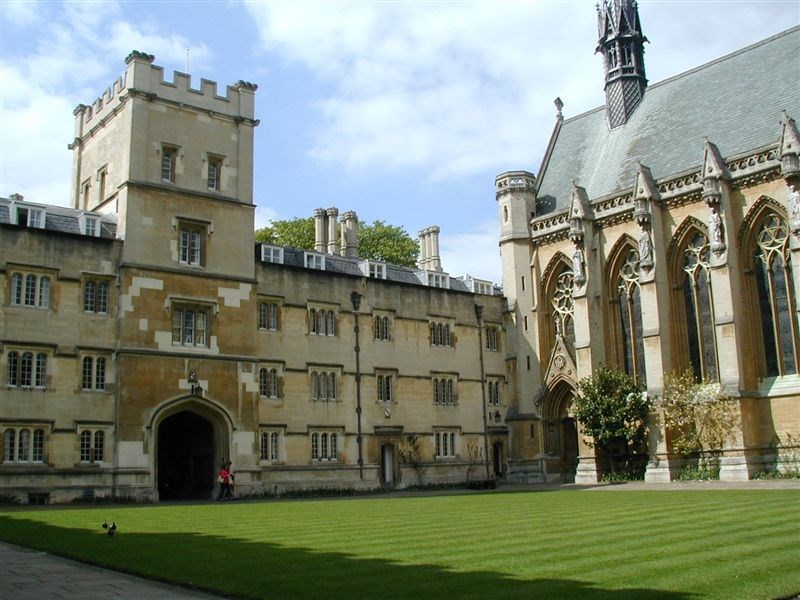
Exeter College, Oxford
The alma mater of Pullman's
But it starts like a very mundane tale, with an ordinary child, working in an ordinary inn, somewhere in Godstow. Unexpectedness knocks at the door when his path crosses that of a secret society known as Oakley Street. They investigate on the religious practices of the Magisterium, that Marisa Coulter - Lyra's mother, remember? - belongs to. By that stage (in the plot installment) I have to confess I was not so gripped by Malcolm and his hero-like desire to save Lyra from the claws of Bonneville, because you already know she represents everything the Magisterium fights against (or for, in some cases): the New Eve. 

On the other hand, the glimpse at the political intricacies of this fantasy world totally got my attention. At that point, the most fascinating character was, I thought, scientist Hannah Relf, attempting to decipher the several layers of meaning produced by the reading of the alethiometer. She offered a riveting, if not more enthralling, counterpart to Dr Mary Malone from The Subtle Knife. So it's only naturally that I wondered what part Hannah will play in the unravelling of the narrative. Will she take on the role of the Serpent too? 
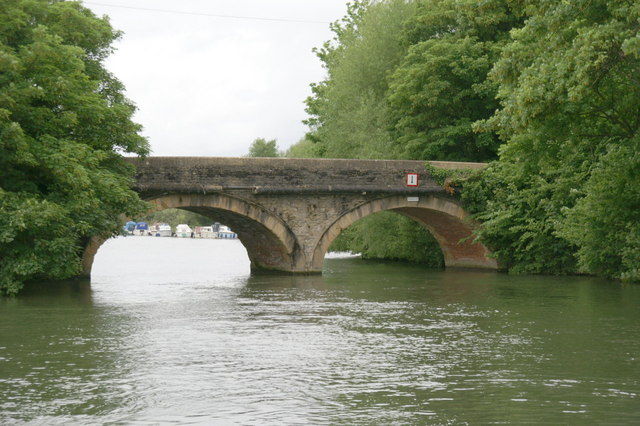
Godstow Bridge and river,
Central setting of La Belle Sauvage
But all my hesitations were shushed by the odyssey that was to come, that is, the trip Malcolm and Alice undertake to save their lives and Lyra's. By that time, the storyline adopts a new tone, that of the journey, and reminds the reader of the great events that were to occur in His Dark Materials. In the face of catastrophe, Malcolm and Alice's behaviours change too. After all, they still are very young kids who begin to witness the true face of the world. Murder, blood, tragedy, torn families, rape... the fact that Pullman worked as a teacher with many children probably accounts for his sharp abilities to step into their shoes and describe with discretion and precision their reactions in the face of horror. 


Wrought with biblical undertones, La Belle Sauvage tackles, once more, the concept of good and evil, without setting up a manichean background. In Philip Pullman's novels, you rarely have the nice versus the bad guys. Perfection is not from this world. Later in the narrative, you often grasp the darkest side of some character or the motives of an another that might have seemed dubious to you, as was the case with Mrs Coulter. Reflecting on the great literary sagas of us millennials,  this is how I want to prove that Pullman is, to my mind, way smarter than J.K. Rowling, by delivering a message which never feels moralising. Because his plots are written according to a multiplicity of viewpoints, the reader is never told what to think or how to consider a character. Same with magic. In Pullman's universe, it is never that obvious, fantasy is part of the mysteries of this world, we don't speak of it, when it happens, it embodies this suspended instant of strangeness that bewilders humans.
Besides, Pullman doesn't have to "sell out" to make his books relevant, nor does he de-naturalises his initial characters, it is about the story, just the story. He also is a far more discreet (thank God for us) celebrity than Rowling, not jittering random thoughts on any topic as they come to him on Twitter...


Marketing strategies aside, La Belle Sauvage does not fail to demonstrate that children too, can resort to violence, and this is the very moment when Malcolm started to become interesting to me. The overall climate of the novel certainly feels very humid - we are dealing with a reconfiguration of Noah's Flood, after all - but in the writing style too. If the main element of Northern Lights was ice (and, by extension, air), The Subtle Knife seemed to be ablazed with fire, while The Amber Spyglass, with its descend into the Underworld, was connected with telluric forces. How ironic was it that I drowned myself into La Belle Sauvage just a month before my hometown was  taken under water, about 2 years after the Seine reached its level-alert peak? The liquid element pervades even the visual imagery to constitute the climax of the novel. However, my sense of enjoyment was most complete towards the end when Alice and Malcolm reach the fairy island. 
William Turner, The Deluge, 1805
Oil on canvas, 143 x 235,6 cm
Tate Britain

Despite a few lengths, several questions remained scattered during the course of my reading. Apart some very menial musings over Mrs Coulter's hair color, I kept wondering about the time period of Lyra's birth. For some reason, I had always imagined her world to be some kind of Neo-Victorian era, but since they mentioned a conflict in the book that really looked like WWI or WWII, I'm not so sure anymore... 
What is sure is that Pullman's descriptions include the Gothic Revival architecture of the Victorian era beside a thirst of knowledge that materialises in the interest for scientific innovations. The whole point of The Book of Dust will be the investigations on the cosmic matter that governs consciousness, opposing free thought to theocratic organisations. Again, Pullman imbues his trilogy with the great philosophical musings of all times.  Are we spirit or matter? It will only take us the second installment, The Secret Commonwealth - which released date has not been set yet - to unearth its ciphers. 


To me, the Harry Potter series is decidedly over (if it'd be my choice I would have erased that terribly sentimental epilogue), and I won't even bother watching Fantastic Beasts vol. 2. Pullman's strength, on the other hand, was to leave readers longing and sad to say farewell to their beloved Lyra and Will. With this new prequel, he succeeded, once more, in having us beg for more. 


mercredi 3 janvier 2018

Postcolonial fiction: Utopia or Dystopia?


‘For readers reared on travellers’ tales, the words desert isle may conjure up a place of soft sands and shady trees where brooks run to quench the castaway’s thirst and ripe fruit falls into his hand, (…). But the island on which I was cast away was quite another place (…)’[1] tells Susan Barton in J.M. Coetzee’s Foe, a rewriting of Daniel Defoe’s Robinson Crusoe. In this extract, the author re-adapts an essential feature of utopian fiction, that is, the motif of the island: Coetzee mocks its traditional association to abundance and possession; indeed, the novel’s male hero, Cruso[2], does his utmost make the place his.


Significantly, literary critic J.K Noyes argues that in the colonial mentality, conquered space is recreated as a Promised Land, a utopian place that is made anew and where colonialism pervades every aspect of social life[3].
Utopia can refer to both a place and a literary genre. Etymologically, the term means ‘no-where’, (u: no and topos: place in Ancient Greek) or ‘good place’ (eu: good and topos:  place). It was coined in 1516 by British author Thomas More, to refer to the place and society that are described in his eponymous tale, in which he stabilises the characteristics of the genre. The island of Utopia, formed of 54 geometrical cities, is depicted as an ideal place of social harmony, in order to criticize the social ills of 16th century Britain. This genre enabled writers to build a political ideal that, in the traditional storyline, was discovered by a foreign traveller. As in the 17th and 18th centuries Britain became progressively a major European power and sought to extend its supremacy over new-discovered colonies, it may not be surprising to find the motif of Utopia in works of British literature, such as Shakespeare’s Tempest (1610) and Johnathan Swift’s Gulliver’s Travels (1726)[4]. A century later however, with the rise of imperialism, globalisation and through the intensification of industrialisation, the utopian island was either re-cast as a remote pastoral suffused with nostalgia (see William Morris’ 1890 News from Nowhere) or a Dystopia[5], the exact reversal of the traditional genre by creating a totalising, nightmarish society. Samuel Butler’s Erewhon[6] seemed to have been a precursor of a genre favoured by British authors in the 20th century, whereas in the 1980s, utopian and dystopian fiction were means for postcolonial authors to exploit their links with the former British Empire. For Ralph Pordzik the utopian genre is naturally linked to postcolonial literature since it addresses the notions of national identity and culture[7].
Plato's vision of the Altantis

We will then analyse the characteristic features and tropes of utopias in the works of Jean Rhys (Wide Sargasso Sea, 1966), V.S. Naipaul (A Bend in the River, 1979), Salman Rushdie (Midnight’s Children, 1981) and J.M. Coetzee (Foe, 1986) as related to British canons of the utopian/dystopian genre. Instead of exploring this dichotomy, these postcolonial authors favour the patterns of heteropias to emphasize the multiplicity of imagined spaces[8]. Utopian fiction is then a means of fictionalising space and culture, even if these writers attempt to ‘decolonise’ Utopia, by creating highly subjective topoi through the exploitation of distinctive styles and the invention of multicultural protagonists.


Utopian features enable authors to fictionalise space and cultural identity: by taking up utopian tropes, postcolonial writers re-asses the ambiguity of the original canon that stands between the ideal and the real, between a literary genre and a political space. The topoi of national identity are conveyed through typical features of utopian fiction: spaces and figures.
The utopian space can be found in two different types of places: the island and the city. Both places are remote and distant to any well-known part on the surface of the globe. If Thomas More’s Utopia is located ‘somewhere between Europe and America’, it seems utterly difficult to reach it on account of its remoteness and uncertain localisation. That is why Erewhon’s subtitle is ‘Over the Range’, as for the traveller, only some natural catastrophe can enable him to get to the utopian space.
The shipwreck is then the most traditional motif that causes the main character of the story to discover the island. This is what happens to Robinson Crusoe who will later be the master of the place, and, similarly, to Susan Barton in J.M Coetzee’s Foe. To strengthen this connection to Utopia, Coetzee shows that the space of the island is submitted to a clear-cut organisation by Cruso’s partriarchal figure, even though with no apparent purpose: the hillside is geometrically divided to create a clear, pure space that reminds one of the circular division of space in More’s tale. Coetzee reinforces this aspect of purity with Cruso’s declaration on page 33, as if the clearing of space by removing any type of growth was a sign of civilisation: ‘ ‘‘ The planting is reserved for those who come after us and have the foresight to bring seed. I only clear the ground for them. (…)’.
Jean Rhys also establishes this link between the utopian space and Nature, but in a different way. When Rochester compares former slave Amélie to an innocent and gentle person, the author addresses the problem of the colonizer/traveller’s gaze: indeed, Rochester perceives the inhabitants of the island as noble savages, persons living in harmony with Nature. The noble savage, according to the coloniser’s ideal, is able to create a utopian space remote from the corruptions of modern civilisation. The theme appears through Rochester’s description of Amélie, as if she was attuned to Nature in a whole-like vision, an impression which is emphasised thanks to the use of the first person pronoun: ‘I could not imagine different weather or a different sky (…) I knew that the girl would be wearing a white dress. Brown and white she would be, her curls (…) her feet bare. There would be the sky and the mountains, the flowers and the girl (…)’[9]


Mumbai today: between modernity and tradition

On the other hand, the theme of perfect civilisation can appear through the modernity of urbanism. This feature is especially striking in Midnight’s Children: the magical qualities of postcolonial Bombay resonate with desire and idealism. Saleem, the main character of the story, considers the city as a collection of sensorial data, thus opening up the possibility for remembrance. This conception may be interpreted as an alternative to the imperial rule, a place where Saleem is able to ‘revise and revise, improve and improve’[10]. The embracement of modernity in the city of Bombay is nevertheless associated to a mythical past (‘It was very different then, there were no night-clubs or pickle factories or (…) Hotels or movie studios’), hence Saleem’s desperate attempt to find the day of the city’s deity, Mumbadevi, on the calendar[11].
Therefore, in Foe and Midnight Children, the invention of postcolonial space relies on the main protagonists’ perception. Similarly, the vision of utopian fiction characters influences the way they conceive the foreign place in which they are immersed. The traveller figure is essential to the discovering of Utopias since it increases the sense of estrangement both for the narrator and the reader. In Gulliver’s Travels, the eponymous character’s journey enables the author to play with different ranges of scales in a quasi-scientific manner: he goes successively to the land of Lulliput – to stress that even tiny people are capable of cruelty since Gulliver is sentenced to be blinded - and to the land of Houyhnhnms. This strange land is inhabited by horses, whose name means ‘the perfection of nature’, and provides the reader with the ideal society-in-reverse: the horses, capable of humanity, reveal the humans’ bestial behaviour. Similarly, Marlow in Heart of Darkness makes a nightmarish journey in which he comes across slaves that lack any human trait; the description of the mass of ‘slowly’ ‘dying’ ‘black shapes’ that he encounters in the Company’s Station has him ‘stepped into the gloomy circle of some Inferno’[12].
The dystopian traits that may appear in colonial fiction are deliberately taken up by postcolonial writers who seek to re-adapt the traveller figure canon. If this traveller is re-cast as the figure of the migrant, his feeling of uneasiness is omnipotent after being displaced. In Naipaul’s novel, Salim – who is from India - is constantly thinking about his foreignness in this strange, new country. Naipaul then creates a dystopian world in which ‘new’ Africa is overwhelmed by modernity: ‘The President had wished to show us a new Africa. And I saw Africa in a way I had never seen it before, saw the defeats and humiliations which until then I had regarded as just a fact of life’. The mix of awe and fascination for Africa is expressed through Salim’s admiration of machinery that already appears in the nightmarish dystopias of Heart of Darkness and 1984. In George Orwell’s novel, the omnipresence of the ‘telescreens’ hints at the citizens’ constant state of surveillance. Naipaul, on the other hand, conveys the nightmare of modernity through Salim’s admiration for aeroplanes. The dystopian qualities of surveillance appear at the moment when the police constantly spies on Metty, Salim’s associate[13].


Apocalypse Now: Coppola's adaptation of Heart of Darkness

The connection between A Bend in the River and 1984 is even more obvious through the figure of the President. His other name is the Big Man, reminding one of the Big Brother figure. Just like Orwell’s character, the Big Man is never characterised nor named: he is only an authoritarian patriarchal figure looming over every aspect of life in this African state: ‘There was a photograph of the President showing his chief’s stick ; and above it on the blue wall, (…) was painted DISCIPLINE AVANT TOUT’[14]. The totalitarian aspect of the catch-phrase is reinforced through the use of capital letters, that can be linked to Orwell’s ‘Big Brother is watching you’.
Thus, the ideal of national culture appearing through utopian/dystopian motifs of British canons and postcolonial fiction helps authors to fictionalise their relations to the British Empire. However, the specificity of utopian patterns in postcolonial novels lies in the way writers re-adapt those themes by decolonising the canon to create highly subjective utopias.


We will then see how, in these novels, the utopian/dystopian features are re-created through the visions of different characters, and that they depend on the perception of the coloniser or the colonised. Addressing the notion of a utopian past bring authors to find alternatives that mingle utopian and dystopian features.

 
In her essay on spatial politics in postcolonial novels, Sarah Upstone dedicates a chapter to the topos of the colonial house, to point out how, in the postcolonial novel, it is assimilated to a utopian space that seeks to perpetuate colonialism[15]. The past is embraced with nostalgia by the former members of the colonised class. The connection with Utopia is enhanced through the closure of the houses that are ‘microcosms’[16] of former colonial spaces. In Midnight’s Children, the utopian house appears in Methwold’s estate, a place re-created as a concentration of former European Empires. The estate is divided in four parts, all bearing the names of European castles, which used to be residences of monarchs. They all allude to the former glory of those European countries: Versailles is associated to the absolute monarchy of Louis XIV, Buckingham Palace recalls the climax of the British Empire under Victoria’s reign, the Escorial Villa is a symbol of Spain that was the first European power in the 16th century, and the Sans Souci Palace represents the glory of the Prussian Empire under Frederick the Great in the 18th century.
Jean Rhys, on the other hand, hints at a remote past with the Coulibri Estate, representing the former glory of Antoinette’s Creole family. Antoinette is the heiress of ex-slave owners, and the Coulibri Estate used to be a plantation run by an upper-class family. Since the slaves have emancipated, Annette, Antoinette’s mother, longs for the colonial past, a symbol of fixity and stability. She seems obsessed by that ‘prosperous’[17] past that she associates with her happy marriage to Mr Cosway.
However, the past is also suffused by nostalgia in the vision of the colonised. The pre-colonial utopia appears as an alternative to the colonial rule, resisting to any type of interpretation. In Foe, the very body of Friday and his acts re-invent a locus amoenus (a space lying outside any limits and associated to a refuge), an attempt at seizing a mysterious space that Susan Barton fails to understand. Friday invents another type of space through writing: instead of copying the word ‘house’ that Susan has taught him, he draws ‘walking eyes’[18]. This appears as a parody of Robinson Crusoe’s fixed island and clear-cut, colonial-like hierarchy. Instead of nostalgia and longing for the past, the timelessness of the re-created utopia has become inscribed in the present: the utopia has become a uchronia[19].
Naipaul, in A Bend in the River, associates pre-colonial life in Africa to an absence of time and history, to the danger of comparing African people to Shakespearian calibans, untamed, uncivilised persons. Caliban, in Shakespeare’s play, is the epitome of the monstrous slave, his name being an anagram for ‘canibal’. In the chapter ‘Imperial Deixis’, Russell West-Pavlov insists on Naipaul’s vision of Africa as a continent slipping backward in an archaic time[20]: ‘You were in a place where the future had come and gone’ thinks Salim. This ‘self-cancelling temporality’ inscribes Africans to their local space in a very disturbing manner. The deterriolisation and decontextualisation in Naipaul’s novel is the author’s way of taking up the Conradian theme of dislocation caused by colonialism.


Sir Joseph Noel Paton, Caliban, 1868
Oil on canvas, 124,5 x 83,8 cm
Glasgow Museums
Similarly when one considers the conception of postcolonial critics such as ‘the diaspora’ or Frederic Jameson’s concept of ‘national allegory’, it is hard not to perceive those concepts to idealistic views[21]. Are not the ‘national allegory’ and the ‘third world’, in a way, utopian re-creations of the Westerner’s critical gaze on postcolonial literature? Even if, for Jameson, the Third World cannot be considered as an avatar of Orientalism, his conception of an unfixed cultural identity inscribed in the political sphere may seem stereotyped. That is why I would focus on Homi Bhabha’s notion of ‘Newness’ since it appears as more relevant to analyse the concept of postcolonial heterotopia[22]. Criticising Jameson’s representation of postcolonial space and national allegory, Homi Bhabha points out that the ‘in-betweeness’[23] of postcolonial fiction is symbolised, not so much in the spatial politics of the novel, but more in the character’s gaze and their relation to time by creating ‘new world borders’[24].


The ‘in-betweeness’ of the utopian space is especially present in the minds of Jean Rhys’ characters. This impression is intensified through the use of the stream-of-consciousness technique, to make a distinctive space built upon feelings and dreams. If, for Rochester, England represents the utmost utopian space of civilisation, it is barely real to his wife Antoinette: ‘ ‘‘Is it true’’ she said, ‘‘that England is like a dream? Because one of my friends who married an Englishman told me so. She said this place London is like a cold dark dream sometimes. I want to wake up.’’ ’. Rochester’s answer too is quite meaningful; the utopian motif appears through the polyphony of the passage: ‘ ‘‘Well’’, I answered annoyed, ‘‘ that is precisely how your beautiful island seems to me, quite unreal and like a dream.’’ ’[25].
The end of Foe, on the other hand, presents an extremely uncertain utopian space. With the ‘home of Friday’, J.M. Coetzee creates both a sanctuary and a decayed space containing the corpses of the main protagonists. This place is not the island anymore, but rather an indistinct submarine locus, that cannot be described because it goes beyond human words and interpretations: ‘But this is not a place of words. (…) This is a place where bodies are their own signs. It is the home of Friday’[26].
Is it possible then to remove any political agenda from the utopian spaces of postcolonial fiction? The best answer seems to lie in Rushdie’s Midnight Children Conference, a space existing in Saleem’s mind only, and yet connected to the destiny of India. Even if Saleem tries his best to invent a mental space for the Midnight Children, acknowledging their diversity, a growing awareness of failure takes grip of him. Nevertheless, he recognises his failure in positive terms. Because, if for Rushdie, the hope lying in India’s independence did not manage to fulfil its goals, the Midnight Children Conference might be a fictional re-creation of the Congress Party, an in-between space, no longer a remote land inscribed in the past or the future, but acknowledging the present.


Postcolonial authors re-adapt the canons of British utopian and dystopian fiction, not by adopting one single mode, but rather by juxtaposing utopias and dystopias in their novels and creating complex heterotopias that suit better the issues of cultural identities. Instead of a fixed place that the characters long for, the heterotopias of postcolonial fiction are highly symbolical worlds characterised by uncertainty and multiplicity, thus avoiding the clichés of the dichotomy Utopia/Dystopia. Furthermore, heterotopias address the present issues, and not so much an ideal that is unreachable. As far as the political agenda of heteropias is concerned, one could wonder if these authors seek to convey optimism or pessimism for the future… but the subtelty of heterotopias may lie in the fact that authors leave this answer to the reader. As a conclusion, Salman Rushdie’s pattern of ‘Snakes and Ladders’ seems to be the best to show how postcolonial writers try to grasp the complexity of the world by inventing balanced images and topoi: ‘the game of Snakes and Ladders captures, as no other activity can hope to, the eternal truth that for every ladder you climb, a snake is waiting just around the corner, and for every snake, a ladder will compensate (…) the duality of up against down, good against evil (…)’.


Bibliography

Primary Sources: fiction
Butler, Samuel. Erehwon. Or Over the Range. (1872) London : Western Cape, 1949
Coetzee, J.M. Foe. New York : Penguin Books, 1987
Conrad, Joseph. Heart of Darkness. (1899) London : Penguin Popular Classics, 1994
Defoe, Daniel. Robinson Crusoe. (1719) Oxford, UK : Oxford World’s Classics, new ed, 2007
More, Thomas. Utopia. (1516) Cambridge : Cambridge University Press, 1989
Naipaul, V.S. A Bend in the River. London : Penguin Books, 1980
Orwell , George. 1984. (1948) London : Penguin Books, 2009
Rhys, Jean. Wide Sargasso Sea. London : Penguin Books, 1968
Rushdie, Salman. Midnight’s Children. (1981) Croydon, UK : Vintage Books, 1995
Shakespeare, William. The Tempest. (1710) Oxford : Oxford University Press, 2008
Swift, Johnathan. Gulliver’s Travels. (1726) Penguin Popular Classics, London : Penguin Popular Classics, New ed, 2007

Secondary Sources: essays and articles
Bhabha, Homi. ‘How Newness Enters the World ; Postmodern Space, Postcolonial Times and the Trials of Cultural Translation’ in The Location of Culture. London : Routledge, 1994, pp. 212-235
De Lange Attie, Gail Fincham, Jeremy Hawthorn and Jakob Lothe, ed. Literary Landscapes : From Modernism to Postcolonialism. Basingtoke, UK : Palgrave Macmillan, 2008
Farris, Wendy B. Ordinary Enchantments : Magical Realism and the Remystification of Narrative. Nashville : Vanderbilt University Press, 2004
Jameson, Frederic. ‘Third-World Literature in the Era of Multinational Capitalism’, in Social Text 15. 1986, pp.65-88
Lopez, Alfred J. Posts and Pasts : A Theory of Postcolonialism. New York : State University of New York Press, 2001
Pordzik, Ralph. The Quest for Poscolonial Utopia : A Comparative Introduction of the Utopian Novel in the New English Literatures. New York : Peter Lang Publishing, 2001
Rushdie, Salman. Imaginary Homelands : Essays and Criticism 1981-1991. London : Vintage Books, 2010
Upstone, Sarah. Spatial Politics in the Postcolonial Novel. Farnham, UK : Ashgate Publishing, 2009
Wegner, Phillip E. Imaginary Communities : Utopia, the Nation, and the Spatial Territories of Modernity. Berkeley : University of California Press, 2002
West-Pavlov, Russell. Spaces of Fiction/ Fictions of Space : Postcolonial Place and Literary Deixis. New York : Palgrave Macmillan, 2010


[1] J. M Coetzee, Foe, New York : Penguin Books, 1987, p.7
[2] ‘Cruso’ is the spelling of Foe’s character based on Robinson Crusoe: J.M. Coetzee played with the canon of the 17th century by providing Defoe’s original protagonist’s name with another spelling.
[3] See J.K Noyes, Colonial Space: Spatiality in the Discourse of German South West Africa 1884-1915, Chur: Harwood, 1992, p.162
[4] Amy Boesky in Founding Fictions: Utopias in Early Modern England interestingly points out that the success of the utopian genre in England and Britain at that time is due to the rise of a truly English or British national identity. Besides, the associations between Utopia and Britain is not foreign to the fact that Britain itself is an island that could be felt as a perfect embodiment of government, culture, structure and isolation. See Amy Broesky, Founding Fictions: Utopias in Early Modern England, Athens: University of Georgia Press, 1996.
[5] ‘Dystopia’ comes from the Ancient Greek dus: bad, ill and topos: place. In literature and science-fiction, it refers to a futuristic society that has degraded into a repressive and highly controlled state, in which the former equalitarian principles of the utopia have been implemented to their extreme.
[6] Samuel Butler too plays on the title of his novel since the name of his dystopia is a palindrome for ‘Nowhere’. It is also interpreted as related to the present: ‘now-here’.
[7] See Ralph Pordzik, ‘Introducing Postcolonial Utopia’ in The Quest for Postcolonial Utopia, New York: Peter Lang Publishing, 2001, pp.1-10
[8] I am here alluding to the Foucaldian concept of heterotopia that I link to the stylistic modifications involved in postmodernist and postcolonial fiction. These are made through fragmentation and discontinuity of spaces to convey a sense of multiple reality.
[9] Wide Sargasso Sea, London: Penguin Books, 1966, p.91
[10] Midnight’s Children, Corydon: Vintage Books, 1995, p.460
[11] See Salman Rushide, Op. cit. p.93
[12] Heart of Darkness, London: Penguin Popular Classics, 1994, p.24
[13] A Bend in The River, London: Penguin Books, 1980, p.216
[14] V.S Naipaul, Op.cit, p.217. The Big Man’s slogan can be translated by ‘Discipline above all’.
[15] See Sarah Upstone, ‘Reversal of Location: Postcolonial Homes’ in Spatial Politics in the Postcolonial Novel, Farnham  Ashgate Publishing, 2009, pp.115-145
[16] Sarah Upstone, Op.cit, p.122
[17] See Jean Rhys, Op.cit, p.5
[18] J.M. Coetzee, Op.cit, p.147
[19] U :non and chronos :time
[20] See Russell West-Pavlov, ‘Imperial Deixis’ in Spaces of Fiction : Postcolonial Place and Literary Deixis, New York : Palgrave Macmillan, pp.117-125
[21] See Frederic Jameson, ‘Third-World Literature in the Era of Multicapitalism’
[22] See Homi Bhabha, How Newness Enters the World ; Postmodern Space, Postcolonial Times and the Trials of Cultural Translation’ in The Location of Culture. London : Routledge, 1994, pp. 212-235
[23] Homi Bhabha, Op.cit, p.214
[24] Homi Bhabha, Op.cit, p.212
[25] Jean Rhys, Op.cit, p.58
[26] J.M. Coetzee, Op.cit, p.157