Affichage des articles dont le libellé est féminisme. Afficher tous les articles

vendredi 29 mai 2020

Reclaiming female agency with Elizabeth Prettejohn

From Harvard University, American art historian Elizabeth Prettejohn is one of the major researchers on painting of the Victorian era. She exclusively confided in the latest developments about the core of the matter.


Les Carnets de Viviane: How did you get interested in the art of the Victorian era?
Elizabeth Prettejohn: I did my first degree at Harvard University and at that point I was most interested in nineteenth-century American art. When I came to London to do the Master’s degree at the Courtauld Institute of Art, I thought that I would be in England only for a short period and that I should therefore take advantage of the opportunity to study British art. That was in 1985 and I have never gone back to America – and am still studying Victorian art! I suppose, therefore, that you could say that my interest had an element of chance or serendipity about it. However, I was also fascinated by a problem that I encountered, and didn’t understand: British Victorian art had a very low reputation at the Courtauld, the principal British institution for the study of the history of art. It had an even lower reputation in the States; I had scarcely encountered it at all in my undergraduate course at Harvard, even though the Fogg Art Museum at Harvard had an excellent collection of Victorian artworks. I wanted to understand why this thriving period of art production had such a low academic and scholarly status; that motivated me to embark on studying it. Since I still don’t understand why that is so – I am still studying Victorian art.

Albert Moore, Juin flamboyant, 1885
Huile sur toile, 47 x 47 cm
Musée d'Art de Ponce, Porto Rico

LCdVV: When and how did you feel the representation of women was a key issue for specialists who research the period?
E.P.: From the first moment I began to study the period, it was obvious that the representation of women was an important endeavour for Victorian artists and the Victorian artworld. In my early work I was most interested in the artists of the Aesthetic Movement (Leighton, Rossetti, Whistler, Burne-Jones, Moore, Solomon, Watts); later I became interested in the Pre-Raphaelite circle – for all of these artists, the representation of the female figure was a crucial intellectual and aesthetic issue. However, the scholarship on that issue was generally weak and unenterprising; much of it was very biographical or anecdotal in character and focussed on the lives and loves of the women in Pre-Raphaelite or Aesthetic circles.

LCdVV: How would you place your work in relation to feminist and gender studies, notably those by Jan Marsh and Griselda Pollock? Do you think it is appropriate to dedicate studies only to female artists and models?

E.P.: I particularly admire the work of Deborah Cherry and Griselda Pollock, whose groundbreaking article of 1984 on Elizabeth Siddall really changed the field. Since then, other scholars have done extremely valuable work in bringing to attention a wider range of women artists; a particularly important example was the exhibition Pre-Raphaelite Women Artists, curated by Jan Marsh and Pamela Gerrish Nunn in 1998. However, the research done so far merely scratches the surface. Not only are there – quite literally – hundreds of Victorian women artists who remain unexplored in the scholarly literature; the existing studies even of the most famous of them (Siddall, Evelyn De Morgan, Joanna Boyce Wells, Marie Spartali Stillman) are very limited and tend to concentrate on the most basic issues about women’s position in the Victorian world. I feel strongly that scholars both of women artists (and models) and of Victorian art in general (including male artists) need much more sophisticated analytical methods for evaluating the aesthetic characteristics of works of art if we are to break new ground in writing the history of Victorian art. That history should include both male and female artists and models. Indeed, the male model is an area of great interest on which there has been astonishingly little research.


LCdVV: The relationship between some painters and their female models is quite problematic. How would you characterise it? Idealist? Misogynistic? Realistic? Stereotypical?
E.P: I consider women models to be equivalent in importance to artists as collaborators in the creation of works of art. Relationships between any two people can be problematic; I am not sure that relationships between painters and models have a special status in this respect. Certainly it would be impossible to generalise by using the terms you are suggesting. Indeed, it is a stereotype to describe the relationship between Victorian artists and their models as ‘misogynistic’ (for example). Take these different cases: Dante Gabriel Rossetti and Jane Morris; Julia Margaret Cameron and Alfred Tennyson; John Singer Sargent and Ellen Terry; Ford Madox Brown and Emma Hill; John Everett Millais and John Ruskin; Lawrence Alma-Tadema and Laura Epps Alma-Tadema. Any of those relationships may have been problematic; all of them were also inspirational and productive.

LCdVV: Can you tell us more about the role of women in the production and reception of Victorian art? Suzanne Fagence Cooper, for instance, asserts it was definitely ‘not passive’.
I agree with Suzanne. I believe that female models were co-creators of the works of art in which they appeared, and thoroughly active agents in the production of such works. Women were also important actors in the art world as critics (Elizabeth Eastlake, Anna Jameson, Emilia Dilke, Alice Meynell, and many others), as art theorists (George Eliot, Vernon Lee), as patrons (too many to list), and no doubt in a variety of other roles.


LCdVV: Please mention some fundamental names of female artists, models and patrons.
E.P: I have mentioned several of the more familiar names already. There are many more whose work as artists, models, and patrons deserves attention but who have been lost from view. Among my favourite artists of the period are Laura Epps Alma-Tadema, Sophie Anderson, Kate Bunce, Eleanor Fortescue-Brickdale, Christiana Herringham, Mabel Nicholson, Annie Swynnerton, Marianne Stokes, Phoebe Traquair, Ethel Walker, Henrietta Ward. I suspect that, had she lived beyond the age of 30, Joanna Boyce Wells would have been among the great artists of the nineteenth century (that is, among all artists, male or female).


LCdVV: Were there any recent groundbreaking exhibitions on the topic?
E.P: I have referred above to the exhibition of 1998, Pre-Raphaelite Women Artists, and it is disappointing that there have been no equivalently revelatory exhibitions in this area in the seventeen years since then. There have been some smaller ventures – for example, the interesting show on Eleanor Fortescue-Brickdale in Liverpool (2012, curated by Pamela Gerrish Nunn), the exhibition on Evelyn De Morgan at Blackwell, the Arts and Crafts house in the Lake District, this summer (2015), and the online exhibition curated by my colleague Katie Tyreman Herrington, Three Graces: Victorian Women, Visual Art, and Exchange (on Aglaia Coronio, Maria Zambaco, and Marie Spartali Stillman. It would be good to see a more ambitious exhibition.


LCdVV: Do you think there is still research to do? How could scholars improve the situation?
E.P: Yes, emphatically: everything is still to be done. Although I have been critical of the work of the first generation of feminist scholars, for writings that could sometimes lack nuance and sophistication, they had two virtues: they worked hard and believed wholeheartedly in their cause. The scholars of today would do well to follow their example in these two crucial respects.


jeudi 20 juin 2019

Elizabeth Siddal, muse préraphaélite ou artiste à part entière ?

Dante Gabriel Rossetti, Beata Beatrix
1864 - 1872, huile sur toile
86,4 x 66cm, Tate Britain
Dans la nuit du 10 février 1862, Dante Gabriel Rossetti, de retour chez lui après avoir enseigné au Working Men's College, trouva sa femme si souffrante qu'il fut incapable de la ranimer, malgré l'aide de quatre docteurs. Plus tôt dans la soirée, Rossetti avait déjà dû ramener Elizabeth Siddal chez eux. La jeune femme, qui avait développé une dépendance au laudanum - solution buvable bon marché à base d'atomes issus du pavot somnifère prescrite sous formes de gouttes depuis le 16ème siècle pour soulager les crampes menstruelles et acquérir un teint d'albâtre - depuis ses deux fausses couches en 1861, mourut d'une overdose, mais plusieurs sources s'accordent pour affirmer qu'il s'agissait vraisemblablement d'un suicide. Si la cause du décès fut qualifiée d'"accidentelle" par le médecin légiste, certains témoignages suggèrent que Rossetti découvrit une lettre d'adieu. Ford Madox Brown aurait alors conseiller à Rossetti de la brûler: à l'époque, le suicide était considéré non seulement comme immoral mais aussi illégal. Si la famille d'Elizabeth Siddal avait pris connaissance d'une telle preuve, elle n'aurait pas pu enterrer leur proche selon les rites funéraires chrétiens. Le cercueil fut ainsi enseveli au cimetière de Highgate en compagnie d'un recueil de poèmes de Rossetti. 

Depuis la fin du 19ème siècle, la légende d'Elizabeth Siddal n'a cessé de fasciner peintres, poètes et cinéastes. En décembre 2013, l'Arcola Theatre fit jouer une pièce éponyme inspirée de la vie de l'artiste, depuis sa découverte par les préraphaélites jusqu'à sa mort. La célèbre séance de pose pour Ophélie, la relation tumultueuse de Siddal et Rossetti ainsi que sa fin tragique ayant nourri de nombreux récits macabres ont fini par occulter la carrière de cette jeune femme hors du commun. Qui est véritablement Elizabeth Siddal ? Quelle artiste et poète se dissimule derrière cette modiste apparemment réservée ?


Enfance et adolescence
Elizabeth Eleanor Siddal est née le 25 juillet 1829 au 7 Charles Street dans le quartier de Mayfair à Londres. D'origine anglo-galloise, son père se plaisait à répéter que la famille était d'ascendance aristocratique. A l'instar de John Durbeyfield dans Tess of the d'Ubervilles de Thomas Hardy (1891), Charles Crooke Siddall  croyait qu'il était l'héritier d'une auberge prospère du Derbyshire. Toute sa vie, il dépensa sa fortune pour revendiquer ses droits. A la naissance d'Elizabeth, Charles possédait une échoppe de coutellerie. En 1831, les Siddall déménagèrent à Southwark, un faubourg insalubre situé dans le sud de la capitale. En 1833, Charles ouvrit un commerce au sein de sa propre demeure. C'est ici que naquirent les autres enfants: Lydia (la soeur dont Lizzie fut la plus proche), Mary, Clara, James, et Henry, élevés dans l'idée qu'ils provenaient d'une illustre famille.
Walter Deverell, La Nuit des rois, 1850
Huile sur toile, 102 x 132,7 cm
Forbes Magazine Collection, New York


Autodidacte, Elizabeth apprit à lire et à écrire. Très jeune, elle se mit à apprécier la poésie après la découverte des écrits de Lord Alfred Tennyson figurant sur un emballage, ce qui l'amena à écrire ses propres poèmes. Dans les années 1840, Lizzie entra au service de la modiste Madame Tozer. En 1849, le poète William Allingham, venu chercher sa maîtresse à la boutique, remarqua la jeune fille. Si l'écrivain ne trouva pas sa beauté particulièrement frappante, il pensa en revanche qu'elle pourrait faire un bon modèle pour son ami Walter Deverell (1827 - 1854); qui travaillait sur une scène inspirée de La Nuit des rois. Le modèle, assis à gauche, apparaît dans une scène déjà chargée d'érotisme. Siddal y interprète le rôle de Viola, la jeune fille nubile travestie en homme au service du Duc Orsino qui l'emploie pour plaider sa cause auprès de la comtesse Olivia. Deverell reconnut que Siddal incarnerait la parfaite Viola mais il reconnut qu'elle n'était pas une simple roturière; c'est pourquoi il persuada sa mère de présenter l'offre aux Siddall comme respectable. Elizabeth était certes flattée mais également méfiante. Rappellons qu'à l'époque victorienne, on percevait le métier de modèle comme analogue à la prostitution. Eleanor Siddal ne fut pas difficile à convaincre: conscient de l'état de santé délicat de sa fille qui espérait rentrer dans une école d'arts appliqués, elle admit que les conditions de travail seraient moins fastidieuses, et le salaire plus attractif. Il fut convenu que sa fille garderait sa profession de couturière à temps partiel. 
William Holman Hunt, Famille
anglaise convertie
, 1850
(détail), Ashmolean Museum
Ainsi débuta la carrière de Lizzie, que Deverell présenta aux autres membres de la confrérie préraphaélite. La nature exacte de sa rémunération est pourtant demeurée obscure. Elle ne pouvait recevoir le type de salaire que les modèles professionnels gagnaient, notamment pour les études de nu. Quelques indices glanés dans la correspondance de Rossetti suggèrent qu'elle posait gratuitement pour ses amis artistes. Hunt dépeignit Siddal dans le rôle de la religieuse soignant le curé pour son tableau Famille anglaise convertie, ainsi qu'en belle éplorée dans Valentin sauvant Sylvia de Proteus (1851), un sujet tiré des Deux Gentilshommes de Venise de Shakespeare. 
Dante Gabriel Rossetti
Elizabeth Siddal, 1854
Encre et crayon, 22,2 x 9,8 cm
Victoria and Albert Museum
Elizabeth Siddal incarne un type de beauté atypique, bien différent des canons de madones issus de la Renaissance qu'on trouvait dans la peinture d'histoire et de genre de l'époque. Si William Michael Rossetti loua son visage "exceptionnel", celui-ci apparaissait comme plutôt quelconque. Grande, les hanches et la poitrine peu marquées, elle portait les cheveux en chignon décoiffé ou lâchés. Siddal ne s'habillait pas comme les femmes victoriennes, préférant les robes amples avec manches bouffantes aux corsets et crinolines. Son épaisse chevelure rousse, son teint pâle, ses paupières lourdes et fines lèvres constituent les traits qui ont rendu l'esthétique des préraphaélites célèbre. Selon Georgiana, la femme du peintre Burne-Jones, leux yeux de Siddal étaient particulièrement envoûtants: ils étaient "merveilleusement lumieux (...) de couleur d'agathe". Ce portrait à la fois sensuel et intimiste représente Lizzie au regard fuyant, un motif récurrent dans les dessins de Rossetti des années 1850. L'artiste ne fait que suggérer la masse de cheveux de son amante grâce à de fines hâchures à la plume, une technique qui lui permettait de créer de surprenants effets de clair-obscur. 


John Everett Millais, Etude pour la tête d'Elizabeth Siddal, 1852
Graphite sur papier, 30,7 x 23,2 cm
Birmingham Museums and Art Galleries

Une brève mais fulgurante carrière
 A la fin de l'automne 1851, Millais et Hunt voyagent pour peindre sur le motif les paysages de leur Angleterre natale. Ils s'attardent dans le Surrey, non loin de la rivière Hogsmill. Il en résulte un tableau qui est demeuré célèbre: celui d'Ophélie, la toile pour laquelle Siddal posa toute habillée dans une baignoire remplie d'eau, chauffée au-dessous par des lampes à huile. Alors que le portrait était presque achevée, les bougies s'éteignirent. Millais, trop absorbé par son travail, ne s'en serait pas aperçu. Siddal attrapa une pneumonie, et son père menaça de traduire le peintre en justice s'il refusait de payer la note du médecin qui s'élevait à 50 livres.

Dante Gabriel Rossetti, Dante dessinant un ange le jour de la mort de Béatrice
1853 - 1854, Aquarelle et gouache sur papier
42 x 61 cm, Ashmolean Musem

Cette même année, Siddal et Rossetti qui s'étaient rencontrés lors de l'élaboration de La Nuit des rois (avec Rossetti dans le rôle du bouffon), deviennent de plus en plus proches. Rossetti, avec ses yeux d'un noir intense et ses cheveux bruns, incarnait alors le parfait archétype du héros romantique. Dés lors, Siddal et Rossetti ne se quittent plus. Il semblerait que c'est à partir de cet instant que Rossetti prit la décision de préserver jalousement celle qu'il surnommait avec affection "ma colombe" ou "Guggums", à l'exclusion de presque tous les autres modèles favoris des autres préraphaélites. Lizzie n'eut pas de mal à être convaincue après la désastreuse expérience d'Ophélie. Ils se seraient ainsi installés ensemble dans le quartier de Blackfriars. Leur ami Ford Madox Brown, l'un des rares visiteurs admis à Chatham Place par Rossetti, écrivit en 1856 dans son journal: "Rossetti m'a montré un tiroir rempli de dessins de Guggums, dieu sait combien (...) C'est une véritable obsession !". 
Dante Gabriel Rossetti, Rossetti posant pour Mademoiselle
Siddal
, 1853, encre et plume sur papier, 12, 9 x 17,5 cm
Birmingham Museums and Art Galleries
Les deux amants vivaient coupés de leur entourage familial et amical, dans un monde isolé, peuplé de rêves et de légendes médiévales. Ils partageaient non seulement les mêmes goûts littéraires, mais aussi une personnalité extravagante et une sensibilité à fleur de peau. Tous deux enclins à la dépression, ils étaient connus pour leurs sautes d'humeur bien avant leur addiction au laudanum. La première oeuvre de Rossetti dans laquelle figure Elizabeth Siddal est une aquarelle intitulée Le premier anniversaire de la mort de Béatrice (1853). Le jeune homme développe une étrange fascination pour son amante qu'il représente inlassablement, sur une centaine de dessins, gravures et esquisses. Progressivement, Lizzie le modèle se confond avec le personnage de Béatrice, la bien-aimée de Dante dont Rossetti partage le prénom et les origines latines. Rossetti était né Charles Gabriel Dante mais il changea son nom pour s'identifier à son mentor, le poète Dante Alighieri. Ce dessin à la plume évoque la nature fusionnelle de la relation entre l'artiste et sa muse. Rossetti a inversé les rôles traditionnels; cette fois-ci, c'est Elizabeth qui est assise à son chevalet et Gabriel qui pose pour elle.
Elizabeth Siddal, Dame attachant un fanion à la lance d'un
chevalier
, vers 1856, aquarelle sur papier, 13, 7 x 13, 7 cm
Tate Britain
Après les promesses de fiançailles avec Rossetti au début des années 1850, Siddal devient son élève. Elle dessine, peint et écrit. Elle est également encouragée par ses amies artistes Anna Howitt (1824 - 1884) et Barbara Leigh Smith (1827 - 1891), chefs de file des premiers mouvements féministes. Si John Ruskin trouvait, à l'instar des spectateurs de la Royal Academy, la beauté de Lizzie plutôt commune, il tomba suos le charme de ses aquarelles inspirées du cycle arthurien. En 1855, le critique d'art devint le mécène de Siddal et lui offrit 150 livres par an en échange de l'acquisition de toutes les oeuvres qu'elle produirait. Une rivalité avait commencé à poindre avec Rossetti, qui lui avait présenté Ruskin. Délaissé, Rossetti s'était réconforté auprès d'autres femmes comme Fanny Cornforth ou Annie Miller. Deux ans plus tard, Siddal déménagea à Sheffield et suivit des cours de dessins pour femmes. Elle commença à peindre la Dame attachant un fanion à la lance d'un chevalier en 1852, un sujet influencé par le thème de l'amour courtois. Comme l'artiste, la dame possède la taille élancée et une longue chevelure rousse, il pourrait s'agir d'un autoportrait. 

De la figure tragique au mythe du vampire
Les portraits de Rossetti montrent Siddal dans le rôle d'une sensuelle femme fatale ou de la demoiselle en détresse, brouillant ainsi les limites entre le réel et le fantasme. Ils transmettent tantôt une image sublimée de la muse, tantôt une idée de faiblesse. Sur le dessin du V&A présenté ci-dessus, Elizabeth Siddal s'appuie sur le rebord de la fenêtre. D'autres ébauches la représentent dans des poses similaires ou statiques, assise dans un fauteuil par exemple. Sa belle-soeur Christina Rossetti (1830 - 1894) décrit ce paradoxe à travers son sonnet "Dans l'atelier de l'artiste" (1856): 
Un visage ressort de toutes ses toiles
Une figure identique est assise, marche ou se penche
Il se repaît des traits de son visage nuit et jour
Non telle qu'elle est, mais telle qu'elle remplit ses rêves
Barbara Leigh Smith, Elizabeth Siddal, 1854
Graphite sur papier, 12, 5 x 9, 5
Mark Samuels Lasner Collection

Le portrait de Barbara Leigh Smith, réalisé à Hastings pendant la convalescence de Siddal, convoque une féminité pleine de dignité. Le modèle pose avec une couronne d'iris dans les cheveux. Son profil permet à l'artiste d'accentuer la noblesse de ses traits. 
Contrairement à la vision idéalisée des artistes masculins qui l'ont représentée, cette toile d'Elizabeth Siddal révèle un autoportrait sans concessions. C'est le seul tableau à l'huile que l'artiste produisit de son vivant. On y aperçoit non la beauté éthérée qui transparaît dans les dessins de ses contemporains, mais une impresson de lassitude. Vers la fin des années 1850, la relation Siddal/ Rossetti bat de l'aile. De retour à Londres, Lizzie attendit désespérément que l'artiste fasse sa demande en mariage. Elle était si malade que Rossetti dut la porter le 13 mai 1860, jour de la cérémonie. Après une fausse couche et un enfant mort-né, Lizzie souffrit de dépression post-natale.  
Elizabeth Siddal, Autoportrait, vers 1854
Huile sur toile, 20, 3 cm de diamètre
Collection particulière
La mort qui en résulta a donné lieu à de curieux récits d'horreur qui ont nourri la légende d'Elizabeth Siddal. Charles Augustus Howell, l'agent de Rossetti réputé pour ses talents de manipulateur, aurait été à l'origine de l'expédition pour déterrer le recueil de poèmes dissimulé dans le cercueil. Rossetti refusa d'être présent lors du service funèbre. C'est Howell qui se mit à diffuser le mythe du corps parfaitement préservé d'Elizabeth Siddal, recouvert par sa crinière rousse. Pendant les années 1860, on racontait qu'un vampire hantait le cimetière de Highgate. Bram Stoker se serait inspiré de cette histoire pour créer le personnage de Lucy Westenra, transformée en vampire par le comte Dracula. 
Les morbides rumeurs circulèrent très tôt: on murmure que Rossetti débuta la réalisation de Beata Beatrix en dessinant sa femme inconsciente. Il achève le tableau en 1872, pour la commémoration des dix ans de la mort de Siddal. Cette toile constitue l'apothéose de de son art, un portrait hommage à lêtre aimé figurant Siddal dans le rôle de Béatrice. Rossetti tente d'épurer sa relation houleuse en confondant son fantasme du personnage de la Vie Nouvelle avec le souvenir de la défunte. 
Le Bernin, L'Extase de Ste Thérèse
1647 - 1652, Statue en marbre (détail)
Rome
L'expression d'Elizabeth rappelle celle de la Sainte Thérèse par le sculpteur baroque Le Bernin, à la charnière entre l'extase religieuse et sexuelle. L'alouette qui apparaît dans un halo fait référence au saint esprit, à la différence que celui-ci est annonciateur de mort. Elle tient la fleur évocatrice du pavot, symbole du sommeil. Le cadran solaire indique l'heure du décès de l'héroïne. A l'arrière-plan, on remarque la présence de Dante et du pont Vecchio: Rossetti a choisi pour cadre la ville de Florence. Dans une lettre de 1871, il affirme que la toile n'est en aucun cas une transcription littérale de son deuil: "A la lecture de ce tableau, il faut se rappeler qu'il ne s'agit aucunement d'une représentation de la Mort, mais d'un état de transe qui saisit Béatrice (...), subitement ravie à la terre pour monter aux cieux". Beata Beatrix incarne une nouvelle étape dans la carrière de Rossetti: c'est l'une des premières huiles d'une série de portraits au cadrage à mi-corps. Ce tableau signe aussi son abandon de thèmes médiévaux, peut-être trop associés à son intense période de création avec sa compagne. 


Elizabeth Siddal possède sans aucun doute les traits féminins les plus illustres de la peinture préraphaélite. Elle incarna la première des "stunners" (terme appliqué aux modèles féminins), comme l'appelaient Rossetti et ses amis. Presque méconnue de son vivant, on a peut-être trop célébré et sa vie hors normes. Si conservateurs et historiens de l'art commencent tout juste à s'intéresser à sa production artistique, force est de constater que sa poésie ne fut jamais publiée de son vivant. Il convient de remettre au goût du jour cette artiste dont le talent a souvent été dénigré par rapport à l'influence de son maître. Notons à ce titre qu'aucune des oeuvres figurant Siddal n'est totalement fidèle: elles présentent la vision que l'artiste a du modèle. très peu de photographies où elle apparaît - permettant d'avoir une image plus réaliste - nous sont parvenues. 


De nombreuses études blâment Rossetti pour avoir abandonné sa femme à la fin des années 1850 en recherchant la compagnie de ses maîtresses. En réalité, peu de sources relatives à cette période nous sont restées. Il semblerait que les amants aient bel et bien vécu séparément, Siddal avec Ruskin eu Europe puis à Sheffield, Rossetti à Londres. Après la mort de sa femme, Rossetti tomba dans une profonde dépression. Incité par Howell, il devint alcoolique à partir de 1866. Rossetti vivait reclus dans son nouvel appartement de Cheyne Walk, en compagnie d’une curieuse ménagerie composée d’animaux exotiques (wombats, entre autres). Hypocondriaque, en proie à des crises d’angoisses, il envisageait sérieusement le suicide jusqu’à sa romance avec la femme de son ami William Morris, Jane. Pourtant, il peignit Beata Beatrix en témoignage de son affection pour celle qui le hanta toute sa vie. Il est fréquent d’opposer la dimension tragique des portraits de Siddal aux tableaux plus sensuels des autres modèles favoris de Rossetti. L’érotisme des dessins produits dans les années 1850 ou de Beata Beatrix permet d’apprécier la volupté des poses de Lizzie.

Depuis les années 1970, Elizabeth Siddal est devenue une star parmi les canons de beauté occidentaux, si bien que des auteurs tels Lucinda Hawksley n’hésitent pas à la qualifier de "top modèle préraphaélite". Elle incarne un idéal typiquement britannique : celui de la pâle jeune fille à la chevelure auburn et aux pommettes roses. Ophélie est un tableau si célèbre que de nombreuses femmes se plaisent à récréer la séance de pose en se plongeant toutes habillées dans une baignoire. Aujourd’hui encore, la fusion entre innocence et sensualité qui transparaît dans les œuvres représentant Elizabeth Siddal ne cesse de faire croître sa légende. 

Affiche du film Melancholia de Lars Von Trier, 2011


Bibliographie

Ouvrages généraux

Suzanne Fagence COOPER, ‘Lizzie Siddal’ in Pre-Raphaelite Art in the Victoria and Albert Museum, Victoria and Albert Museum Publications, Londres, 2003, pp.122 – 123

Elizabeth PRETTEJOHN, ‘Elizabeth Siddal : two interpretations’ in The Art of the Pre-Raphaelites, op.cit, 2000, pp.74 – 84

Ouvrages spécialisés

Elisabeth BRONFEN, Over her dead body : death, femininity and the Aesthetic, Manchester University Press, 1992

Robert Julian HAFNER, Mistress, model, muse and mentor : women in the lives of famous artists, Lulu Publishing, 2014

Jacky Colliss HARVEY, Red : A history of the Redhead, Black Dog & Leventhal Publishers, 2015

Jenny RIDD, A destiny defined : Dante Gabriel Rossetti and Elizabeth Siddal in Hastings, Edgerton Publishing, 2008

Monographies

Alicia Craig FAXON, Dante Gabriel Rossetti, Abbeville Press, 1989

Lucinda HAWKSLEY, Lizzie Siddal : the tragedy of a Pre-Raphaelite supermodel, Andre Deutsh, 2005

Jan MARSH, Elizabeth Siddal 1829 –

1862 : Pre-Raphaelite artist, Ruskin Gallery, University of Sheffield, 1991

---, The legend of Elizabeth Siddal, Quartet Books, 1992

Catalogues d’exposition

The Pre-Raphaelites, Tate Gallery et Penguin Books, Londres, 1984

Jan MARSH et Pamela GERRISH NUNN, Pre-Raphaelite women artists, Manchester City Art Galleries, 1998


mardi 5 mars 2019

Lizzie Siddal uncovered at Wightwick Manor and Gardens


Wightick Manor and Gardens certainly is some dream of an estate. It is open all year round but with various time entries depending on the season. One of the best times of the year to admire the domain is probably Halloween.
I had the opportunity to visit it twice, first on a stormy afternoon perfectly suiting the somewhat gloomy mood of the season and the next day bathed in sunlight, enhancing the colour contrasts between the green of the lawns and the warm autumnal hues.
On both days, the grounds were resonating with the cries of children following the pumpkin trail. This holiday was devoted to special outdoor and spooky crafts events: Wightwick Manor and Gardens truly brought all Hallows Eve through family-friendly activities.


This hidden gem is located in the heart of the West Midlands, a couple of miles from Wolverhampton. Not the easiest to access though, an erratic bus service from town will stop in front of the Mermaid Pub that one needs to circle to access the hill. Most enjoyable is that the estate reveals its wonders only when the ascension is complete. There, one can marvel at the manor towering its enchanted landscape garden. This features diversities of styles, ranging from formal borders in the main lawn to wilder woodland in the back. A few architectural surprises, such as the bridge inspired by the Mathematical one in Cambridge, or the “sun seat”, embellish these “garden rooms” redesigned by Thomas Mawson in 1904, in line with the Arts and Crafts ideal of craftsmanship and regionalism.
Shapes are clearly defined, privileging naturalistic treatment of beech trees, magnolia lifts, rose beds and holly walks. Dense hedging and stonewalls create the backbone of the park conceived as an essential component of the house.
This 17th century original building was crumbling down when manufacturer Theodore Mander bought the site. The first construction phase ended in 1887, the second extension containing the Great Parlour wing took place in 1893. The triangular gabled rooftops, ochre twist brick chimneys and oak wooden beams aim at reproducing Elizabethan simplicity. Narrow stained-glass window panes add up to the pattern of the façades.
Touring the house with a guide felt like a privilege as the interior normally does not open before 12 off season. She started with a brief historical account of the Mander family who had made a fortune from paint and varnish. Influenced by Oscar Wilde’s lectures on the “House Beautiful” in 1884, Theodore and Flora decided to decorate the manor with Morris and Co wallpapers, De Morgan ceramics, Kempe glass and antique furniture. Flora Mander, a gifted embroiderer herself, established her empire in the drawing room where she entertained social gatherings. She reached the boudoir, her private sitting room, through a small secret door.
The different sets of rooms changed functions over the course of time. From the onset, Wightwick Manor had modern facilities: central heating and electricity. The library, also a study, holds books reflecting the Manders’ concerns for art, literature and politics. The billiard room was initially used by men to play after dinner, but by the 1930s, females would join as well. “No cat or person here” declare certain labels displayed on sofas, while other cushions with stitched cats grant you the right to sit, some remembrance of Lady Mander’s love for pets and how she forbade visitors to remove them from chairs because of their claws.
Bedrooms upstairs were made to accommodate many guests. Their names, inspired by their decoration (the Indian Bird Room, the Acanthus Room), are painted on the doors. Quotes by Geoffrey Mander’s cherished poets can be seen on their walls. Alongside the family bedrooms are the nurseries, where the children played, ate their meals and slept with Nanny. The tower servants’ rooms are directly connected to the service wing downstairs. They had cold and hot running water, a bathtub, and were provided with very comfortable living conditions, which was unusual by the start of the 20th century. All this arrangement was meant at generating domestic feeling and a sense of elegance.


It was not before 1937 that Wightwick Manor was opened to the public by Sir Geoffrey and donated to the National Trust. Having remarried in 1930 with Rosalie Glynn Grylls, Sir Geoffrey, a radical Liberal MP, refurbished the house his father Theodore Mander had left him. Rosalie, the academic, was the impulse behind the Pre-Raphaelite collection that made Wightwick’s Manor fame. Having given up her political career, she focussed instead on researching British literature and art, beginning with a biography of Mary Shelley. She acquired then works by artists close to William Morris, with an increased heed for female painters, notably his daughter May, Lucy Madox Brown and Maria Spartali Stillman.
In addition to these, the Malthouse (a section of the original farm buildings used for malting and brewing) shelters the De Morgan collection, dedicated to this creative couple. During my visit, the gallery showcased some of the most iconic canvasses by Evelyn de Morgan including Flora, Harmonia and Cadmus or Night and Sleep.

Evelyn de Morgan, Cadmus and Harmonia, 1877
Oil on canvas, 102 x 45 cm
De Morgan Foundation
To that date, Wightwick Manor owns the works of eleven professional women artists on permanent display, more than any other National Trust institution and some national galleries. To commemorate the anniversary of female suffrage last year, the National Trust honoured women’s histories: the “Muse to Maker” show at the Red House for instance, was part of this Women and Power programme on the most famous females of the Pre-Raphaelite circle and their contribution to the Arts and Crafts Movement. At Wightwick Manor, the re-enactments of the Suffragettes march had been so popular throughout 2018 that they were brought back for the Halloween season. Based on Emeline Pankhurst’s autobiography, volunteers in costume performed indoors, which rooms were adorned with green and purple banners, and other “votes for women” signs.


So it was only logical that Wightwick Manor should hold from March to December “Beyond Ophelia: a celebration of Lizzie Siddal” to acknowledge her status as poet and artist. Located in the single guest bedroom with the Daisy Morris wallpaper, it comprised a total of twelve artworks in various techniques and a couple of loans formerly owned by the Manders, all of which gathered and some mounted in frame for the very first time. As in the other bedrooms, it  featured two full poems and some quotations on the wall. This was the second retrospective on Elizabeth Eleanor Siddal only, curated seventeen years after the show at the Ruskin Gallery by Jan Marsh.
Siddal is known either as the model who sat for Ophelia, one of the nation’s most iconic paintings, or the tragic muse of Dante Gabriel Rossetti, but this thematical display explored the acquisition history of Siddal’s works, her subject-matter and style. The few biographical elements were only available to apprise the viewer’s understanding of Siddal’s career choices, her working conditions as a professional artist.


With exhibits spread between wall hangings and pieces of furniture (two tables in the corners, one in the centre, plus the fireplace and small sofa facing the window), the viewer was free to wander as he or she pleased: artworks all embodied the basis of the reflection on one particular aspect of her legacy. It made sense though, to go from left to right, starting with the nearest wall to the entrance. Panels indicated the distinct sections of the argument, along with labels, written in simple lettering design and accessible language free of jargon. Their visual identity was reinforced thanks to the stylised reproduction in dark blue and yellow of a Rossetti ink sketch of Lizzie working, at her easel.
Since Siddal’s work is small in scale and range, it was significant to present it in such an intimate setting. The viewer could thus get extremely close to the artworks, noticing the intricacy of details in pen and ink sketches, the variations in watercolour tints and get immersed in her ominous motifs. I was also surprised to discover that some artworks were not that small – contrary to what catalogues had led me to believe – but almost medium format. Besides, the soft pastel hues of green with touches of pink and blue wallpaper emphasised the jewel-like patches and strong outlines of the drawings.

Interestingly, we began not with her youth but a 1854 drawing entitled Lovers Listenning to Music, revealing great mastery of light and shade[1]. It was part of a lot of six works bought by the Manders at a Sotheby’s auction in 1961, from which art dealer and historian Jeremy Maas was outbid “thus creating a world record of her work”. Lady Mander was acquainted with Helen Rossetti Angeli as well, who owned The Haunted Wood and The Eve of Saint Agnes. Both women agreed Siddal had “real original talent, not at all Dante Gabriel Rossetti”. Overall, Lady Mander’s 1964 biography of Rossetti provoked a surge of interest in Pre-Raphaelite studies. Reproductions of letters and Sotheby’s estimations that the visitor could read and manipulate at his/ her will added up to the feeling of proximity with the collectors’ history. 
Elizabeth Siddal, The Haunted Wood, 1856
Gouache on paper, 11 x 12 cm
National Trust
On this same table, a copy of The Germ – the literary magazine of the Pre-Raphaelites – was to be found. It was open on the page revealing a drawing of Siddal as Viola by Walter Deverell. This exhibit and the video filmed by curator Hannah Squire constituted the most groundbreaking enquiry of the show. According to Dr Jan Marsh, who acted as its scientific advisor, the discovery of Siddal by Walter Deverell in a milliner’s shop was a piece of fiction transmitted by several generations of the Pre-Raphaelite circle, which made the legend of Elizabeth Siddal more convincing. In her interview, Dr Marsh reassessed Siddal’s early biography by claiming she herself took the initiative to sit for Deverell and showed some sketches to his father, the principal of the London School of Design – now Royal College of the Arts - as she was probably already working as a dressmaker for the family. The rest of the video is dedicated to Siddal’s poem "Silent Wood" read by one of the manor’s volunteers on soft notes of background music.
This section, adequately entitled “Life and Aspirations”, investigated on Siddal’s background as an burgeonning artist. Since her family was thought to have been unsupportive and because she lacked money for training, Siddal demonstrated quite some ambition for her condition (that is, lower-middle class). If drawing was often practiced by accomplished young ladies fit for marriage, it was regarded an amateur, not a professional, activity. Siddal, on the contrary, expected more than entering the studio by merely sitting for artists. She enjoyed spending time with and learning from the Pre-Raphaelite Brotherhood, unchaperoned.


However, most major institutions – like the Royal Academy – didn’t admit women. If you wanted to get education, it was through private tuition (often for a fee) or regional, less prestigious art schools, which still implemented gender segregation. It seems that in exchange of modelling, Siddal required Rossetti to teach her painting. Her lover, who had secured John Ruskin’s patronage for her in 1855[1], encouraged imagination, creativity and authenticity, rather than accuracy and refined composition, in line with early Pre-Raphaelite doctrines. Working at Rossetti’s and borrowing from his materials, Siddal never had a studio of her own. In 1857, when she attended the Sheffield School of Design, there was no life class available, as drawing from the nude was deemed improper for ladies, so she probably studied through basic elements of figure (outline and shading), copy from casts, engravings or ornamental design and nature (plants and flowers). Yet an institution of this type was initially meant for craftsmanship, not fine art.


“Style and subjects”: the core of the matter. Poetry fuelled Siddal’s potential for innovation. Though deprived of ancient classical education, she received modest instruction during her childhood and teenage years (e.g. reading and writing), but that was enough to bring an awareness of existing literary traditions. Influenced by Keats and Tennyson, Siddal’s poetry and art are suffused with Romanticism. Siddal intensively collaborated with Rossetti too, by illustrating his poems. Sister Helen remains faithful to its original source by manifesting sympathy for the eponymous protagonist, using witchcraft to take revenge on her beloved, who has wronged her. Siddal’s expressive, if not awkward poses, were inspired by medieval manuscripts and early Italian art. She dealt with religious subject-matter too: she drew no less than six sketches of the Virgin and Child, three of which on display. Unlike the lack of command usually ascribed to her, this betrays some attempts at commercial strategy, as this type of modern moral subject was thought acceptable for a lady artist. With that many versions on the topic, varying the characters poses and the move from Annunciation to Nativity scenes makes us wonder whether she intended to devise a cycle on the life of Mary.

Elizabeth Siddal, Nativity or Madonna and Child, 1860
Pencil on paper, National Trust
Her figures are stiff silhouettes in long robes, so the focus really is on hands and faces. Often appearing in claustrophobic settings, her compositions have been interpreted in the context of 19th century separate spheres. The Victorians attributed the private, domestic space of home to femininity, whereas the public, outside world was perceived as male territory. It is not rare to see windows in the corner of Siddal’s designs and women leaning towards them. With Cecilia, Patron Saint of music, Siddal conceives artistic creation as an isolated activity that should be performed alone in a peaceful environment, akin to religious devotion.
Interspersed between exhibits, pieces of poetry complement Siddal’s pictorial production. Often related to the gouache The Haunted Wood hung nearby, "Silent Wood" conveys a sense of gloom through Gothic touches and uneasiness. Precision of botanical detail and rendition of heavy rhythm through a pattern of couplets contribute to forge some enclosed, self-contained feeling. The visual translation of the theme is even grimmer, alluding to the Doppelgänger motif of Nordic folklore: meeting your double implied your imminent death. This is delivered in the contorted pose of the female character, surprisingly opening her arms to the ghost[1]The other writings in the spotlight are “Love and Hate” plus extracts of “The Lust of the Eyes” and “Dead Love”. Apparently written in private, this care for Siddal’s poetry coincided with the publication of her poems’ new edition by Dr Serena Trowbridge, who gave a talk at Wightwick last January. More than her visual production, Siddal’s verse reflects her tastes in popular legends and ghost stories, enabling her to explore themes of lost love and death, therefore fitting in a Victorian poetical convention.

                  
Elizabeth Siddal, St Cecilia, 1860
Right: pencil and ink on paper, 21,5 x 20 cm ; left: pencil on paper, 20,5 x 17 cm
National Trust

In tune with its collection, Wightwick wished to shed a new analysis on Siddal’s use of female characters. Either powerful or melancholy figures, they depart from the customary depiction of voluptuous femmes fatales we are used to seeing in Pre-Raphaelite painting. It was quite unconventional for ladies to represent violent women, such as Sister Helen. The saints Siddal was attracted to are marked by their life of solitude. The Eve of St Agnes invokes a ritual performed by virgins on 21st January to see their future husbands but Agnes is in fact the protector of those seeking chastity and purity. 
Dante Gabriel Rossetti, The Palace of Art
1857, engraving on paper by the
Dalziel Brothers, 8,6 x 7,9 cm
Tate Britain
Cecilia became a Christian martyr because of her faith as she was forced to marry a pagan whom she managed to convert. In the pen and ink version, kneeling Cecilia throws her head back in ecstasy towards the heavens. The three sketches on this motif expose how Siddal experimented with layout by drawing Cecilia and the Angel closer, brought together by their passion for music embodied in the shape of the organ, and building their own “Palace of Art”[1]. To put it in a nutshell, Elizabeth Siddal readapted popular, literary and biblical legend by concentrating narrative tension on the emotional struggles experienced by her favourite heroines.


Visitors’ participation was encouraged with the display of Sir Galahad’s drawings on both sides, newly mounted. Hinges allowed you to turn the frames and disclose Siddal’s lack of funds as she sometimes drew on the front and rear of paper to save it. This take on the Arthurian cycle was part of a project that never came to be: Siddal began working on designs for the Moxon publication of Tennyson’s poems, from which these were derived. Contrary to previous literary depictions of the Knight extolling masculine action, Galahad[1], in his startled expression, is self-denying. It is a moment of divine revelation and one of the very first images of the quest for the Holy Grail in Pre-Raphaelite art.

Elizabeth Siddal, Sir Galahad, 1860
Pencil on paper, 20,5 x 17 cm
National Trust
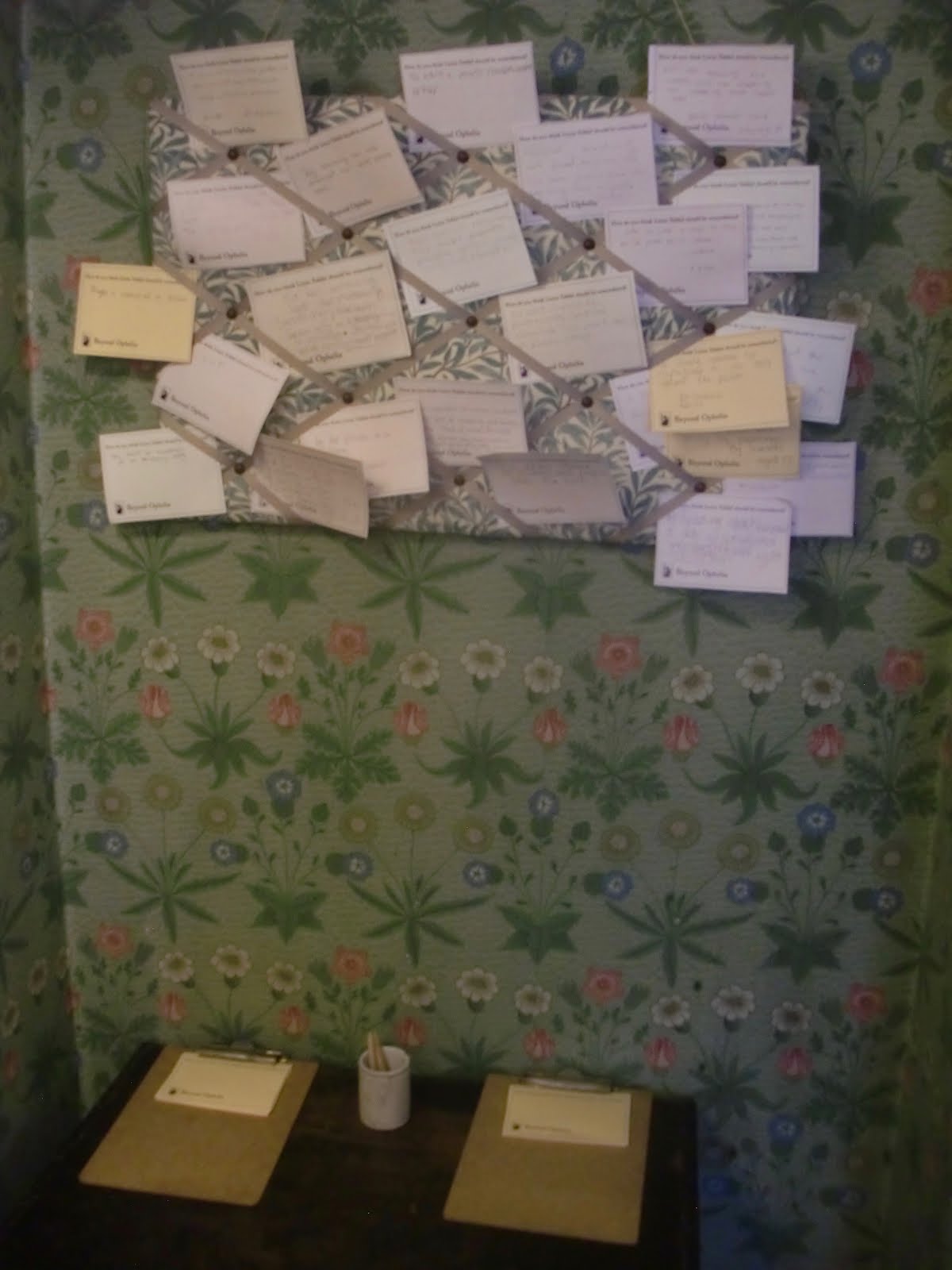
Visitors were further invited to have their say on a board upholstered with Morris fabric in the corner of the room. Pencils and paper postcards were placed on a table, reading “How do you think Lizzie Siddal should be remembered?”. Answers were diverse, empowering and gave food for thought: ‘by being an inspiration to women (and men)’, ‘to have a yearly remembrance’, ‘by showing her work amongst her male peers’, ‘maybe a memorial or statue’. I thought this was probably the most poignant legacy one could leave her: sending her a note, an honourable way of resurrecting her for posterity.
On the first day I entered the Daisy period room, I had a chat with a visitor who peered at my notebook. I had the feeling she was quite representative of art-amateurs on whom Elizabeth Siddal exerts ongoing fascination. Other viewers I’ve talked to already knew her name and parts of her life. It was as this precise point that I realised how much of a celebrity she was in Great Britain, a country proud of its national school of painting, praising the individuality and originality of Pre-Raphaelite art.

The scrapbook left on the couch engaged you to “Discover” more, making for the absence of catalogue. It was organised in chapters and added some information on the artworks. From a more detailed study of her drawings to working conditions of women in the Victorian art world, you could learn about Siddal’s complicated relationships with Rossetti and Ruskin as they both stimulated and limited her career opportunities. Despite these restrictions, we grasp that she made a point of appearing as “Artist-Painter” in the 1861 census, at a time when her ill health provoked by miscarriages probably prevented her from producing anything. Adding some information on the exhibits’ sources of inspiration, it also gave prominence to their provenance, an invaluable piece of evidence for any research on that an elusive body of work. This ended up with the printing of a couple of poems whose evocative titles evoke sorrow, remorse and passion.
Previous to my detailed enquiry on the display, I was lucky enough to be granted an interview with Helen Bratt-Wyton. Now house and collections manager at Wightwick Manor and Gardens, she wrote her dissertation on William Morris and socialism before getting interested in women’s history and domestic service. She started by informing me that an initial mistake provided the basis of the project: Sister Helen was authenticated with other drawings from the Ashmolean Museum and re-attributed to Elizabeth Siddal (some of her sketches were thought to be Rossetti’s).

The choice of the title was made to dismantle stereotypes associating Siddal to the drowning heroine she sat for. The aim was to point out her contribution to the Pre-Raphaelite movement by influencing some of its “brothers” in return. This was all the more necessary as the loans from descendants of the Pre-Raphaelites came to Wightwick almost by accident, Helen explained to me. What appealed to them in the first place was the taste for scandal and the direst aspects of Siddal’s biography. For this precise reason, Helen stressed that the scrapbook had been devised for viewers who wanted to know more about her life[1]
Elizabeth Siddal, Sister Helen, 1860
Ink and chalk on paper, 13 x 15 cm
National Trust
Its purpose was to raise an awareness of the Rossettis’ responsibility in editing Siddal’s “legend”, without adopting a polemical tone: Dante Gabriel indeed destroyed her notebooks and correspondence after she passed away. This is why I appreciated the lack of data on her sickness, drug addiction and early death in the exhibition itself. Yet her career had, according to early 20th century collectors and critics, little artistic merits and value on the market. Thanks to the Manders, this erroneous conception started to evolve[2].

This change can be felt in the current use of language, women artists are less and less the daughters of wives of …, to be portrayed as makers in their own right, argued Helen. In that sense, the Women and Power programme might have been conceived as overtly political, but this informal discussion felt incredibly refreshing to share about my Ph.D topic without any judgment from my respondent.
There has certainly been a gap in reception of gender studies between my homeland and the countries they originated from. In the UK, it is not a shame to be both activist and researcher, on the contrary, it is rather embraced by art historians working in the field. When I debate with British or American curators, I don’t feel the need to restrain myself, moderate my speech, or prove my point. Let’s just say that to French art historians, Siddal could appear as a mere ‘department’ of the more prolific painters she was acquainted with[3].


Therefore, it is a shame this display did not elicit more attention from the media. I came across it almost by accident on social networks, through the Facebook page of Wightwick Manor and Gardens, which promotes relatively well its events. One can then deplore the absence of general press coverage as reviews were published on specialised websites or blogs (The Kissed Mouth, William Morris Society amongst them), the most disappointing being, without a doubt, the one from the Victorian Web. As much as I respect this database, its author has completely missed the point, falling into the very pit the exhibition sought to disclaim: most her artworks are interpreted as “borrowings from Rossetti”, The Haunted Wood is esteemed as “illegible”, while all “can only be viewed as (…) amateur”. Nevertheless, Anna McNay devoted the show a long, significant article in Studio International and it seems the revision of Siddal’s poems has caused some renewed scholarly attention to her career.


In the end, did Wightick Manor and Gardens succeed in progressing beyond Ophelia? Despite Simon Cooke’s assertion that “this is an inflated estimation, a misreading that privileges the legend and not the facts”, this show, in my opinion, fulfilled its pledges in tearing Elizabeth Siddal apart from constant comparisons to her male counterparts. For the first time, the narrative of the muse we have come to know as “Lizzie” has been framed out of Pre-Raphaelite mythography, endowing her early start with more agency. This looks all the more promising in an era favourable to female heritage finally making its way to museums and galleries. It also gives one many hopes for the upcoming “Pre-Raphaelite Sisters” show at the National Portrait Gallery, unveiling the stories of twelve artists and models central to the movement, Siddal featuring as one of its stars. Exhibitions of this scope are essential to open the doors of world-famous museums to women studies. Traditional art histories need to be thus shattered by alternative narratives reconfiguring the canon.


[1] According to William Michael Rossetti, this represents his brother and Siddal as a couple on the Lovers’ Seat, a popular romantic spot in Hastings


[1] John Ruskin, after seeing some of her works under Rossetti’s initiative, offered Siddal an annual allowance of £150 for her whole artistic output

[1] This very painting was chosen to feature in the 1857 summer exhibition set up by Pre-Raphaelite associate Ford Madox Brown, at Russell Place. Elizabeth Siddal was its sole female artist

[1] Cecilia, from a noble Roman family in the first centuries of our era, is the heroine of Tennyson’s 1832 poem "The Palace of Art"

[1] Renowned for his gallantry and worthiness, Sir Galahad, illegitimate son of Lancelot, is the only knight able to see the grail with Percival

[1] Siddal and Rossetti’s relationship is in that respect characterised as ‘dysfonctional’. Marriage seemed to have been a source of quarrel as Gabriel avoided to commit for lack of financial means while their relationship risked of damaging her reputation
[2] Siddal’s collection was hung in Rossetti’s home after she died from laudanum overdose. It was spread through the photographic portfolio compiled by her husband in 1871
[3] I am here referring to an expression employed by Hector Obalk to describe Camille Claudel’s career in relation to her master and lover Auguste Rodin, interviewed for the opening of a museum dedicated to her in March 2017 (source: “Visites Privées” Youtube channel hosted by Stéphane Bern)