Affichage des articles dont le libellé est postmodernisme. Afficher tous les articles

mercredi 3 janvier 2018

Postcolonial fiction: Utopia or Dystopia?


‘For readers reared on travellers’ tales, the words desert isle may conjure up a place of soft sands and shady trees where brooks run to quench the castaway’s thirst and ripe fruit falls into his hand, (…). But the island on which I was cast away was quite another place (…)’[1] tells Susan Barton in J.M. Coetzee’s Foe, a rewriting of Daniel Defoe’s Robinson Crusoe. In this extract, the author re-adapts an essential feature of utopian fiction, that is, the motif of the island: Coetzee mocks its traditional association to abundance and possession; indeed, the novel’s male hero, Cruso[2], does his utmost make the place his.


Significantly, literary critic J.K Noyes argues that in the colonial mentality, conquered space is recreated as a Promised Land, a utopian place that is made anew and where colonialism pervades every aspect of social life[3].
Utopia can refer to both a place and a literary genre. Etymologically, the term means ‘no-where’, (u: no and topos: place in Ancient Greek) or ‘good place’ (eu: good and topos:  place). It was coined in 1516 by British author Thomas More, to refer to the place and society that are described in his eponymous tale, in which he stabilises the characteristics of the genre. The island of Utopia, formed of 54 geometrical cities, is depicted as an ideal place of social harmony, in order to criticize the social ills of 16th century Britain. This genre enabled writers to build a political ideal that, in the traditional storyline, was discovered by a foreign traveller. As in the 17th and 18th centuries Britain became progressively a major European power and sought to extend its supremacy over new-discovered colonies, it may not be surprising to find the motif of Utopia in works of British literature, such as Shakespeare’s Tempest (1610) and Johnathan Swift’s Gulliver’s Travels (1726)[4]. A century later however, with the rise of imperialism, globalisation and through the intensification of industrialisation, the utopian island was either re-cast as a remote pastoral suffused with nostalgia (see William Morris’ 1890 News from Nowhere) or a Dystopia[5], the exact reversal of the traditional genre by creating a totalising, nightmarish society. Samuel Butler’s Erewhon[6] seemed to have been a precursor of a genre favoured by British authors in the 20th century, whereas in the 1980s, utopian and dystopian fiction were means for postcolonial authors to exploit their links with the former British Empire. For Ralph Pordzik the utopian genre is naturally linked to postcolonial literature since it addresses the notions of national identity and culture[7].
Plato's vision of the Altantis

We will then analyse the characteristic features and tropes of utopias in the works of Jean Rhys (Wide Sargasso Sea, 1966), V.S. Naipaul (A Bend in the River, 1979), Salman Rushdie (Midnight’s Children, 1981) and J.M. Coetzee (Foe, 1986) as related to British canons of the utopian/dystopian genre. Instead of exploring this dichotomy, these postcolonial authors favour the patterns of heteropias to emphasize the multiplicity of imagined spaces[8]. Utopian fiction is then a means of fictionalising space and culture, even if these writers attempt to ‘decolonise’ Utopia, by creating highly subjective topoi through the exploitation of distinctive styles and the invention of multicultural protagonists.


Utopian features enable authors to fictionalise space and cultural identity: by taking up utopian tropes, postcolonial writers re-asses the ambiguity of the original canon that stands between the ideal and the real, between a literary genre and a political space. The topoi of national identity are conveyed through typical features of utopian fiction: spaces and figures.
The utopian space can be found in two different types of places: the island and the city. Both places are remote and distant to any well-known part on the surface of the globe. If Thomas More’s Utopia is located ‘somewhere between Europe and America’, it seems utterly difficult to reach it on account of its remoteness and uncertain localisation. That is why Erewhon’s subtitle is ‘Over the Range’, as for the traveller, only some natural catastrophe can enable him to get to the utopian space.
The shipwreck is then the most traditional motif that causes the main character of the story to discover the island. This is what happens to Robinson Crusoe who will later be the master of the place, and, similarly, to Susan Barton in J.M Coetzee’s Foe. To strengthen this connection to Utopia, Coetzee shows that the space of the island is submitted to a clear-cut organisation by Cruso’s partriarchal figure, even though with no apparent purpose: the hillside is geometrically divided to create a clear, pure space that reminds one of the circular division of space in More’s tale. Coetzee reinforces this aspect of purity with Cruso’s declaration on page 33, as if the clearing of space by removing any type of growth was a sign of civilisation: ‘ ‘‘ The planting is reserved for those who come after us and have the foresight to bring seed. I only clear the ground for them. (…)’.
Jean Rhys also establishes this link between the utopian space and Nature, but in a different way. When Rochester compares former slave Amélie to an innocent and gentle person, the author addresses the problem of the colonizer/traveller’s gaze: indeed, Rochester perceives the inhabitants of the island as noble savages, persons living in harmony with Nature. The noble savage, according to the coloniser’s ideal, is able to create a utopian space remote from the corruptions of modern civilisation. The theme appears through Rochester’s description of Amélie, as if she was attuned to Nature in a whole-like vision, an impression which is emphasised thanks to the use of the first person pronoun: ‘I could not imagine different weather or a different sky (…) I knew that the girl would be wearing a white dress. Brown and white she would be, her curls (…) her feet bare. There would be the sky and the mountains, the flowers and the girl (…)’[9]


Mumbai today: between modernity and tradition

On the other hand, the theme of perfect civilisation can appear through the modernity of urbanism. This feature is especially striking in Midnight’s Children: the magical qualities of postcolonial Bombay resonate with desire and idealism. Saleem, the main character of the story, considers the city as a collection of sensorial data, thus opening up the possibility for remembrance. This conception may be interpreted as an alternative to the imperial rule, a place where Saleem is able to ‘revise and revise, improve and improve’[10]. The embracement of modernity in the city of Bombay is nevertheless associated to a mythical past (‘It was very different then, there were no night-clubs or pickle factories or (…) Hotels or movie studios’), hence Saleem’s desperate attempt to find the day of the city’s deity, Mumbadevi, on the calendar[11].
Therefore, in Foe and Midnight Children, the invention of postcolonial space relies on the main protagonists’ perception. Similarly, the vision of utopian fiction characters influences the way they conceive the foreign place in which they are immersed. The traveller figure is essential to the discovering of Utopias since it increases the sense of estrangement both for the narrator and the reader. In Gulliver’s Travels, the eponymous character’s journey enables the author to play with different ranges of scales in a quasi-scientific manner: he goes successively to the land of Lulliput – to stress that even tiny people are capable of cruelty since Gulliver is sentenced to be blinded - and to the land of Houyhnhnms. This strange land is inhabited by horses, whose name means ‘the perfection of nature’, and provides the reader with the ideal society-in-reverse: the horses, capable of humanity, reveal the humans’ bestial behaviour. Similarly, Marlow in Heart of Darkness makes a nightmarish journey in which he comes across slaves that lack any human trait; the description of the mass of ‘slowly’ ‘dying’ ‘black shapes’ that he encounters in the Company’s Station has him ‘stepped into the gloomy circle of some Inferno’[12].
The dystopian traits that may appear in colonial fiction are deliberately taken up by postcolonial writers who seek to re-adapt the traveller figure canon. If this traveller is re-cast as the figure of the migrant, his feeling of uneasiness is omnipotent after being displaced. In Naipaul’s novel, Salim – who is from India - is constantly thinking about his foreignness in this strange, new country. Naipaul then creates a dystopian world in which ‘new’ Africa is overwhelmed by modernity: ‘The President had wished to show us a new Africa. And I saw Africa in a way I had never seen it before, saw the defeats and humiliations which until then I had regarded as just a fact of life’. The mix of awe and fascination for Africa is expressed through Salim’s admiration of machinery that already appears in the nightmarish dystopias of Heart of Darkness and 1984. In George Orwell’s novel, the omnipresence of the ‘telescreens’ hints at the citizens’ constant state of surveillance. Naipaul, on the other hand, conveys the nightmare of modernity through Salim’s admiration for aeroplanes. The dystopian qualities of surveillance appear at the moment when the police constantly spies on Metty, Salim’s associate[13].


Apocalypse Now: Coppola's adaptation of Heart of Darkness

The connection between A Bend in the River and 1984 is even more obvious through the figure of the President. His other name is the Big Man, reminding one of the Big Brother figure. Just like Orwell’s character, the Big Man is never characterised nor named: he is only an authoritarian patriarchal figure looming over every aspect of life in this African state: ‘There was a photograph of the President showing his chief’s stick ; and above it on the blue wall, (…) was painted DISCIPLINE AVANT TOUT’[14]. The totalitarian aspect of the catch-phrase is reinforced through the use of capital letters, that can be linked to Orwell’s ‘Big Brother is watching you’.
Thus, the ideal of national culture appearing through utopian/dystopian motifs of British canons and postcolonial fiction helps authors to fictionalise their relations to the British Empire. However, the specificity of utopian patterns in postcolonial novels lies in the way writers re-adapt those themes by decolonising the canon to create highly subjective utopias.


We will then see how, in these novels, the utopian/dystopian features are re-created through the visions of different characters, and that they depend on the perception of the coloniser or the colonised. Addressing the notion of a utopian past bring authors to find alternatives that mingle utopian and dystopian features.

 
In her essay on spatial politics in postcolonial novels, Sarah Upstone dedicates a chapter to the topos of the colonial house, to point out how, in the postcolonial novel, it is assimilated to a utopian space that seeks to perpetuate colonialism[15]. The past is embraced with nostalgia by the former members of the colonised class. The connection with Utopia is enhanced through the closure of the houses that are ‘microcosms’[16] of former colonial spaces. In Midnight’s Children, the utopian house appears in Methwold’s estate, a place re-created as a concentration of former European Empires. The estate is divided in four parts, all bearing the names of European castles, which used to be residences of monarchs. They all allude to the former glory of those European countries: Versailles is associated to the absolute monarchy of Louis XIV, Buckingham Palace recalls the climax of the British Empire under Victoria’s reign, the Escorial Villa is a symbol of Spain that was the first European power in the 16th century, and the Sans Souci Palace represents the glory of the Prussian Empire under Frederick the Great in the 18th century.
Jean Rhys, on the other hand, hints at a remote past with the Coulibri Estate, representing the former glory of Antoinette’s Creole family. Antoinette is the heiress of ex-slave owners, and the Coulibri Estate used to be a plantation run by an upper-class family. Since the slaves have emancipated, Annette, Antoinette’s mother, longs for the colonial past, a symbol of fixity and stability. She seems obsessed by that ‘prosperous’[17] past that she associates with her happy marriage to Mr Cosway.
However, the past is also suffused by nostalgia in the vision of the colonised. The pre-colonial utopia appears as an alternative to the colonial rule, resisting to any type of interpretation. In Foe, the very body of Friday and his acts re-invent a locus amoenus (a space lying outside any limits and associated to a refuge), an attempt at seizing a mysterious space that Susan Barton fails to understand. Friday invents another type of space through writing: instead of copying the word ‘house’ that Susan has taught him, he draws ‘walking eyes’[18]. This appears as a parody of Robinson Crusoe’s fixed island and clear-cut, colonial-like hierarchy. Instead of nostalgia and longing for the past, the timelessness of the re-created utopia has become inscribed in the present: the utopia has become a uchronia[19].
Naipaul, in A Bend in the River, associates pre-colonial life in Africa to an absence of time and history, to the danger of comparing African people to Shakespearian calibans, untamed, uncivilised persons. Caliban, in Shakespeare’s play, is the epitome of the monstrous slave, his name being an anagram for ‘canibal’. In the chapter ‘Imperial Deixis’, Russell West-Pavlov insists on Naipaul’s vision of Africa as a continent slipping backward in an archaic time[20]: ‘You were in a place where the future had come and gone’ thinks Salim. This ‘self-cancelling temporality’ inscribes Africans to their local space in a very disturbing manner. The deterriolisation and decontextualisation in Naipaul’s novel is the author’s way of taking up the Conradian theme of dislocation caused by colonialism.


Sir Joseph Noel Paton, Caliban, 1868
Oil on canvas, 124,5 x 83,8 cm
Glasgow Museums
Similarly when one considers the conception of postcolonial critics such as ‘the diaspora’ or Frederic Jameson’s concept of ‘national allegory’, it is hard not to perceive those concepts to idealistic views[21]. Are not the ‘national allegory’ and the ‘third world’, in a way, utopian re-creations of the Westerner’s critical gaze on postcolonial literature? Even if, for Jameson, the Third World cannot be considered as an avatar of Orientalism, his conception of an unfixed cultural identity inscribed in the political sphere may seem stereotyped. That is why I would focus on Homi Bhabha’s notion of ‘Newness’ since it appears as more relevant to analyse the concept of postcolonial heterotopia[22]. Criticising Jameson’s representation of postcolonial space and national allegory, Homi Bhabha points out that the ‘in-betweeness’[23] of postcolonial fiction is symbolised, not so much in the spatial politics of the novel, but more in the character’s gaze and their relation to time by creating ‘new world borders’[24].


The ‘in-betweeness’ of the utopian space is especially present in the minds of Jean Rhys’ characters. This impression is intensified through the use of the stream-of-consciousness technique, to make a distinctive space built upon feelings and dreams. If, for Rochester, England represents the utmost utopian space of civilisation, it is barely real to his wife Antoinette: ‘ ‘‘Is it true’’ she said, ‘‘that England is like a dream? Because one of my friends who married an Englishman told me so. She said this place London is like a cold dark dream sometimes. I want to wake up.’’ ’. Rochester’s answer too is quite meaningful; the utopian motif appears through the polyphony of the passage: ‘ ‘‘Well’’, I answered annoyed, ‘‘ that is precisely how your beautiful island seems to me, quite unreal and like a dream.’’ ’[25].
The end of Foe, on the other hand, presents an extremely uncertain utopian space. With the ‘home of Friday’, J.M. Coetzee creates both a sanctuary and a decayed space containing the corpses of the main protagonists. This place is not the island anymore, but rather an indistinct submarine locus, that cannot be described because it goes beyond human words and interpretations: ‘But this is not a place of words. (…) This is a place where bodies are their own signs. It is the home of Friday’[26].
Is it possible then to remove any political agenda from the utopian spaces of postcolonial fiction? The best answer seems to lie in Rushdie’s Midnight Children Conference, a space existing in Saleem’s mind only, and yet connected to the destiny of India. Even if Saleem tries his best to invent a mental space for the Midnight Children, acknowledging their diversity, a growing awareness of failure takes grip of him. Nevertheless, he recognises his failure in positive terms. Because, if for Rushdie, the hope lying in India’s independence did not manage to fulfil its goals, the Midnight Children Conference might be a fictional re-creation of the Congress Party, an in-between space, no longer a remote land inscribed in the past or the future, but acknowledging the present.


Postcolonial authors re-adapt the canons of British utopian and dystopian fiction, not by adopting one single mode, but rather by juxtaposing utopias and dystopias in their novels and creating complex heterotopias that suit better the issues of cultural identities. Instead of a fixed place that the characters long for, the heterotopias of postcolonial fiction are highly symbolical worlds characterised by uncertainty and multiplicity, thus avoiding the clichés of the dichotomy Utopia/Dystopia. Furthermore, heterotopias address the present issues, and not so much an ideal that is unreachable. As far as the political agenda of heteropias is concerned, one could wonder if these authors seek to convey optimism or pessimism for the future… but the subtelty of heterotopias may lie in the fact that authors leave this answer to the reader. As a conclusion, Salman Rushdie’s pattern of ‘Snakes and Ladders’ seems to be the best to show how postcolonial writers try to grasp the complexity of the world by inventing balanced images and topoi: ‘the game of Snakes and Ladders captures, as no other activity can hope to, the eternal truth that for every ladder you climb, a snake is waiting just around the corner, and for every snake, a ladder will compensate (…) the duality of up against down, good against evil (…)’.


Bibliography

Primary Sources: fiction
Butler, Samuel. Erehwon. Or Over the Range. (1872) London : Western Cape, 1949
Coetzee, J.M. Foe. New York : Penguin Books, 1987
Conrad, Joseph. Heart of Darkness. (1899) London : Penguin Popular Classics, 1994
Defoe, Daniel. Robinson Crusoe. (1719) Oxford, UK : Oxford World’s Classics, new ed, 2007
More, Thomas. Utopia. (1516) Cambridge : Cambridge University Press, 1989
Naipaul, V.S. A Bend in the River. London : Penguin Books, 1980
Orwell , George. 1984. (1948) London : Penguin Books, 2009
Rhys, Jean. Wide Sargasso Sea. London : Penguin Books, 1968
Rushdie, Salman. Midnight’s Children. (1981) Croydon, UK : Vintage Books, 1995
Shakespeare, William. The Tempest. (1710) Oxford : Oxford University Press, 2008
Swift, Johnathan. Gulliver’s Travels. (1726) Penguin Popular Classics, London : Penguin Popular Classics, New ed, 2007

Secondary Sources: essays and articles
Bhabha, Homi. ‘How Newness Enters the World ; Postmodern Space, Postcolonial Times and the Trials of Cultural Translation’ in The Location of Culture. London : Routledge, 1994, pp. 212-235
De Lange Attie, Gail Fincham, Jeremy Hawthorn and Jakob Lothe, ed. Literary Landscapes : From Modernism to Postcolonialism. Basingtoke, UK : Palgrave Macmillan, 2008
Farris, Wendy B. Ordinary Enchantments : Magical Realism and the Remystification of Narrative. Nashville : Vanderbilt University Press, 2004
Jameson, Frederic. ‘Third-World Literature in the Era of Multinational Capitalism’, in Social Text 15. 1986, pp.65-88
Lopez, Alfred J. Posts and Pasts : A Theory of Postcolonialism. New York : State University of New York Press, 2001
Pordzik, Ralph. The Quest for Poscolonial Utopia : A Comparative Introduction of the Utopian Novel in the New English Literatures. New York : Peter Lang Publishing, 2001
Rushdie, Salman. Imaginary Homelands : Essays and Criticism 1981-1991. London : Vintage Books, 2010
Upstone, Sarah. Spatial Politics in the Postcolonial Novel. Farnham, UK : Ashgate Publishing, 2009
Wegner, Phillip E. Imaginary Communities : Utopia, the Nation, and the Spatial Territories of Modernity. Berkeley : University of California Press, 2002
West-Pavlov, Russell. Spaces of Fiction/ Fictions of Space : Postcolonial Place and Literary Deixis. New York : Palgrave Macmillan, 2010


[1] J. M Coetzee, Foe, New York : Penguin Books, 1987, p.7
[2] ‘Cruso’ is the spelling of Foe’s character based on Robinson Crusoe: J.M. Coetzee played with the canon of the 17th century by providing Defoe’s original protagonist’s name with another spelling.
[3] See J.K Noyes, Colonial Space: Spatiality in the Discourse of German South West Africa 1884-1915, Chur: Harwood, 1992, p.162
[4] Amy Boesky in Founding Fictions: Utopias in Early Modern England interestingly points out that the success of the utopian genre in England and Britain at that time is due to the rise of a truly English or British national identity. Besides, the associations between Utopia and Britain is not foreign to the fact that Britain itself is an island that could be felt as a perfect embodiment of government, culture, structure and isolation. See Amy Broesky, Founding Fictions: Utopias in Early Modern England, Athens: University of Georgia Press, 1996.
[5] ‘Dystopia’ comes from the Ancient Greek dus: bad, ill and topos: place. In literature and science-fiction, it refers to a futuristic society that has degraded into a repressive and highly controlled state, in which the former equalitarian principles of the utopia have been implemented to their extreme.
[6] Samuel Butler too plays on the title of his novel since the name of his dystopia is a palindrome for ‘Nowhere’. It is also interpreted as related to the present: ‘now-here’.
[7] See Ralph Pordzik, ‘Introducing Postcolonial Utopia’ in The Quest for Postcolonial Utopia, New York: Peter Lang Publishing, 2001, pp.1-10
[8] I am here alluding to the Foucaldian concept of heterotopia that I link to the stylistic modifications involved in postmodernist and postcolonial fiction. These are made through fragmentation and discontinuity of spaces to convey a sense of multiple reality.
[9] Wide Sargasso Sea, London: Penguin Books, 1966, p.91
[10] Midnight’s Children, Corydon: Vintage Books, 1995, p.460
[11] See Salman Rushide, Op. cit. p.93
[12] Heart of Darkness, London: Penguin Popular Classics, 1994, p.24
[13] A Bend in The River, London: Penguin Books, 1980, p.216
[14] V.S Naipaul, Op.cit, p.217. The Big Man’s slogan can be translated by ‘Discipline above all’.
[15] See Sarah Upstone, ‘Reversal of Location: Postcolonial Homes’ in Spatial Politics in the Postcolonial Novel, Farnham  Ashgate Publishing, 2009, pp.115-145
[16] Sarah Upstone, Op.cit, p.122
[17] See Jean Rhys, Op.cit, p.5
[18] J.M. Coetzee, Op.cit, p.147
[19] U :non and chronos :time
[20] See Russell West-Pavlov, ‘Imperial Deixis’ in Spaces of Fiction : Postcolonial Place and Literary Deixis, New York : Palgrave Macmillan, pp.117-125
[21] See Frederic Jameson, ‘Third-World Literature in the Era of Multicapitalism’
[22] See Homi Bhabha, How Newness Enters the World ; Postmodern Space, Postcolonial Times and the Trials of Cultural Translation’ in The Location of Culture. London : Routledge, 1994, pp. 212-235
[23] Homi Bhabha, Op.cit, p.214
[24] Homi Bhabha, Op.cit, p.212
[25] Jean Rhys, Op.cit, p.58
[26] J.M. Coetzee, Op.cit, p.157


samedi 19 août 2017

'Velvet Goldmine', or the aesthetics of contemporary dandysm


When David Bowie was interviewed in May 1973, and asked to define ‘decadent rock’ for the magazine Melody Maker, Bowie answered ‘not putting a white rose on a white table, for fear of the thorn scratching the table’. This statement, stressing the musical genre's extreme refinement, shows the parallel between early seventies rock and decadence, a notion that had already been used to describe a controversial artistic movement, that is, a sub-genre of late nineteenth century Symbolism.
American director Todd Haynes, in his movie Velvet Goldmine (1998), goes one step further to relate seventies rock to Decadentism by pointing out that writer Oscar Wilde was actually the first artist to present himself as a ‘pop idol’. In the movie, Haynes traces the origins of glam rock back to Oscar Wilde and his philosophy of art for art’s sake. 
Velvet Goldmine is a fictional re-creation of the artistic/amourous relationships between David Bowie (aka Ziggy Stardust, the alter ego that Bowie created and embodied in the early seventies), Iggy Pop and Lou Reed. The film tells the story of glam rock star Brian Slade (actor Jonathan Rhys Meyer) who staged the murder of his own persona, Maxwell Demon, on tour. For the tenth anniversary of Slade’s shooting on stage, New-York Herald journalist Arthur Stuart (Christopher Bale) receives a new assignment from his boss: to find out what has happened to Slade since. This enquiry enables the journalist and several characters of the movie to look back on to the rise and development of glam rock in Britain thanks to Brian Slade’s music, and also to narrate Slade’s relationship with American artist Curt Wild (Ewan McGregor). Velvet Goldmine deals with the craze for glam rock in the seventies, how it influenced the music industry, youth culture and the emergence of new sexual identities.


‘Glam rock’, ‘glitter rock’ or ‘decadent rock’ is a subgenre of rock music, mostly characterised by its visual qualities and theatricality. By reacting against the protest songs and folk of the sixties, glam rockers sought to focus on performance, costume and make-up, thus removing the political dimension that rock'n'roll had acquired in the previous decade. Musically speaking, glam rockers tried to innovate by mingling ballads and hard riffs to convey an otherworldly atmosphere to their songs. They also wrote similar lyrics describing the fall of dystopian worlds, the issues of stardom, or provocative narratives about transsexual characters. The most emblematic artists and bands of the genre are David Bowie, T.Rex, Brian Ferry and Roxy Music, and Queen. If glam rock was mostly embraced by British musicians, it notably influenced American artists like Lou Reed and Iggy Pop (whose albums Transformer and Raw Power were produced by Bowie in 1972 and 1973).
Unfortunately, the distinctive features of glam rock led critics to under-evaluate the topic, thus deeming glam rock as ‘rock’n’roll with lipstick or simply rock in costume’. As a result, if jazz and, more recently, the sixties’ music have been accepted as proper objects of enquiry, studies about glam rock are scarce and often prejudiced, maybe because of its extreme ways to attract popular audiences. However, Velvet Goldmine, because of Haynes’ status as an independent filmmaker, prompted reviewers to include this celebration of glam rock in the field of gender or postmodern studies. It enabled theorists to re-evaluate glam rock and its social aspects, by removing the clichés that one found in essays dealing with a strictly musical perspective


The rock star's modelling of identities through visual spectacle


Velvet Goldmine depicts the rise and fall of rock stars by throwing into relief the creation of their statuses as icons, or, as young Oscar Wilde puts it ‘idols’. These terms not only enhances their godlike qualities, but they allude to their status of images as well. In this sense, Brian Slade and Curt Wild seek to be recognised easily, and to acquire some well-known significance. 
Not only is the film built according to a complex network of references about literature and pop music, but the mere names and looks of the main characters are visual puns. Haynes displays some remarkable knowledge of glam rockers’ background in his intertextual fashioning of onomastics, and probably expects the spectator to decipher them. The main character of the movie is mainly inspired by David Bowie’s early career. Most of the film’s storyline was actually based on Bowie’s unauthorised biography Backstage Passes, written by Bowie’s ex-wife Angela Barnett. 
Slade’s creation of his persona Maxwell Demon, a rock star coming from outer space, mirrors Bowie’s alter ego Ziggy Stardust from Mars. The dates framing the chronology of the film relatively coincide with Bowie’s career as Ziggy: like Bowie, Slade’s career soared in the early seventies and started performing as his alter ego around 1972. Slade’s murder of Maxwell Demon in 1974, the opening event of the movie, recalls David Bowie’s sacrifice of Ziggy when he announced in July 1973 during the Odeon Hammersmith concert in London that he would never ever perform as such.  

If Brian Slade’s looks recall Bowie’s attitudes and performances as Ziggy Stardust, Curt Wild (Ewan McGregor) is portrayed as Iggy Pop for his first appearance: half-naked, wearing straight leather jeans and ending up his gig naked. Later on in the course of the narrative, Curt Wilde reminds one more of Kurt Cobain, Nirvana’s lead singer, with his greasy blond hair and black-painted nails, a similarity that one finds, naturally, in the protagonist’s first name. His surname, on the other hand, might refer to his affiliation with Oscar Wilde, who is, in Velvet Goldmine, considered as the nineteenth century mentor of glam rock. This interpretation is reinforced by the fact that Curt, at the end of the story, owns Wilde’s green pin, thus revealing the circular pattern of the movie.


However, ‘Wild’ may be read as an adjective, corresponding to his ferocious personality and stage performances, but also alluding to Curt’s youth: ‘Curt Wild (…) came from the aluminium trailer parks of Michigan, where rock folklore claims far more primitive origins (…) he was promptly sent off for eighteen months of electric shock treatment. It was guaranteed that the treatment would fry the fairy clean out of his mind, but all it did was make him go bonkers whenever he heard an electric guitar.’ It is worth noticing that the shock treatment event was inspired by what actually happened to Lou Reed in 1956 when his parents tried to ‘cure’ his bisexuality.
Jack Fairy, on the other hand, even though he is not that present in the narrative, symbolises the direct heir (or reincarnation, since the movie constantly blurs the boundaries between reality and fiction) of Oscar Wilde. He is presented by Mandy - Slade’s wife - as a true dandy, the genuine inventor of glam rock: ‘Jack was truly the first of his kind. A true original, everyone stole from Jack.’ Naturally, his surname refers to the colloquial term used to describe a gay person, but it alludes to Brian Ferry as well, leader of  Roxy Music AND Marc Bolan, pioneer of glam rock, singer of TRex, who died tragically in a car accident before his 30th birthday. 
Slade and Wild’s way of life reveal the vanity of artistic illusion: to stand out, they try by every means to be advertised, noticed, using self-publicity, outrage and provocation. ‘The secret of becoming a star is knowing how to behave like one’, claims Jerry Devine, Brain Slade’s manager: to do so, Slade and Wild adopt an eccentric way of living to instil their public figures with fantasy. These elements appear as essential to design the myth of the rock star.


In her essay ‘The Affective Sensibility of Fandom’, Laurence Grossberg points out that for fans, rock stars acquire a peculiar form of significance because they ‘organise social life and specific difference that matters as markers of identity’, but also because of their deification, exposed through their excesses, orgies, and drug abuse. In Velvet Goldmine, Arthur Stuart’s fascination for Brian Slade and Curt Wild is clearly motivated by a will to live the same type of decadent experiences that the rock stars have. Jerry Devine, Slade’s manager, is the one who introduces Slade to stardom, and the orgies that the artist will later be famous for. Devine is actually modelled after Tony Defries, the manager who made a celebrity out of Bowie’s character. 


Tony Zanelta, personal assistant to Bowie, expressed his dislike for Defries by declaring that ‘Defries thought that to be a star, you should act like one, so everything was first class’. Jerry Devine considers that ‘to behave like a star’, Brian should be promoted as a celebrity, and act as an icon. At this point in the movie, Brian almost always appears surrounded by a group of fashion designers, producers and bodyguards working for his label, Bijou Music. The scene where they are portrayed drinking champagne in a music-hall, entertained by singers, epitomises the secluded world of luxury that they have created for the rock star: the crew is placed on the same side as the singers, that is, on the stage, and they freeze, as if they were conscious of being filmed. The frozen dimension is reinforced by their similar gold and white costumes matching the colours of the setting.

   
The artificial dimension of Brian Slade’s career reaches its climax when the star is performing. In these scenes, Todd Haynes tries to re-create the provocative attitudes of Bowie in concerts, that the artist considered as a total form of spectacle. The Ziggy Stardust tour was noticed for its theatricality: it involved various types of media and artistic performances. For the two concerts at the Rainwbow theatre in London - 19th and 20th August 1972 - Bowie played with mime Lindsay Kemp and his cast. The setting was divided into several grounds and Bowie later added three screens projecting images of rock icons like glam rocker Marc Bolan, Little Richard and Elvis Presley, as if Ziggy Stardust was one of their descendants. Similarly, at the end of Velvet Goldmine, during the farewell concert to glam rock, images of Brian Slade and Curt Wild appear on a piece of cloth while Jack Fairy comes out of a coffin to perform one of Slade’s songs.

As a consequence, Brian Slade is presented by his crew and manager as an object of desire. If the spectator wonders if some of the movies’ sequences really happened, Todd Haynes strengthens the sense of fantasy that surrounds rock stars like Slade, Wild, and Fairy. Fantasies are necessary to build up their legend, as Mandy Slade puts it while she remembers Jack Fairy’s entrance at the club where she first met her husband: ‘I needn’t mention how essential dreaming is to the character of the rock star’. Dreaming and fantasy indeed enable the director to establish an artistic lineage between Oscar Wilde, Jack Fairy, Brian Slade and Curt Wild. In the movie, they are portrayed as dandies of some otherworldly nature. The movie starts with a shot that reads ‘1854, Birthplace of Oscar Wilde’, and a baby is left on a doorstep while an UFO flies away.
Whether this UFO is really dropped Oscar Wilde on earth matters little, Todd Haynes rather stresses that the extra-terrestrial nature of these characters accounts for their genius. One might see this sense of differentiation as a defensive technique against the trauma and stigmatisation they suffered as young gay boys. Oscar, Jack and Brian imagined themselves to be different, and thus to be unique: ‘Jack would discover that somewhere there were others quite like him, singled out for a great gift’. Their link as exceptional dandies is materialised by an emerald on Oscar Wilde’s collar. During the film, the emerald pin is passed from dandy to dandy, as if it granted its owner with fame and luck: Jack Fairy finds it in the schoolyard, after being bullied, probably at the place where Oscar lost it when he endured similar abuse, Brian Slade steals it from Jack while kissing him, to then give it to Curt Wild as a gift, who eventually passes it to Arthur Stuart.
                            
If glam rockers want to appear as dandies, they do so by placing particular importance upon physical appearance, refined language and leisure, thus establishing a cult of the self. The affiliation with Oscar Wilde is quite conspicuous when one notices the numerous allusions to The Picture of Dorian Gray and to Wilde’s aphorisms. These quotes enhance art’s beauty and futility, equating Wilde’s philosophy of art of art’s sake. In one scene mimicking a press conference, Brian Slade is placed in full light, at the centre of a circus arena shrouded in darkness. Not unlike Oscar Wilde who used to hand out visiting cards describing himself as ‘Professor of Aesthetics’, Slade is introduced as a scholarly authority by his assistant: ‘the Aesthete gives characteristic evidence replete with pointed epigram and startling paradox, while explaining his views on morality in art’

In this scene, Brian Slade answers to the journalists’ questions by quoting Wilde’s aphorisms written on boards held up by Brian’s assistants. When one journalist asks: ‘Is it your belief that all dandies are homosexual?’, he answers ‘Ha! Nothing makes one so vain as being told one is a sinner!’. This aphorism comes from a dialogue between Dorian Gray and Lord Henry in Chapter 8 of The Picture of Dorian Gray. Henry, the epitome of the dandy, uses this phrase to comfort Dorian who has just learned that Sybil Vane has committed suicide, because of Dorian’s lack of interest in her.
Furthermore, if Jerry Devine’s character is mostly based on Bowie’s manipulative manager Tony Defries, since most of Velvet Goldmine’s dialogue comes from Oscar Wilde’s quotes, one can easily compare him to Lord Henry, the protagonist who introduces Dorian Gray to a life of luxury and refinement. Devine is actually the person that builds up Brian’s public figure. He is characterised through his aphorisms about stardom: ‘It doesn’t really matter what a man does with his life. What really matters is the legend that grows up around him’. Probably following Devine’s advice, Brian quoting Oscar Wilde to deliver provocative statements is aimed at building up his legend and baffling journalists. Provocation and outrage are means for him to be noticed, especially when he is asked about his eccentric costumes and music. When one journalist asks: ‘Brian, why the make-up?’, the star answers: ‘Because rock’n’roll’s a prostitute. It should be tarted up, performed. The music is the mask…’, thus acknowledging surface and illusion as distinctive features of his art.
Lord Henry, aka George Sanders,
cool before anyone in 1945
Velvet Goldmine tackles the issue of the rock star’s identity by questioning the relation between Brian Slade and his persona Maxwell Demon. Todd Haynes tries to convey a sense of doubt for the spectator to wonder how much one can involve oneself into playing a role, and to what extent the creature or the image is linked to its creator. The relation between doubles, originals and copies is reinforced by the fact that every glam rocker seems to be a copy of Jack Fairy, who is himself a copy of Oscar Wilde. In his essay ‘The Invention of People: Velvet Goldmine and the Unburrying of Queer Desire’, Nick Davis argues that Brian Slade is the ‘surpreme stylist with no style (…) appearing in an endless array of costumes, posters, videos and pictures’. As a result, the star more appears as an image or his alter ego, ‘becoming synonymous with his commodified persona’Just like David Bowie wrote the story of superstar Ziggy Stardust who was killed by some of his fans, Maxwell Demon’s narrative is about a space creature destroyed by its own success. When Brian Slade aka Maxwell Demon is shot on stage, this event seems to fulfil the prophecy that the musician had attributed to his character, whereas it was a carefully planned event, especially when we learn in the movie, later on, that Brian Slade’s murder on stage was a ‘shooting hoax’. What is so compelling about Todd Haynes’ movie is that, unlike one would think, the spectator is never prompted to wonder who shot Maxwell Demon – even though it is hinted that Jack Fairy was responsible for it - but rather whether he really was shot, and what happened to him afterwards. 

Further on in the movie, we understand that the shooting logically occurred after the fall of the star, his addiction to cocaine and his will to end up the tour despite his manager’s claim that Brian was ‘contractually bound to finish the Maxwell Demon tour as Maxwell Demon’. When Arthur Stuart has to find out what happened to Brian Slade in 1984, he discovers that Brian, probably after enduring plastic surgery, has reincarnated into Tommy Stone, the famous American pop star with perfect tanned skin and blond hair, most of the time wearing a white suit. Many critics compared these looks to some of the characters that David Bowie invented after he symbolically killed Ziggy Stardust, especially The Thin White Duke and how he appeared on the cover of the album Let’s Dance (1983).


Shocking, outrage: undermining stable assumptions about identity and sexuality

Imitation, doubles and personas play a key role in the movie since they enable characters to re-design their images. What Brian Slade, Curt Wilde and Jack Fairy are notorious for in the film is precisely what attracted critics’ and journalists’ attention as regarded David Bowie and glam rockers: the ability to constantly re-adapt themselves, to incorporate new styles and former models into their music. This is why, according to Stuart Lenig, glam rock ‘fuses styles and media (…) mixing theatre, pop music and technology’. 
Therefore, Todd Haynes reflects glam rock’s musical and visual diversity in the numerous appearances of rock stars wearing several costumes. Throughout the story, Brian Slade adopts various styles alluding to precise musical trends.We first see him as a mod, with a tight tuxedo and neat hair-dress, then wearing hippie-like clothes recalling David Bowie’s cover for The Man Who Sold the World. Naturally, it is when the spectator sees him as Maxwell Demon that his costumes are the most noticeable: mingling Victorian-inspired costumes and glam rock aesthetics, Brian presents himself as a fashion magnate, since his fans will dress and make-up according to his image. For Arthur Stuart who used to be a Brian Slade and Curt Wild fan, imitating gay icons was a way to see himself as an object of aesthetic contemplation. While Arthur is portrayed at the beginning of the movie hiding away from his parents to wear tight clothes and make-up, Brian’s shocking assertions about his bisexuality are the touchstone for Arthur to reveal his queer feelings to his parents while watching Brian on TV claiming: I should think that if people were to get the wrong impression of me, (…) it wouldn’t be the wrong impression in the slightest’. This ‘burst of exhibitionist self-discovery’, is triggered by Arthur worship’s for his favourite stars: this identification enables Arthur to accept his difference and bisexuality.


While exposing the ambiguous sexual tendencies of his characters, Todd Haynes deals with the seventies’ sexual revolution to question whether it really achieved a recognition of gay communities. ‘What was so interesting about the glam era, was that it was about bisexuality and breaking down the boundaries between gays and straights, between masculinity and femininity with this androgyny thing’ Haynes argues in an interview, adding that this sexual freedom ‘drastically changed, or reverted to something different, or went to hibernation in the eighties’. Glam rockers’ androgyny is not exposed only through their make-up and costumes, they also proclaim their bisexuality to make it notorious. 
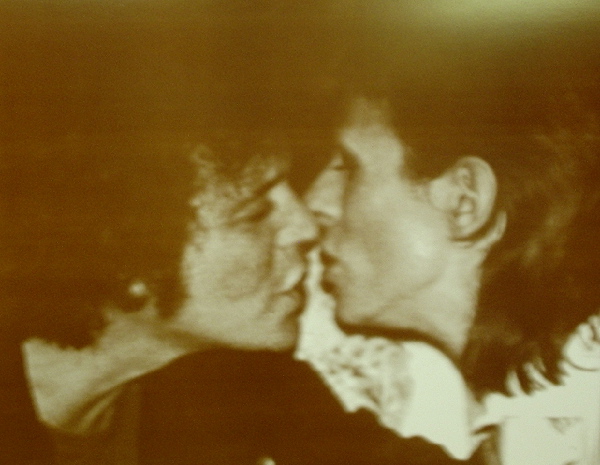
The picture that has caught the press’ attention as regards Brian’s career the one portraying him and Curt Wild kissing, an act they performed before journalists during a conference. ‘And they tell you it’s not natural!’ shouts Brian before kissing his fellow-musician. If this passage hints at the relationship that Bowie had with Iggy Pop and Lou Reed, it certainly displays bisexuality as transgression. At the outset of the film, one common-looking man expresses his shock, equating teenagers’ behaviour with ‘disgrace’. The most violent confrontation between the seventies’ sexual freedom and Britain’s previous, conservative generation occurs when Arthur’s father discovers that his son has been masturbating over the photograph of Brian Slade and Curt Wild kissing. ‘You bring shame to this family!’ exclaims Arthur’s father, before urging his son to leave their house forever.
By presenting themselves as objects of desires, Velvet Goldmine’s glam rockers expose their bodies as a source of visual pleasure. This is particularly the case while they perform the song ‘Baby’s On Fire’. During the concert, Brian Slade comes towards Curt Wild who is playing his solo, to kneel before him and bite his guitar’s strings: the sexual act is reproduced and simulated on stage. In the background, the crowd can be heard screaming, and the move precisely seems to be performed in order to arouse the audience. The concerts of glam rockers thus imply a typical anti-conformist body language and enhance their iconic status. This move was actually first performed by Bowie for his concert at the Oxford City Hall in June 1972 with his guitarist Mick Ronson. At the time, this move was perceived as utmost sexual provocation, and it was publicised by Mick Rock who took a picture of this moment that appeared in Melody Maker magazine, annotated and signed by Bowie himself.  


In Velvet Goldmine, the exhibition of glam rockers’ bodies relies on display and flamboyance. Todd Haynes blurs the definitive limits of sexuality by revealing stars’ bodies through artifice: they become a source of fantasy for their fans who seek to dress like them, to feel that they belong to this community of aesthetes. Nevertheless, the displaying of the male body in Haynes’ movie does not function as a source of identification for the spectator, it is not a vehicle for the visibility of the subject position either: the director prefers to use cinema to question the discourses about the sexual body and its connection to illusion. In Cinema 2: The Time-Image, Gilles Deleuze develops the concept of the ‘power of the gesture’ as related to postmodern cinema, by pointing out that the displaying of the ‘gest’ establishes a ‘thread which goes from one category to another’. In Todd Haynes’ film, the use of make-up and costume indeed enable rock stars to mingle sexual categories, and to appear as outer space creatures (like Maxwell Demon or Oscar Wilde) to expose their transsexual bodies.

By mingling the narratives of several characters about the glam era, Todd Haynes provides the spectator with a kaleidoscopic view of the seventies thanks to a complex set of technical effects corresponding to his topic. Many theorists agree to characterise Todd Haynes’ films as ‘postmodern’, because he deals with the art of simulation, pastiche, and contemporary culture. What is certain is that he deals with the issue of art’s usefulness and mocks the Hollywood model by building his movies on assemblages of references and the questioning of consumerism. The technical effects of Velvet Goldmine suit the topic since Todd Haynes emphasises theatricalisation, imitation and illusion. The use of zooming is most of the time dramatic and fast. For instance, a scene portrays teenager Arthur while he is in literature class, drawing a picture of Brian Slade as the teacher reads a passage from The Picture of Dorian Gray: ‘There were times when it appeared to Dorian Gray that the whole of history was merely a record of his own life, not as he had lived it in act and circumstance, but as his imagination had created it for him (…). He felt that he’d known them all, those strange terrible creatures that had passed along the stage of life and made sin so marvellous and evil so full of subtlety. It seemed that in some mysterious way their lives had been his own’
As the teacher reads the third sentence, he makes a pause and the zoom focuses on his face: we have the illusion that he is staring at Arthur –who appears in the previous shot- as if he had just noticed that his student was not paying attention. On the other hand, the Dorian Gray passage sums up the whole movie so well that the teacher quoting (at this moment, even though he still holds the book, he has stopped reading, and seems to quote by heart) Oscar Wilde is a direct address to Arthur, to urge him to lead his life like a dandy. And indeed, since Arthur investigates about Brian Slade’s shooting hoax and mixes his own memories of the early seventies with the narratives by Brian’s friends, the lives of these ‘strange terrible figures’ become ‘his own’.


The most remarkable feature of Velvet Goldmine is perhaps how Todd Haynes merges allusions to ‘high’ culture – through references to Oscar Wilde, and a reflection about the role of originality and imitation - and to ‘low’ culture by tackling the link between the star-system and fandom. In that sense, the movie mirrors the aesthetics of glam rock, which were aimed at being provocative to draw the public’s attention. Yet, glam rockers fashioned their image as refined dandies, and included subtle artistic references in their songs. Similarly, Brian Slade’s costumes as Maxwell Demon are glittering and colourful, fans try to reproduce them and Slade’s makeup, just like Arthur who adopts Brian’s blue tinting to go to the ‘Death of Glitter’ concert. On the other hand, many of Brian’s costumes are inspired by the male bourgeois outfits of the Victorian era.

Even though the movie is framed by several characters’ narratives, Arthur Stuart’s viewpoint dominates the storyline. In a way, Todd Haynes restores the respect one owes to fandom and how it actively participated in the developing of the glam rock movement for these stars used celebrity and provocation as means to attract popular audiences. As far as glam music is concerned, let us not forget that, in the expression ‘pop music’, that is, what glam rock belongs to, the adjective ‘pop’ comes from ‘popular’. 
In her essay ‘Fandom as Pathology: the Consequences of Characterisation’, Joli Jonson declares that the stigmatisation of fans as excessive, obsessed individuals is characteristic of a ‘media-addicted age’ and that this stigmatisation is seen only as a response to the star-system. Todd Haynes explores these issues by filming the audience of Slade and Wild’s concerts that are bewitched by the music and the stars’ behaviour on stage. However, by taking a former fan’s viewpoint as the movie’s main guideline, Haynes gives dignity to the fan’s vision.


Focusing on an ex fan’s viewpoint recording the testimonies of Brian’s relatives and friends enables Velvet Goldmine to convey a self-conscious meditation on the problem of story-telling by blurring the boundaries between fantasy and reality. In an interview he gave to Stephen Dalton for Uncut Magazine, Todd Haynes declared: ‘the film is an outright attack on a lot of unexamined assumption of what films are supposed to be, on the things people hold dear about films, which is, that’s real. That was always my target, which is I think what glam rock’s target was’. The theatricality of the movie indeed exceeds any stable form of representation, thus challenging the effectiveness of information, perhaps to make the spectator wonder about the nature of certain events. 
At one point, towards the end of the movie, a sequence shows Arthur Stuart and Curt Wild having sex after the ‘Death of Glitter’ concert. The blurred way of filming this sequence, as if it happened in a dream, entices us to think that this event only belongs to Arthur’s fantasy. Still, when we connect this sequence to the rest of the movie, to the moment when, for instance, Curt Wild refuses to be interviewed by Arthur about Brian Slade’s death, the spectator wonders whether Curt Wild’s refusal comes from his will to deny what happened between him and one of his numerous fans. This is why Nick Davis paradoxically characterises this scene as a ‘flitting image from the past that does not correspond to the way it really was’ and a ‘memorialisation of desires’ in a pre-era of gay liberation, by pointing out how inextricably memories, desires and fantasies merge in the movie. Nick Davis thus compares the aesthetics of Velvet Goldmine to the Jamesonian concept of the postmodern mode: ‘the symptom of social impotence (…) that leaves little option but the imaginary’. To assert their identity as a queer community, glam rockers and their fans resort to dreaming.
Therefore, Velvet Goldmine does not present events in a chronological way, even though it opens with Oscar Wilde’s extraordinary birth. To clearly distinguish the complex combination of various timelines, one needs to watch the film several times because it explores the relationship between storytelling and the media, mingling diverse sources of information such as television, advertisement posters, radio announcements, and newspapers’ headlines. The information the spectator gathers is so fragmented that, after Arthur has completed is research about Brian Slade’s shooting hoax, both he and the spectator are invited to reflect about the ends of media as purveyors of truth: narratives, fantasies and fascination do not exactly coincide with the notion of newsworthy information. On the contrary, subjective storytelling seems more relevant as another means of communication, that is more attuned to glam rock for it is an art of simulacra and theatricality.


Todd Haynes’ film is not a documentary about glam rock, nor is it a biopic about David Bowie’s career in the early seventies. The director prefers to mingle reality and fiction in order to convey a certain spirit, for the spectator to experience a mood about what glam rock might have been. Just like glam rockers, Todd Haynes deliberately plays on images, mixes popular and high culture references, probably expecting the spectator to decipher these allusions. Therefore, the director is self-conscious about the film’s sense of artifice. The film is neither an attempt at studying the psyche of the protagonists, it explores the surface of cultural exchanges focusing on music and dance, costuming and outrage. Besides, it is a respectful engagement in the life of an ex-glam rock fan. We may wonder if, thanks to films like Velvet Goldmine addressing the issues of gender and stardom through the media of cinema, glam rock will be considered as a serious topic of analysis. In 2001, John Cameron Mitchell, another independent filmmaker, questioned the notion of gender within the frame of rock music in Hedwig and the Angry Inch, a musical telling the life of a transsexual star who looks for her ‘other half’. Todd Haynes, in 2007, re-adapted the relationship between rock music and the notion of fragmented identity in I’m Not There: Suppositions on a Film Concerning Dylan, in which several actors played Bob Dylan’s role, notably a woman (Cate Blanchett). Perhaps the most relevant impact of these films is their ability to bring a cinema of transgression to the mainstream.


Bibliography

Primary Sources
Fiction and Aphorisms
   Wilde, Oscar. The Picture of Dorian Gray. (1891) London: Penguin Classics, 2000
   ---. Oscar Wilde’s Wit and Wisdom: A Book of Quotations. London: Dover Thrift Editions, 1998
Filmography
   Hedwig and the Angry Inch. Dir. John Cameron Mitchell. New Line Cinema, 2001
   I’m Not There: Suppositions on a Film Concerning Dylan. Dir. Todd Haynes. Paramount Pictures, 2007
   Velvet Goldmine. Dir. Todd Haynes, starr. Jonathan Rhys Meyer, Ewan McGregor,
Christian Bale, Tony Colette, Eddie Izzard. Miramax Films, 1998
Discography
   Bowie, David. Hunky Dowry. RCA Records, 1971
   ---. The Man who Sold the World. Mercury Records, 1971
   ---. Space Oddity. RCA Records, 1972
   Pop, Iggy. Raw Power. MainMan and Columbia Records, 1973
   Reed, Lou. Sally Can’t Dance. RCA Records, 1974
   ---. Transformer. RCA Records, 1972
   Roxy Music. Roxy Music. Island Records, 1972
   T.Rex. Tanx. EMI and T.Rex Wax Co, 1973
   Velvet Goldmine: Music from the Original Motion Picture. Fontana London, 1998

Secondary Sources
On cinema and Todd Haynes’ movies
   Benjamin, Walter. Illuminations: Essays and Reflections. New York: Schocken, 1976
   Jameson, Frederick. Postmodernism, or the Cultural Logic of Late Capitalism. Duke University Press Books, 1990
   Morrison. James, ed. All that Heaven Allows: The Cinema of Todd Haynes. London and New York: Wallflower Press, 2007
   Deleuze, Gilles. Cinema 2: The Time-Image. Trans. Hugh Tanliuson and Robert Galeta. Minneapolis: University of Minnesota Press, 1989
   Wyatt, Justin. ‘Cinematic/Sexual: An Interview with Todd Haynes’ in Film Quaterly, 1993, n°93, pp.2-8
On the music industry, star-system and glam-rock:
   Dalton, Stephen. ‘Glam Rock: Scary Monsters, Super Freaks’ interview with Todd Haynes for Uncut Magazine, nov.1998, pp.1-5
   Gourdon, Anne-Marie. Le Rock: aspects esthétiques, culturels et sociaux. Paris: CNRS Editions, coll. Arts du spectacle, 1994
   Hebdige, Dick. Subculture. London: Routledge, 1979
   Lenig, Stuart. The Twisted Tale of Glam Rock. California, Santa Barbara: Praeger Press, 2001
   Lewis, Lisa A. Adoring Audience: Fan Culture and Popular Media. London: Routledge, 1992
   McCain, Gillian and Leg. Please Kill me: the Uncensored Oral History of Punk, New York: Grove Press
   Seknadje, Enrike. David Bowie, Le Phénomène Ziggy Stardust et autres essais. Paris: Corbis, Philippe Auliac, 2009

   Waldrep, Shelton. The Aesthetics of Self-Invention: Oscar Wilde to David Bowie. Minneapolis: University of Minnesota Press, 2004