mercredi 1 mai 2019

Rossetti and the religion of female beauty


Venus Verticordia (detail) 1868
Oil on canvas
Russell-Cotes Arts Gallery Museum
Bournemouth, UK
‘Most people admire (Rossetti’s paintings) very much (…) –but (they are) still more remarkable for gross sensuality of a revolting kind’[1] wrote William Holman Hunt (1827-1910), commenting on Rossetti’s change of style during the 1860s. This statement seems all the more surprising since Hunt is known as the former ‘Brother’ of Dante Gabriel Rossetti (1828-1882), who was also part of the Pre-Raphaelite movement. Nevertheless, Hunt’s criticism emphasises the peculiarity of Rossetti’s art and his overt eroticism. Rossetti’s late style is characterized by an obsession for portraits of female figures. Rossetti’s female representations celebrate two particular artistic types, from the ‘fair maidens’ to the ‘femmes fatales’.
The ‘fair maiden’ refers to the medieval ideal of courteous love, the maiden being a faithful lady endowed with magical powers. The knight must revere her and accomplish heroic deeds in order to become her sweetheart. In visual arts and in medieval poetry, ‘fair’ may allude to light complexion and hair.
A femme fatale, on the other hand, is an alluring, seductive woman ensnaring her lover thanks to the irresistible desire she is able to convey. She uses her physical attributes to entrap him. The great amount of fascination she exerted on 19th century artists made her a stock character in literature and art. Accordingly, Rossetti painted different ranges of fair maidens and femmes fatales by depicting well-known heroines, his favourites being Beatrice, Queen Guenevere and Greco-Roman goddesses. Still, he also drew his inspiration from contemporary life and his models, who were either his friends or lovers. We shall then try to identify if there is a specific Rossettian style as related to femininity, by stressing how the artist combines these types of ideal, sometimes within the same painting. 

Raphael, Madonna and Child, 1505
Oil on wood, 44 x 59,5 cm,
National Gallery of Art, Washington
The Victorian ideal of beauty relied on two dimensions: artistic and social norms. Artistic canons derived from what students from the Royal Academy of London were taught: the imitation of High Renaissance Old Masters. This type of emulation was particularly favoured by Sir Joshua Reynols (1723-1792), founder of the Royal Academy of the Arts. R.A. students learned to paint according to the laws of perspective, from the essays by Alberti and Italian theoricians, to balance their hierarchised compositions with chiaroscuro and elegance of line. This had an impact on their models’ depiction: they seemed idealised, despite the ‘reality’ of the sitters. Raphael’s Mother and Child, for instance, was the epitome of the masterpiece that R.A. students sought to copy: the Virgin has this particular remote gaze one finds in other High Renaissance paintings (see Michelangelo or Da Vinci’s representations of the same biblical character), and the typical inclined pose of the head. Hair is tied up, the shape of the face is perfectly oval, and her features are neatly balanced: the nose stands right in the middle of her face, and the mouth is located exactly half-way between the line of the nose end and the line of the chin.
Richard Regrave, The Governess, 1844
Oil on canvas, 71,1 x 91,5 cm
Victoria and Albert Museum
Rossetti and his fellow members of the Pre-Raphaelite Brotherhood criticised this artistic tradition for they thought that the depictions of their contemporaries were stereotyped imitations of those ideals, depriving the models of their authenticity. The Victorian ideals of feminine beauty privileged petite women with tied up, brown hair, and lady-like, submissive attitudes. Such representations could be found in the drawings of popular magazines such as Punch, but it was also immortalised by contemporary genre artists. In The Governess, Richard Redgrave (1804-1888) emphasises the submission of the main character with her lowering gaze. She epitomises the perfect Victorian woman, with her black dress and her delicate looks.

Dante Gabriel Rossetti, Paolo and Francesca da Rimini, 1855
Watercolour on paper, 25,4 x 59,5 cm
Tate Britain

Rossetti’s women, on the other hand, differ from the Renaissance Madonnas or the Victorian ideal of meekness. They are characterised by flowing hair, large eyes and heavy eyelids, Greek-like noses and full lips. He enhances the fleshy parts of the models like the medieval poets focusing on one particular part of the woman’s body, creating blasons. In Bocca Baciata, the mouth is indeed the main interest of the painting, as is indicated in the title. Almost at the centre of the picture, it attracts the viewer on account of its glowing red colour, contrasting with the paleness of the face. Red hair is another distinctive feature of Rossetti’s style. In this picture, the painter represents Fanny Cornforth (1835-1906) – Rossetti’s housekeeper and mistress - who actually had blond hair.
John Everett Millais, Ophelia (detail)
1852, Tate Britain
It was Elizabeth Siddal (1829-1862), Rossetti’s wife, model and pupil, who made red hair popular in the bohemian artistic circles of the time[1]. From his early drawings of her to the representations of other, fleshier women, Rossetti's style evolved. In the triptych above, Lizzie’s features are delicate and sensuous yet childlike. This childlike aspect also appears in other pictures of the P.R.B, especially in Millais’ painting. Still, the striking red hair motif in Rossetti's early depictions of Lizzie and later representations of other "femmes fatales" with Lizzie’s hair reveal the blurring of the fair maiden ideal and the seductress within certain pictures. In Dante's Dream, Rossetti’s last oil on canvas, the painter had intially intended to depict Beatrice as Elizabeth Siddal. The lady is presented on her deathbed, her reclining attitude showing her in a position of weakness. Later on, when Rossetti decided to complete his painting, he modified Beatrice’s features to make her look more like Jane Morris, his main lover during the 1870s, after his wife had died.
Dante's Dream, 1871
Oil on canvas, 211 x 317
Walker Art Gallery, Liverpool

In Bocca Baciata, there still is that element of ethereality to be found in early paintings; the common feature of Rossetti’s portraits during the 1860s is the vacant stare of the models, who seem to avoid looking directly at the viewer. This trait pervades the pictures with an impression of melancholy, as if Rossetti created a poetic language that suited to the mood of the sitter: women are represented in a self-contained world, oblivious of any other exterior element. Lizzie’s depictions however possess a morbid dimension. The P.R.B and especially Rossetti re-adapt the traditional depiction of the red-head figure who was usually associated to traitors -such as Judas- and prostitutes - such as Mary Magdalene.
Dante Gabriel Rossetti, Bocca Baciata, 1859
Oil on panel, 32 x 27 cm
Boston Museum of Fine Arts
Rossetti’s pictures were deemed as provocative, since he endowed the beauty of unconventional heroines with nobleness and seduction. Firstly, he was careful to not to choose professional models so the pictures could look more spontaneous. Lizzie Siddal, Jane Morris, Fanny Cornforth and Alexa Wielding, apart from being acquainted to the artist, were all from lower-class background than his. If Elizabeth Siddal was remarkable thanks to her size, hair and eyes, Jane Morris was described as a quiet person with a ‘dark and pale’ face, and a ‘Ionian Greek’ mien[1].
Rossetti’s women appear as tall and massive on his portraits: the models almost fills the whole picture, leaving little space for the setting. At a time when feminist groups started to gather to claim the same rights as men, Rossetti’s representations of women might have constituted an echo to this ‘New Woman’ type, which embodied a threat to political and social life[1]. In many pictures, Rossetti’s sitters might be regarded as frightening creatures: in Monna Vanna, the cold stare of the protagonist and the glass heart around her neck show her as a merciless figure.
Monna Vanna, 1866
Oil on canvas, 88,9 x 86,4 cm
Tate Britain
The sensuality of the portraits is so conspicuous that it appeared as shocking to contemporary viewers. Rossetti enhanced the erogenous parts of the female body such as the mouth, shoulders, and hands[1].  William Holman Hunt was not the only one to be appalled by Rossetti’s women. In 1871 Scottish writer Robert Buchanan wrote an article about Rossetti, entitled The Fleshly School of Poetry: Mr D.G. Rossetti, condemning the artist for his ‘weary wasting, yet exquisite sensuality; nothing virile, nothing tender, nothing completely sane; a superfluity of extreme sensibility’.
By celebrating the beauty of women that Rossetti actually knew, his portraits subtly mingle reality and fantasy, creating complex ideals and myths around these fascinating figures. Rossetti worked with what he called ‘stunners’, that is, women who caught his attention and were able to fascinate him, seduce and frighten him at the same time. This type of female beauty was described as a ‘union of strange and puissant physical loveliness with depth and remoteness of gaze’[3]. Throughout Pre-Raphaelite literature, the stories of these stunners have been mythified: successively, how he met and drew them, and the complex nature of his relationships to them. This explains how art critics and biographers still are fascinated with Rossetti’s love affairs that he incorporated in his portraits, sometimes, the artist is even described as a saviour figure, rescuing these women from their low-life condition. Besides, let us not forget that, during the Victorian era, modelling was regarded as being a type of work situated only a little above prostitution. Women who embraced this career made quite a bold choice: they could expose themselves to the criticism of friends and contemporaries. This might explain why Rossetti was always careful not to paint his sitters in the nude tradition, except in Ligeia Siren and Venus Verticordia.
Found! 1853
Oil on canvas, 91,4 x 78,7 cm
Delaware Art Museum
Innovating with a highly personal style enabled Rossetti to re-interpret the traditional genres of religious and history painting. He then mixes various genres by combining portraits with literary or modern-life inspirations. For instance, his depictions of the fallen woman can be regarded as representations of the Modern Eve. Such is the case with Found!, displaying Fanny Cornforth in the role of the prostitute. Just as in Rossetti’s poem of the same name, she is recognized by her former lover and shrinks out of shame before him. The pose is unconventional for it is very awkward: her body is twisted from the neck to the knees, and the line of the body contrasts the line of the arms, directed towards the male protagonist. The impression of uneasiness is reinforced by her expression, with her closed eyes and half-open mouth, almost shown in profile.
Fanny Cornforth seemed to be the perfect figure to embody the modern-life prostitute, while Elizabeth Siddal was cast as the medieval queen and Jane Morris as the evil temptress. Alexa Wielding, on the other hand, was often chosen to represent the courtesan or the enigmatic sorceress. As a contrast to Fanny Cornforth, Alexa Wielding, whom Rossetti noticed while walking in the Strand in 1865, was chosen to embody more ethereal figures, on account of her refined face. When Rossetti painted Lady Lillith, Fanny initially sat for the picture, but the artist substituted her features for those of Alexa, since the owner of the painting, Frederick Leyland, considered the original too earthly[1]. 

Proserpine, 1874
Oil on canvas
61 x 125, 1 cm
Tate Britain
As a result, Rossetti cast his friends and lovers as heroines suiting their personalities. The fleshiness and sensuality of the characters, overwhelmed by a dreamy quality, thus pervades Rossetti’s pictures. For the artist, physical and spiritual types of love were intertwined. This dimension is particularly relevant in the depictions of Jane Morris, which become increasingly physical over the 1870s. In Proserpine, the Greek line of the nose, the lips and the shape of the eyes are clearly delineated, yet Jane Morris embodied an unattainable Goddess who is doomed to live in the Underworld. The dark undertones is heightened through the cold hues of the painting, which are present through the mass of brown hair and the blue-green dress. Significantly, Rossetti returned to oils in the 1860s, after painting exclusively in watercolour or gouache during the 1850s. Oils enabled him to insist on the physicality of his models. The body of Jane Morris was so massive that it even appeared as masculine, especially in the representation of her shoulders and neck. Rossetti could thus re-adapt the androgynous canon of Greek statues. 
Elizabeth Siddal, on the other hand, was portrayed as more delicate and ethereal – her first representations are made through drawing and watercolour, two mediums highlighting the dreamlike dimensions of the pictures  - even if Rossetti tried to represent his wife as a noble queen. In the early 1850s, her individuality was already blurred by Rossetti’s fantasy of her as Beatrice, Dante’s lover; while Rossetti fantasised himself as the Italian poet. Lizzie’s portrait as Beatrice after her death in 1862 presents the culmination of this blurring between reality and fantasy. In Beata Beatrix, Rossetti portrays her in the traditional position of religious ecstasy (one can think of Bernini’s Saint Theresa) to immortalise her through his art. The physicality of Lizzie’s body slips away as the central protagonist is painted through a sort of haze that sets the surreal aspect of the scene into relief. Accordingly, Lizzie’s eyes are closed, transelike, while her clothes and hands are over-shadowed. The artist threw Lizzie’s face into relief by painting a golden halo around it and through a game of contrasting hues: on the whole, the character’s face attracts the viewer’s attention, for Rossetti used a lighter tone than for the rest of the painting, yet, once more, he enhances the erotic parts of her body; the shadows under the neck and near the eyelids are made more apparent, just as the dark tones of the lips. The overall effect of grace also comes from the distinctive lighter draperies standing against the darkness of the dress.
Gustave Moreau,
Tattoed Salomé (detail)

1876, oil on canvas
Gustave Moreau Museum
Grace and form are part of what is considered as the ‘moods’ of Rossetti’s female portraits. The recurrent, decorative patterns of Rossetti’s late style are distinctive features of the Aesthetic style. Aestheticism in the UK paralleled the emergence of the Symbolist movement in Europe, and it aimed at representing ‘art for art’s sake’. The choice to depict women as connected to the senses was favoured by fin-de-siècle artists, to present art as a pure sensual form[1]. Symbolists such as Fernand Khnopff (1858-1921) and Gustave Moreau (1826-1898) obsessively portrayed Femmes fatales especially when they embodied the stereotype of the fascinating Oriental character. In Moreau’s numerous versions of Salomé, the eponymous character is eroticised through her jewels, which point at the naked parts of her body.
The Beloved, 1865 - 1866
Oil on canvas, 82,5 x 76,2 cm
Tate Britain

Similarly, The Beloved presents an Oriental-like composition, in which space is built through the presence of several women, forming a whole decorative pattern. Besides, this painting is noticeable for the focus on jewels and flowers, elements that appear in many Rossettian paintings of the 1860s and 1870s. The design of women’s features, jewels and flowers produce an overall dreamy atmosphere, but the picture’s appealing to the senses is made through colour and the presence of musical instruments, which are characteristic of Aesthetic canvasses. The connection between colour and music is particularly striking in what can be considered as Rossetti’s ‘symphonies of colours’. In The Daydream, the symphony in blues and greens is created thanks to the various shades of green in the background and on the dress of Jane Morris. With the careful rendering of the draperies echoing the limbs’ movements and Jane’s eye colour, Rossetti explores diverse tones of blue, to produce a whole effect of harmony responding to the green tones of the leaves. This effect is even more poignant in La Ghirlandata. The dark greens are subtly rendered to throw the warm colours of Alexa Wilding’s hair and mouth into relief. The key of the painting lies in the contrast between the dark tones of greens and the warm oranges, yellows and reds. The artist, by catching women plunged into rêverie, meant to appeal to the viewer’s senses: sight, sound and touch.

La Ghirlandata, 1873
Oil on canvas, 124 x 85 cm
Guildhall Gallery, London
The Daydream, 1880
Oil on canvas, 158,7 x 92,7 cm
Victoria and Albert Museum
                           
                                                  
The complexity of Rossetti’s representation of female beauty lies in the multiple influences he draws from contemporary life and literature on the one hand, and in the tension between the physicality and the dreamlike quality of the portraits on the other hand. By intertwining real life and artistic issues, physical and artistic love and by depicting sensuous women, Rossetti is able to create a type of art that overcomes moral categories. Rossetti’s portraits are aimed at catching woman in an ethereal moment, thus creating a true religion of beauty. However, what may seem surprising is that this highly personal vision of the female body, that was controversial when Rossetti was still active, became quite influential to the development of the Aesthetic Movement, partly because of Rossetti’s distinctive personality and way of painting. Indeed, he was revered by Edward Burne-Jones (1833-1898), and his female type influenced Burne-Jones’ work even after he died. Since Rossetti paints subjective portraits of friends or lovers cast as literary or mythical heroines, remarkable through their distinctive features, it may be fair to talk about a Rossettian artistic type, which flouted the canons of Victorian female beauty.


[1] In Nicoll, John. Dante Gabriel Rossetti, London: Studio Vista, Cassell and Collier Macmillan, 1975, p.125
[1] See Lucinda Hawksley, ‘The Red-Hair Model’ in Lizzie Siddal: The Tragedy of a Pre-Raphaelite Supermodel, London: Andre-Deutsch, ch.1
[1] See William Michael Rossetti about Jane Morris in Dante Gabriel Rossetti, His Family Letters with a Memoir, 1885, I, p.199: ‘Her face was at once tragic, mystic, passionate, calm, beautiful and gracious-a face for a sculptor and a face for a painter-a face not at all like that of an Englishwoman, rather of an Ionian Greek. It was not a face for that large class of English people who only take to the ‘perfect’ and not to the beautiful and the superb. Her complexion was dark and pale, her eyes a deep penetrating grey, her massive wealth of hair gorgeously rappled (…)’.
[1] ‘Instead of primarily focusing on the face and the head, Rossetti often included more of the torso (…) sensualizing to a hitherto unheard-of degree the erogenous parts of the body’. Susan P. Casteras, Pre-Raphaelites Challenges to Victorian Canons of Beauty, The Huntington Library Quaterly, vol.55, n°1, p.29
[3] F.W.H. Myers, ‘Rossetti and the Religion of Beauty’, Cornhill Magazine, February 1883, p.220
[1] Jennifer Lee, ‘The Forgotten Muse: Alexa Wilding’, The Pre-Raphaelite Society Newsletter of the United States, Number 19, Spring 2008
[1] For the connection between Rossetti and the Aesthetic movement, see Tim Barringer, ‘Pre-Raphaelites and Aesthetes’ ch.5, in Reading the Pre-Raphaelites, pp.135-155


mardi 5 mars 2019

Lizzie Siddal uncovered at Wightwick Manor and Gardens


Wightick Manor and Gardens certainly is some dream of an estate. It is open all year round but with various time entries depending on the season. One of the best times of the year to admire the domain is probably Halloween.
I had the opportunity to visit it twice, first on a stormy afternoon perfectly suiting the somewhat gloomy mood of the season and the next day bathed in sunlight, enhancing the colour contrasts between the green of the lawns and the warm autumnal hues.
On both days, the grounds were resonating with the cries of children following the pumpkin trail. This holiday was devoted to special outdoor and spooky crafts events: Wightwick Manor and Gardens truly brought all Hallows Eve through family-friendly activities.


This hidden gem is located in the heart of the West Midlands, a couple of miles from Wolverhampton. Not the easiest to access though, an erratic bus service from town will stop in front of the Mermaid Pub that one needs to circle to access the hill. Most enjoyable is that the estate reveals its wonders only when the ascension is complete. There, one can marvel at the manor towering its enchanted landscape garden. This features diversities of styles, ranging from formal borders in the main lawn to wilder woodland in the back. A few architectural surprises, such as the bridge inspired by the Mathematical one in Cambridge, or the “sun seat”, embellish these “garden rooms” redesigned by Thomas Mawson in 1904, in line with the Arts and Crafts ideal of craftsmanship and regionalism.
Shapes are clearly defined, privileging naturalistic treatment of beech trees, magnolia lifts, rose beds and holly walks. Dense hedging and stonewalls create the backbone of the park conceived as an essential component of the house.
This 17th century original building was crumbling down when manufacturer Theodore Mander bought the site. The first construction phase ended in 1887, the second extension containing the Great Parlour wing took place in 1893. The triangular gabled rooftops, ochre twist brick chimneys and oak wooden beams aim at reproducing Elizabethan simplicity. Narrow stained-glass window panes add up to the pattern of the façades.
Touring the house with a guide felt like a privilege as the interior normally does not open before 12 off season. She started with a brief historical account of the Mander family who had made a fortune from paint and varnish. Influenced by Oscar Wilde’s lectures on the “House Beautiful” in 1884, Theodore and Flora decided to decorate the manor with Morris and Co wallpapers, De Morgan ceramics, Kempe glass and antique furniture. Flora Mander, a gifted embroiderer herself, established her empire in the drawing room where she entertained social gatherings. She reached the boudoir, her private sitting room, through a small secret door.
The different sets of rooms changed functions over the course of time. From the onset, Wightwick Manor had modern facilities: central heating and electricity. The library, also a study, holds books reflecting the Manders’ concerns for art, literature and politics. The billiard room was initially used by men to play after dinner, but by the 1930s, females would join as well. “No cat or person here” declare certain labels displayed on sofas, while other cushions with stitched cats grant you the right to sit, some remembrance of Lady Mander’s love for pets and how she forbade visitors to remove them from chairs because of their claws.
Bedrooms upstairs were made to accommodate many guests. Their names, inspired by their decoration (the Indian Bird Room, the Acanthus Room), are painted on the doors. Quotes by Geoffrey Mander’s cherished poets can be seen on their walls. Alongside the family bedrooms are the nurseries, where the children played, ate their meals and slept with Nanny. The tower servants’ rooms are directly connected to the service wing downstairs. They had cold and hot running water, a bathtub, and were provided with very comfortable living conditions, which was unusual by the start of the 20th century. All this arrangement was meant at generating domestic feeling and a sense of elegance.


It was not before 1937 that Wightwick Manor was opened to the public by Sir Geoffrey and donated to the National Trust. Having remarried in 1930 with Rosalie Glynn Grylls, Sir Geoffrey, a radical Liberal MP, refurbished the house his father Theodore Mander had left him. Rosalie, the academic, was the impulse behind the Pre-Raphaelite collection that made Wightwick’s Manor fame. Having given up her political career, she focussed instead on researching British literature and art, beginning with a biography of Mary Shelley. She acquired then works by artists close to William Morris, with an increased heed for female painters, notably his daughter May, Lucy Madox Brown and Maria Spartali Stillman.
In addition to these, the Malthouse (a section of the original farm buildings used for malting and brewing) shelters the De Morgan collection, dedicated to this creative couple. During my visit, the gallery showcased some of the most iconic canvasses by Evelyn de Morgan including Flora, Harmonia and Cadmus or Night and Sleep.

Evelyn de Morgan, Cadmus and Harmonia, 1877
Oil on canvas, 102 x 45 cm
De Morgan Foundation
To that date, Wightwick Manor owns the works of eleven professional women artists on permanent display, more than any other National Trust institution and some national galleries. To commemorate the anniversary of female suffrage last year, the National Trust honoured women’s histories: the “Muse to Maker” show at the Red House for instance, was part of this Women and Power programme on the most famous females of the Pre-Raphaelite circle and their contribution to the Arts and Crafts Movement. At Wightwick Manor, the re-enactments of the Suffragettes march had been so popular throughout 2018 that they were brought back for the Halloween season. Based on Emeline Pankhurst’s autobiography, volunteers in costume performed indoors, which rooms were adorned with green and purple banners, and other “votes for women” signs.


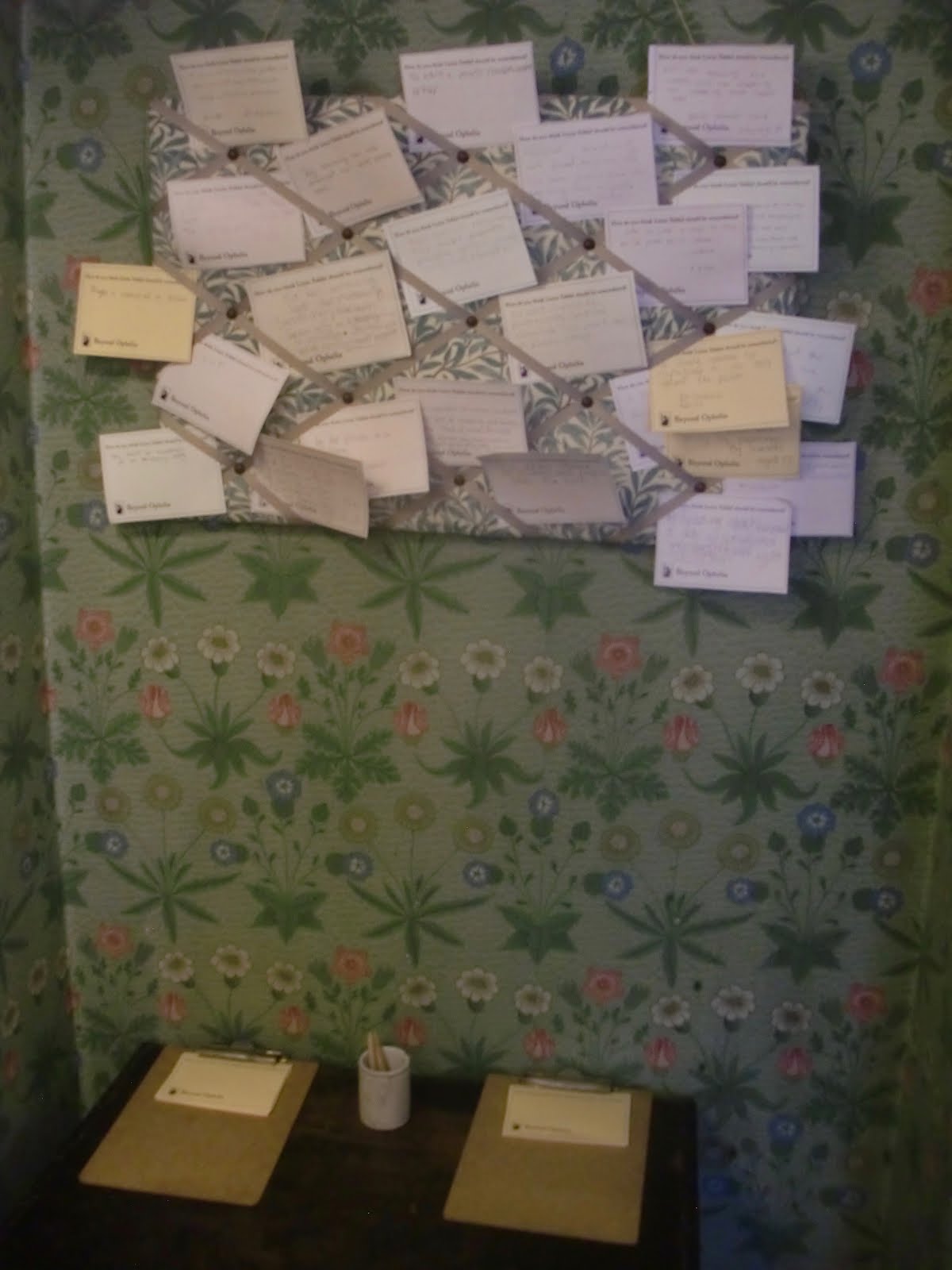
So it was only logical that Wightwick Manor should hold from March to December “Beyond Ophelia: a celebration of Lizzie Siddal” to acknowledge her status as poet and artist. Located in the single guest bedroom with the Daisy Morris wallpaper, it comprised a total of twelve artworks in various techniques and a couple of loans formerly owned by the Manders, all of which gathered and some mounted in frame for the very first time. As in the other bedrooms, it  featured two full poems and some quotations on the wall. This was the second retrospective on Elizabeth Eleanor Siddal only, curated seventeen years after the show at the Ruskin Gallery by Jan Marsh.
Siddal is known either as the model who sat for Ophelia, one of the nation’s most iconic paintings, or the tragic muse of Dante Gabriel Rossetti, but this thematical display explored the acquisition history of Siddal’s works, her subject-matter and style. The few biographical elements were only available to apprise the viewer’s understanding of Siddal’s career choices, her working conditions as a professional artist.


With exhibits spread between wall hangings and pieces of furniture (two tables in the corners, one in the centre, plus the fireplace and small sofa facing the window), the viewer was free to wander as he or she pleased: artworks all embodied the basis of the reflection on one particular aspect of her legacy. It made sense though, to go from left to right, starting with the nearest wall to the entrance. Panels indicated the distinct sections of the argument, along with labels, written in simple lettering design and accessible language free of jargon. Their visual identity was reinforced thanks to the stylised reproduction in dark blue and yellow of a Rossetti ink sketch of Lizzie working, at her easel.
Since Siddal’s work is small in scale and range, it was significant to present it in such an intimate setting. The viewer could thus get extremely close to the artworks, noticing the intricacy of details in pen and ink sketches, the variations in watercolour tints and get immersed in her ominous motifs. I was also surprised to discover that some artworks were not that small – contrary to what catalogues had led me to believe – but almost medium format. Besides, the soft pastel hues of green with touches of pink and blue wallpaper emphasised the jewel-like patches and strong outlines of the drawings.

Interestingly, we began not with her youth but a 1854 drawing entitled Lovers Listenning to Music, revealing great mastery of light and shade[1]. It was part of a lot of six works bought by the Manders at a Sotheby’s auction in 1961, from which art dealer and historian Jeremy Maas was outbid “thus creating a world record of her work”. Lady Mander was acquainted with Helen Rossetti Angeli as well, who owned The Haunted Wood and The Eve of Saint Agnes. Both women agreed Siddal had “real original talent, not at all Dante Gabriel Rossetti”. Overall, Lady Mander’s 1964 biography of Rossetti provoked a surge of interest in Pre-Raphaelite studies. Reproductions of letters and Sotheby’s estimations that the visitor could read and manipulate at his/ her will added up to the feeling of proximity with the collectors’ history. 
Elizabeth Siddal, The Haunted Wood, 1856
Gouache on paper, 11 x 12 cm
National Trust
On this same table, a copy of The Germ – the literary magazine of the Pre-Raphaelites – was to be found. It was open on the page revealing a drawing of Siddal as Viola by Walter Deverell. This exhibit and the video filmed by curator Hannah Squire constituted the most groundbreaking enquiry of the show. According to Dr Jan Marsh, who acted as its scientific advisor, the discovery of Siddal by Walter Deverell in a milliner’s shop was a piece of fiction transmitted by several generations of the Pre-Raphaelite circle, which made the legend of Elizabeth Siddal more convincing. In her interview, Dr Marsh reassessed Siddal’s early biography by claiming she herself took the initiative to sit for Deverell and showed some sketches to his father, the principal of the London School of Design – now Royal College of the Arts - as she was probably already working as a dressmaker for the family. The rest of the video is dedicated to Siddal’s poem "Silent Wood" read by one of the manor’s volunteers on soft notes of background music.
This section, adequately entitled “Life and Aspirations”, investigated on Siddal’s background as an burgeonning artist. Since her family was thought to have been unsupportive and because she lacked money for training, Siddal demonstrated quite some ambition for her condition (that is, lower-middle class). If drawing was often practiced by accomplished young ladies fit for marriage, it was regarded an amateur, not a professional, activity. Siddal, on the contrary, expected more than entering the studio by merely sitting for artists. She enjoyed spending time with and learning from the Pre-Raphaelite Brotherhood, unchaperoned.


However, most major institutions – like the Royal Academy – didn’t admit women. If you wanted to get education, it was through private tuition (often for a fee) or regional, less prestigious art schools, which still implemented gender segregation. It seems that in exchange of modelling, Siddal required Rossetti to teach her painting. Her lover, who had secured John Ruskin’s patronage for her in 1855[1], encouraged imagination, creativity and authenticity, rather than accuracy and refined composition, in line with early Pre-Raphaelite doctrines. Working at Rossetti’s and borrowing from his materials, Siddal never had a studio of her own. In 1857, when she attended the Sheffield School of Design, there was no life class available, as drawing from the nude was deemed improper for ladies, so she probably studied through basic elements of figure (outline and shading), copy from casts, engravings or ornamental design and nature (plants and flowers). Yet an institution of this type was initially meant for craftsmanship, not fine art.


“Style and subjects”: the core of the matter. Poetry fuelled Siddal’s potential for innovation. Though deprived of ancient classical education, she received modest instruction during her childhood and teenage years (e.g. reading and writing), but that was enough to bring an awareness of existing literary traditions. Influenced by Keats and Tennyson, Siddal’s poetry and art are suffused with Romanticism. Siddal intensively collaborated with Rossetti too, by illustrating his poems. Sister Helen remains faithful to its original source by manifesting sympathy for the eponymous protagonist, using witchcraft to take revenge on her beloved, who has wronged her. Siddal’s expressive, if not awkward poses, were inspired by medieval manuscripts and early Italian art. She dealt with religious subject-matter too: she drew no less than six sketches of the Virgin and Child, three of which on display. Unlike the lack of command usually ascribed to her, this betrays some attempts at commercial strategy, as this type of modern moral subject was thought acceptable for a lady artist. With that many versions on the topic, varying the characters poses and the move from Annunciation to Nativity scenes makes us wonder whether she intended to devise a cycle on the life of Mary.

Elizabeth Siddal, Nativity or Madonna and Child, 1860
Pencil on paper, National Trust
Her figures are stiff silhouettes in long robes, so the focus really is on hands and faces. Often appearing in claustrophobic settings, her compositions have been interpreted in the context of 19th century separate spheres. The Victorians attributed the private, domestic space of home to femininity, whereas the public, outside world was perceived as male territory. It is not rare to see windows in the corner of Siddal’s designs and women leaning towards them. With Cecilia, Patron Saint of music, Siddal conceives artistic creation as an isolated activity that should be performed alone in a peaceful environment, akin to religious devotion.
Interspersed between exhibits, pieces of poetry complement Siddal’s pictorial production. Often related to the gouache The Haunted Wood hung nearby, "Silent Wood" conveys a sense of gloom through Gothic touches and uneasiness. Precision of botanical detail and rendition of heavy rhythm through a pattern of couplets contribute to forge some enclosed, self-contained feeling. The visual translation of the theme is even grimmer, alluding to the Doppelgänger motif of Nordic folklore: meeting your double implied your imminent death. This is delivered in the contorted pose of the female character, surprisingly opening her arms to the ghost[1]. The other writings in the spotlight are “Love and Hate” plus extracts of “The Lust of the Eyes” and “Dead Love”. Apparently written in private, this care for Siddal’s poetry coincided with the publication of her poems’ new edition by Dr Serena Trowbridge, who gave a talk at Wightwick last January. More than her visual production, Siddal’s verse reflects her tastes in popular legends and ghost stories, enabling her to explore themes of lost love and death, therefore fitting in a Victorian poetical convention.

                  
Elizabeth Siddal, St Cecilia, 1860
Right: pencil and ink on paper, 21,5 x 20 cm ; left: pencil on paper, 20,5 x 17 cm
National Trust

In tune with its collection, Wightwick wished to shed a new analysis on Siddal’s use of female characters. Either powerful or melancholy figures, they depart from the customary depiction of voluptuous femmes fatales we are used to seeing in Pre-Raphaelite painting. It was quite unconventional for ladies to represent violent women, such as Sister Helen. The saints Siddal was attracted to are marked by their life of solitude. The Eve of St Agnes invokes a ritual performed by virgins on 21st January to see their future husbands but Agnes is in fact the protector of those seeking chastity and purity. 
Dante Gabriel Rossetti, The Palace of Art
1857, engraving on paper by the
Dalziel Brothers, 8,6 x 7,9 cm
Tate Britain
Cecilia became a Christian martyr because of her faith as she was forced to marry a pagan whom she managed to convert. In the pen and ink version, kneeling Cecilia throws her head back in ecstasy towards the heavens. The three sketches on this motif expose how Siddal experimented with layout by drawing Cecilia and the Angel closer, brought together by their passion for music embodied in the shape of the organ, and building their own “Palace of Art”[1]. To put it in a nutshell, Elizabeth Siddal readapted popular, literary and biblical legend by concentrating narrative tension on the emotional struggles experienced by her favourite heroines.


Visitors’ participation was encouraged with the display of Sir Galahad’s drawings on both sides, newly mounted. Hinges allowed you to turn the frames and disclose Siddal’s lack of funds as she sometimes drew on the front and rear of paper to save it. This take on the Arthurian cycle was part of a project that never came to be: Siddal began working on designs for the Moxon publication of Tennyson’s poems, from which these were derived. Contrary to previous literary depictions of the Knight extolling masculine action, Galahad[1], in his startled expression, is self-denying. It is a moment of divine revelation and one of the very first images of the quest for the Holy Grail in Pre-Raphaelite art.

Elizabeth Siddal, Sir Galahad, 1860
Pencil on paper, 20,5 x 17 cm
National Trust
Visitors were further invited to have their say on a board upholstered with Morris fabric in the corner of the room. Pencils and paper postcards were placed on a table, reading “How do you think Lizzie Siddal should be remembered?”. Answers were diverse, empowering and gave food for thought: ‘by being an inspiration to women (and men)’, ‘to have a yearly remembrance’, ‘by showing her work amongst her male peers’, ‘maybe a memorial or statue’. I thought this was probably the most poignant legacy one could leave her: sending her a note, an honourable way of resurrecting her for posterity.
On the first day I entered the Daisy period room, I had a chat with a visitor who peered at my notebook. I had the feeling she was quite representative of art-amateurs on whom Elizabeth Siddal exerts ongoing fascination. Other viewers I’ve talked to already knew her name and parts of her life. It was as this precise point that I realised how much of a celebrity she was in Great Britain, a country proud of its national school of painting, praising the individuality and originality of Pre-Raphaelite art.

The scrapbook left on the couch engaged you to “Discover” more, making for the absence of catalogue. It was organised in chapters and added some information on the artworks. From a more detailed study of her drawings to working conditions of women in the Victorian art world, you could learn about Siddal’s complicated relationships with Rossetti and Ruskin as they both stimulated and limited her career opportunities. Despite these restrictions, we grasp that she made a point of appearing as “Artist-Painter” in the 1861 census, at a time when her ill health provoked by miscarriages probably prevented her from producing anything. Adding some information on the exhibits’ sources of inspiration, it also gave prominence to their provenance, an invaluable piece of evidence for any research on that an elusive body of work. This ended up with the printing of a couple of poems whose evocative titles evoke sorrow, remorse and passion.
Previous to my detailed enquiry on the display, I was lucky enough to be granted an interview with Helen Bratt-Wyton. Now house and collections manager at Wightwick Manor and Gardens, she wrote her dissertation on William Morris and socialism before getting interested in women’s history and domestic service. She started by informing me that an initial mistake provided the basis of the project: Sister Helen was authenticated with other drawings from the Ashmolean Museum and re-attributed to Elizabeth Siddal (some of her sketches were thought to be Rossetti’s).

The choice of the title was made to dismantle stereotypes associating Siddal to the drowning heroine she sat for. The aim was to point out her contribution to the Pre-Raphaelite movement by influencing some of its “brothers” in return. This was all the more necessary as the loans from descendants of the Pre-Raphaelites came to Wightwick almost by accident, Helen explained to me. What appealed to them in the first place was the taste for scandal and the direst aspects of Siddal’s biography. For this precise reason, Helen stressed that the scrapbook had been devised for viewers who wanted to know more about her life[1]. 
Elizabeth Siddal, Sister Helen, 1860
Ink and chalk on paper, 13 x 15 cm
National Trust
Its purpose was to raise an awareness of the Rossettis’ responsibility in editing Siddal’s “legend”, without adopting a polemical tone: Dante Gabriel indeed destroyed her notebooks and correspondence after she passed away. This is why I appreciated the lack of data on her sickness, drug addiction and early death in the exhibition itself. Yet her career had, according to early 20th century collectors and critics, little artistic merits and value on the market. Thanks to the Manders, this erroneous conception started to evolve[2].

This change can be felt in the current use of language, women artists are less and less the daughters of wives of …, to be portrayed as makers in their own right, argued Helen. In that sense, the Women and Power programme might have been conceived as overtly political, but this informal discussion felt incredibly refreshing to share about my Ph.D topic without any judgment from my respondent.
There has certainly been a gap in reception of gender studies between my homeland and the countries they originated from. In the UK, it is not a shame to be both activist and researcher, on the contrary, it is rather embraced by art historians working in the field. When I debate with British or American curators, I don’t feel the need to restrain myself, moderate my speech, or prove my point. Let’s just say that to French art historians, Siddal could appear as a mere ‘department’ of the more prolific painters she was acquainted with[3].


Therefore, it is a shame this display did not elicit more attention from the media. I came across it almost by accident on social networks, through the Facebook page of Wightwick Manor and Gardens, which promotes relatively well its events. One can then deplore the absence of general press coverage as reviews were published on specialised websites or blogs (The Kissed Mouth, William Morris Society amongst them), the most disappointing being, without a doubt, the one from the Victorian Web. As much as I respect this database, its author has completely missed the point, falling into the very pit the exhibition sought to disclaim: most her artworks are interpreted as “borrowings from Rossetti”, The Haunted Wood is esteemed as “illegible”, while all “can only be viewed as (…) amateur”. Nevertheless, Anna McNay devoted the show a long, significant article in Studio International and it seems the revision of Siddal’s poems has caused some renewed scholarly attention to her career.


In the end, did Wightick Manor and Gardens succeed in progressing beyond Ophelia? Despite Simon Cooke’s assertion that “this is an inflated estimation, a misreading that privileges the legend and not the facts”, this show, in my opinion, fulfilled its pledges in tearing Elizabeth Siddal apart from constant comparisons to her male counterparts. For the first time, the narrative of the muse we have come to know as “Lizzie” has been framed out of Pre-Raphaelite mythography, endowing her early start with more agency. This looks all the more promising in an era favourable to female heritage finally making its way to museums and galleries. It also gives one many hopes for the upcoming “Pre-Raphaelite Sisters” show at the National Portrait Gallery, unveiling the stories of twelve artists and models central to the movement, Siddal featuring as one of its stars. Exhibitions of this scope are essential to open the doors of world-famous museums to women studies. Traditional art histories need to be thus shattered by alternative narratives reconfiguring the canon.


[1] According to William Michael Rossetti, this represents his brother and Siddal as a couple on the Lovers’ Seat, a popular romantic spot in Hastings


[1] John Ruskin, after seeing some of her works under Rossetti’s initiative, offered Siddal an annual allowance of £150 for her whole artistic output

[1] This very painting was chosen to feature in the 1857 summer exhibition set up by Pre-Raphaelite associate Ford Madox Brown, at Russell Place. Elizabeth Siddal was its sole female artist

[1] Cecilia, from a noble Roman family in the first centuries of our era, is the heroine of Tennyson’s 1832 poem "The Palace of Art"

[1] Renowned for his gallantry and worthiness, Sir Galahad, illegitimate son of Lancelot, is the only knight able to see the grail with Percival

[1] Siddal and Rossetti’s relationship is in that respect characterised as ‘dysfonctional’. Marriage seemed to have been a source of quarrel as Gabriel avoided to commit for lack of financial means while their relationship risked of damaging her reputation
[2] Siddal’s collection was hung in Rossetti’s home after she died from laudanum overdose. It was spread through the photographic portfolio compiled by her husband in 1871
[3] I am here referring to an expression employed by Hector Obalk to describe Camille Claudel’s career in relation to her master and lover Auguste Rodin, interviewed for the opening of a museum dedicated to her in March 2017 (source: “Visites Privées” Youtube channel hosted by Stéphane Bern)